
On this page
Your needs, this model
Does it fit your priorities?
Does the 2000 Classic meet a 305-square-foot room requirement at the manufacturer’s stated four air changes per hour, without substituting a 4.8-ACH figure?
Yes at the exact 305-square-foot, four-ACH rating. Its 4.8-ACH area is not stated, so the stricter ordinary room-size answer must remain unknown and fail if essential.
Explore this need in the finder →Can you choose the app-free Classic and still keep local sensor-based Auto?
Yes. The exact page separates Classic from the Smart Wi-Fi/app option, and the AD2000 manual documents local particle-sensing Auto on the AD2000 configuration.
Explore this need in the finder →Is three-color feedback enough when you do not require a numeric PM2.5 readout on the purifier itself?
Yes. The AD2000 manual describes blue/orange/red status categories but no on-unit numeric PM2.5 concentration.
Explore this need in the finder →Is general activated-carbon odor/VOC filtration enough, or is an included named Pet Allergy Filter essential?
The supplied carbon and UltraHEPA arrangement supports the general filter choice, but the current listing does not identify a Pet Allergy Filter with ARC Formula.
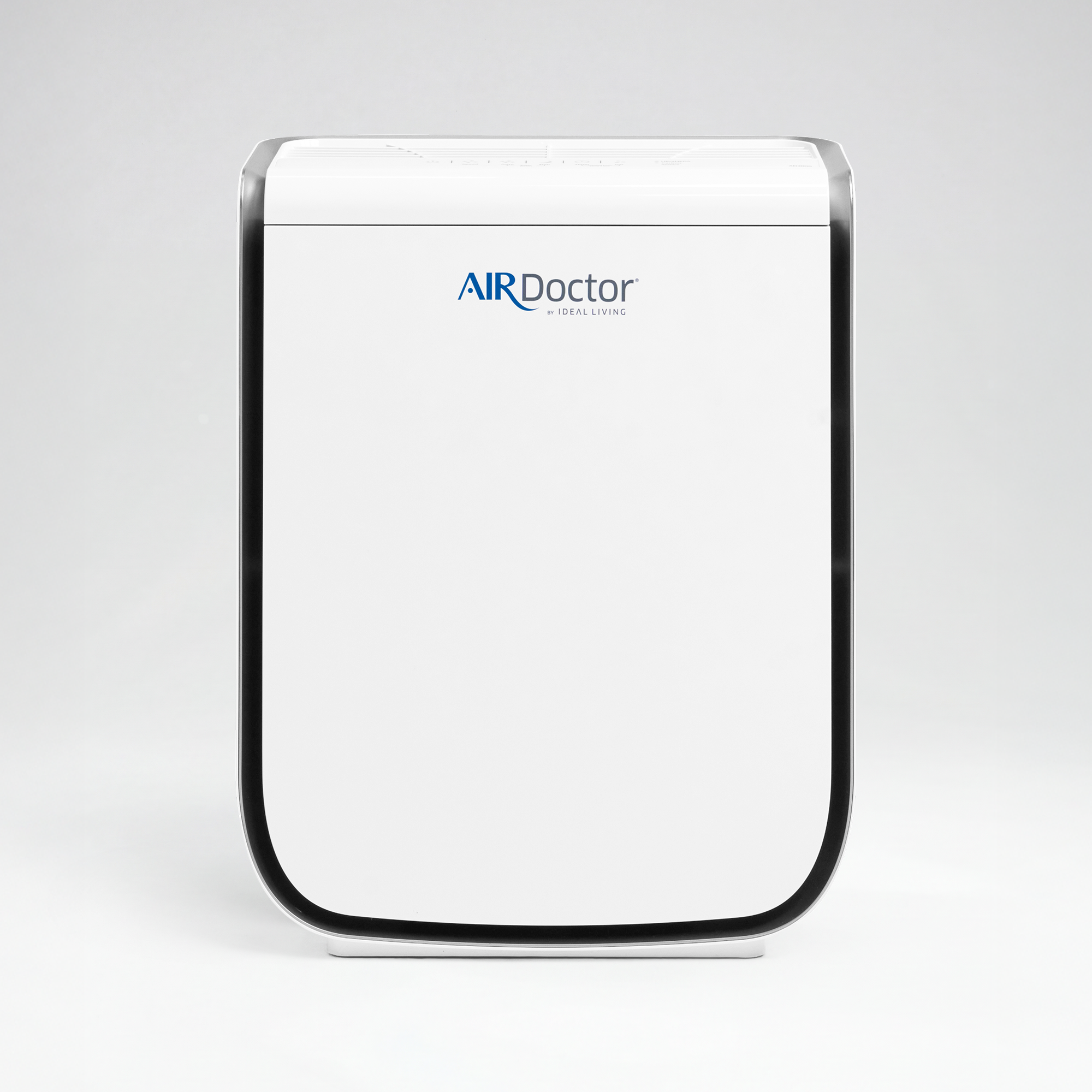
Explore this need in the finder →The AirDoctor 2000 Classic is the app-free branch of AirDoctor’s compact rectangular purifier. It combines a manufacturer-rated 305-square-foot room at four air changes per hour (ACH), three filter stages, and local sensor-based Auto. The exact product page does not publish a 4.8-ACH area, so this is not a dependable pick if your essential requirement is a repeated-cleaning rating at that faster benchmark. At the stated rate it is a clear small-room option; at 4.8 ACH the answer remains unknown.
Classic means no app, not no automatic operation
AirDoctor’s current offer lists AD2000 Classic, SKU 90AD200AD01, separately from AD2000 Smart. The Smart option is the one the page associates with Wi-Fi, a mobile app, and an air-quality forecast. Classic avoids that setup. Its AD2000 manual describes a touch panel, four fan speeds (Low, Medium, High, and Boost), an automatic particle-sensing mode, and a three-color status monitor. The top setting is called Boost, not Turbo, so a specifically named Turbo requirement remains unconfirmed. Auto chooses a fan speed from the sensor’s air-quality categories; blue, orange, and red mean good, fair, and poor. That feedback is categorical, not a numeric PM2.5 measurement on the body.
The same manual documents a timer from one to 24 hours, a control lock, and a dim function that darkens the panel. Its “Night” function dims lights; it is not evidence that the fan drops to a particular sound level. The manual also documents a switchable ionizer. Buyers who do not want that function can turn it off. AirDoctor’s page lists CARB certification, but that label should not be stretched into a claim that this review has independently measured ozone, particle removal, or health outcomes.
Read the room rating at its printed rate
The current exact listing gives 305 square feet at four ACH and a smoke CADR of 162 CFM. Keep both qualifiers attached. The first is a manufacturer room-area figure at four air changes per hour; the second is the smoke-specific clean-air-delivery value. Neither is this site’s lab measurement. The exact page does not state the 4.8-ACH area used by the ordinary room-size question. If you choose any positive 4.8-ACH minimum in the finder, the Classic will correctly fail rather than convert its four-ACH claim into a faster rate.
That distinction matters for a room with an open doorway, high ceiling, or regular traffic between spaces. A square-foot headline does not guarantee that every part of a room receives the same filtered-air circulation. For a closed bedroom or home office whose actual footprint fits the printed rating, the 2000’s size is easier to accommodate than AirDoctor’s 3500 or 4000. If you need a larger documented space, the 3500 page lists 630 square feet at four ACH; that too is a four-ACH claim, not a 4.8 figure.
Three stages and a continuing replacement routine
The manufacturer describes a pre-filter, a Carbon/Gas Trap/VOC filter, and an UltraHEPA filter. The AD2000 manual identifies replacement parts as ADF20034 for the pre-filter, ADF2002 for carbon, and ADF2001 for UltraHEPA. It says the carbon filter lasts up to six months and UltraHEPA up to 12 months depending on use and environment. Those are approximate maker intervals, not guarantees. Check the exact replacement set and current availability before buying, especially because the periodic filter expense is part of ownership. The manual says to remove protective plastic from the filters before first use, keep both sides at least a foot from walls, and keep the appliance on the floor. Do not place it where a curtain can block an intake or outlet. No numeric noise range is established in the sources reviewed here.
AirDoctor states that UltraHEPA captures 99.99% of particles as small as 0.003 microns. That is a manufacturer filter claim; it does not by itself show the air concentration in your room or treat a medical condition. The separate carbon stage is the useful point for ordinary household odors and gases. The product page does not list an included Pet Allergy Filter with ARC Formula, so the standard carbon stage should not be sold as that specialty media.
Who should choose Classic?
Choose the 2000 Classic when you want a modestly sized, app-free purifier with local Auto, a switchable ionizer, and an exact 305-square-foot four-ACH rating. It is less suitable when you require app control, a numeric PM2.5 screen, a verified 4.8-ACH area, or a published acoustic ceiling. If connected monitoring matters, compare the AirDoctor 2000 Smart, but remember that the manufacturer page does not state its Wi-Fi band. If a cylindrical body and a slightly higher four-ACH area fit better, the AirDoctor 1500 is rated at 320 square feet and 170 CFM smoke CADR; its exact app status is less clear. Compare the actual space, control preference, and filter plan rather than treating the brand name as one uniform configuration.
Sources: AirDoctor’s exact 2000 product page and offer record; its official 2000/2000i manual article and AD2000 manual (12.21 R12); and the AirDoctor 3500 page for the comparison.
Key details at a glance
| Clean air delivery rate (CADR) | 162 CFM |
|---|---|
| Published rated input power | 110 W |
| App control | No |
| Body width | 13.85 in |
| Body depth | 6.6 in |
| Body height | 18.72 in |
More specifications and setup details
| Published product weight | 10 lb |
|---|---|
| On-unit numeric PM2.5 display | No |
| Included Pet Allergy Filter with ARC Formula | No |
| Turbo fan setting | No |
| Manufacturer filter-check/replacement guidance | AD2000 manual: carbon up to six months and UltraHEPA up to 12 months, depending on use and environment. |
| Built-in bipolar ionizer | Yes |
| Local ionizer on/off control | Yes |
Use the exact model’s instructions for operating limits, supplied equipment and version differences.
Sources for this assessment
Check the room rating against your actual space.
Compare room-area figures at 4.8 air changes per hour, then check their stated or calculated basis, placement and filter care.