
On this page
Your needs, this model
Does it fit your priorities?
Do you want a manual-only model without app functions, while keeping sensor-based Auto at the unit?
Yes. The exact AD3500 Classic offer is the no-app SKU 90AD350AD01, and the AD3500 manual documents local controls and sensor-driven Auto. It is not the connected Smart SKU.
Explore this need in the finder →Is a colored air-quality status indicator enough when you do not need a numeric PM2.5 number on the purifier?
Yes. The manual describes a qualitative blue/orange/red indicator but no numeric on-unit PM2.5 display.
Explore this need in the finder →Do you require a room-size rating of at least 606 square feet at exactly 4.8 ACH?
This offer does not meet that essential condition. The manufacturer publishes 630 square feet at four changes per hour, and the 4.8-ACH value remains unknown.
Explore this need in the finder →Do you need a local ionizer on/off control and a Boost speed?
Yes. The AD3500 manual documents a local Ion control that switches the ionizer and a Boost fan setting.
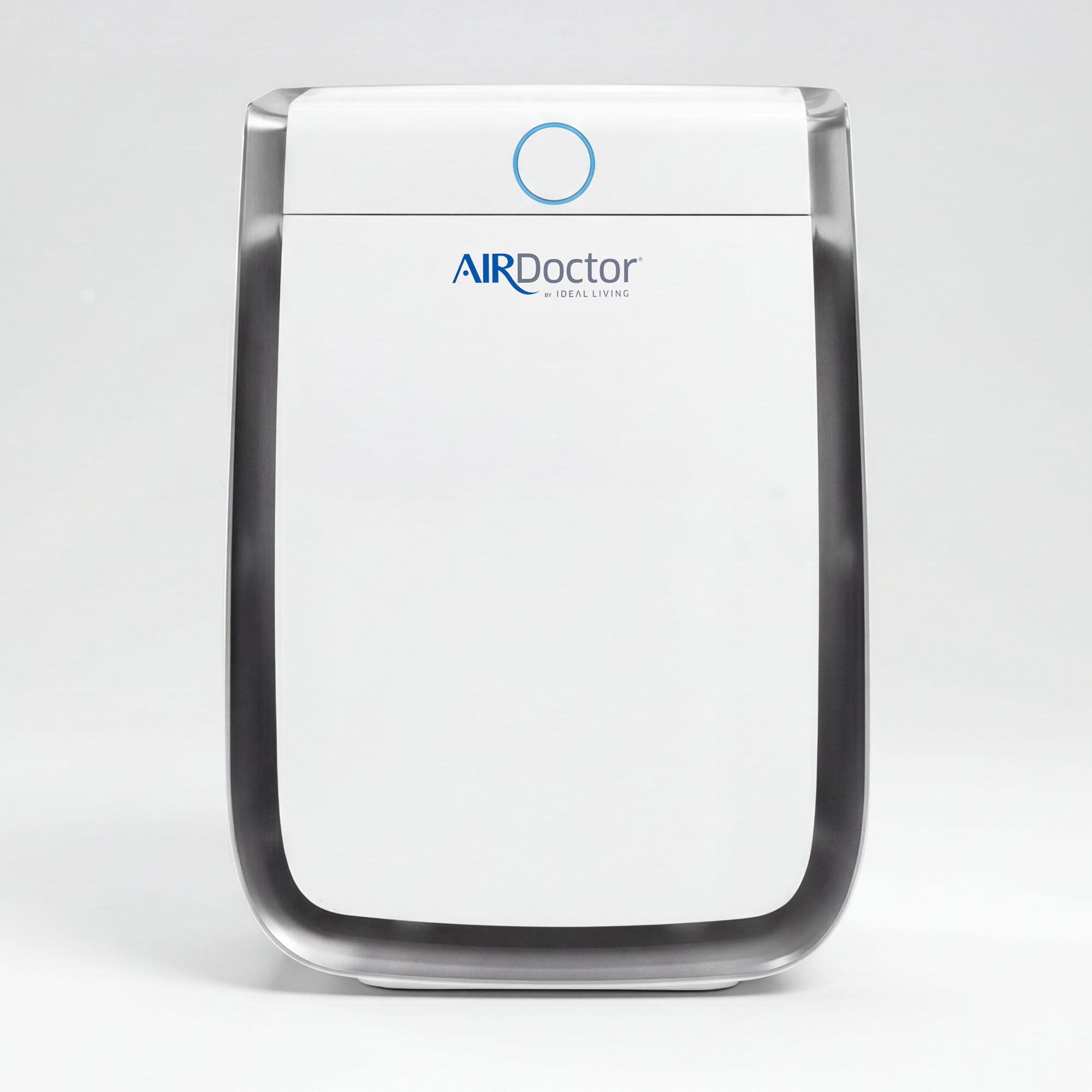
Explore this need in the finder →The AirDoctor 3500 Classic is the no-app version of AirDoctor’s mid-size room purifier: it combines a sensor-based Auto mode, four selected fan speeds and a three-part filter stack, but leaves phone control out of the package. It suits someone who wants the machine to adjust itself while remaining a local-button appliance. Its strongest room claim is 630 square feet at four air changes per hour, not a verified 4.8-ACH rating, so do not treat that headline as equivalent to a faster cleaning benchmark.
Choose the Classic when app-free operation matters
The current product listing separates the AD3500 Classic (SKU 90AD350AD01) from the AD3500 Smart (SKU 90AD350SC01). The Classic listing does not include the Smart option’s Wi-Fi connection and mobile-app features. That distinction matters if you want to avoid app setup or need a model with no app functions. Both are still purifier-first units, not room fans or air conditioners.
At the unit, the AD3500 manual describes power, fan speed, Auto, Dim, timer, ionizer and filter-reset controls. Auto reads the built-in air-quality monitor and changes fan speed; the indicator is qualitative, using blue, orange and red status rather than showing a numeric PM2.5 concentration. The fan can also be selected at Low, Medium, High or Boost. Boost is useful for a short higher-output run, but it does not turn the room-size headline into a guarantee for every floor plan.
Read the room claim at its stated air-change rate
AirDoctor’s exact 3500 page says it circulates a 630-square-foot room four times per hour. Its own comparison table gives 638 square feet at that same rate. I use the product-page figure as the conservative headline, but neither source publishes a 4.8-ACH area for this model. If your requirement is specifically at least 606 square feet at 4.8 ACH, the 3500 does not meet that evidence-based filter. Its smoke CADR is listed as 340 CFM; dust and pollen CADR values are not provided on the reviewed page, so this is not a complete pollutant-by-pollutant performance profile.
For scale, AirDoctor’s current 2000 page lists a lower 162-CFM smoke CADR and a 305-square-foot, four-ACH claim, while the 4000 page lists 370 CFM and 694 square feet at four ACH. Those are manufacturer figures on different product pages, not independent comparative testing. The 3500 sits between them on the published smoke-CADR and four-change claims; choose by the room you actually need to serve, not by a brand-wide “up to” area.
Understand the three-stage filter routine
The current box listing names one purifier, one pre-filter attached to the carbon/VOC filter, one Premium Carbon/VOC filter and one UltraHEPA filter. The pre-filter catches larger debris; the carbon stage targets gases, VOCs and odors; and AirDoctor says its UltraHEPA layer captures very small particles. Those are manufacturer descriptions, not a promise to remove every indoor pollutant or a medical result.
Maintenance is a real part of ownership. The AD3500 manual says to vacuum the pre-filter monthly or when dust buildup is visible. It gives roughly six months for the carbon/gas-trap stage and 12 months for the UltraHEPA filter, with the change indicators also alerting you. These are different replacement cycles, so plan for two types of consumables rather than assuming one annual cartridge. AirDoctor recommends its compatible replacements; the manual warns that unverified third-party filters may fit poorly or reduce the intended performance. The manual’s filter-change sequence requires unplugging the unit, lifting the top of the front cover and removing each filter by its tabs. It also explains how to reset the indicator from the panel.
Good controls, with a few limits
The manual documents a Dim function that turns off the control-panel lights, a timer that can shut the purifier off after one to 24 hours, and a control lock. Dim is not described as a separate Night fan mode. The built-in ionizer can be switched on or off at the panel; shoppers who do not want ionization can leave that function off. The manual recommends vacuuming the air-quality sensor chamber if its readings seem unreliable.
AirDoctor lists the Classic at 18 pounds, 15.75 inches wide and 23 inches tall. Depth is inconsistent: the product page says 8.75 inches while the 3500 manual says 8.25. Leave that dimension unresolved if the unit must fit a very exact gap. The same manual lists 11 watts on low and 110 watts on high, so a quieter low setting uses less power than sustained high-speed operation. AirDoctor’s comparison table lists 32 dB at low and 59 dB at high, but does not state a weighting method; do not use those numbers as a verified dB(A) limit.
The Classic is the sensible 3500 choice when you want local-only operation, sensor-driven Auto, a qualitative air-quality light and the listed 340-CFM smoke CADR. Its boundaries are equally important: no numeric on-unit PM2.5 reading, no confirmed 4.8-ACH room area, and separate filter replacement schedules. If phone control is essential, choose the 3500 Smart instead; if the room is larger, compare the 4000’s higher published smoke CADR rather than stretching the Classic’s four-change claim.
Sources: AirDoctor’s U.S. AirDoctor 3500 product listing, its exact offer record, the AD3500 U.S. owner manual, AirDoctor’s U.S. purifier collection and comparison table, and its 2000 and 4000 product pages.
Key details at a glance
| Clean air delivery rate (CADR) | 340 CFM |
|---|---|
| Published rated input power | 110 W |
| App control | No |
| Body width | 15.75 in |
| Body height | 23 in |
| Published product weight | 18 lb |
More specifications and setup details
| On-unit numeric PM2.5 display | No |
|---|---|
| Included Pet Allergy Filter with ARC Formula | No |
| On-unit lock for accidental control changes | Yes |
| Turbo fan setting | Yes |
| Automatic pre-filter scraper and dust tray | No |
| Manufacturer filter-check/replacement guidance | AD3500 manual gives approximately 6 months for Carbon/Gas Trap/VOC and 12 months for UltraHEPA; follow indicator and conditions. |
| Built-in bipolar ionizer | Yes |
| Local ionizer on/off control | Yes |
| Built-in heating mode | No |
| Built-in humidification mode | No |
Use the exact model’s instructions for operating limits, supplied equipment and version differences.
Sources for this assessment

Check the room rating against your actual space.
Compare room-area figures at 4.8 air changes per hour, then check their stated or calculated basis, placement and filter care.