
On this page
Your needs, this model
Does it fit your priorities?
Do you need a version with app control and Wi-Fi, not the no-app Classic option?
Yes. The exact AD3500 Smart offer is SKU 90AD350SC01; the current listing describes Wi-Fi and mobile-app air-quality forecast features.
Explore this need in the finder →Is a color air-quality signal enough if you do not need a numeric PM2.5 reading on the purifier?
Yes. The manual describes a blue/orange/red status light rather than numeric PM2.5 on the unit; Smart adds app features, not a documented numeric panel.
Explore this need in the finder →Is this the right option if 606 square feet at exactly 4.8 ACH is essential?
No. The manufacturer’s 630-ft² claim is at four ACH; it does not establish 606 ft² at 4.8 ACH.
Explore this need in the finder →Do you want local choice to switch the ionizer off, even on an app-connected version?
Yes. The exact product listing keeps the common AD3500 controls, and the AD3500 manual documents a physical Ion on/off control; app access is a separate feature.
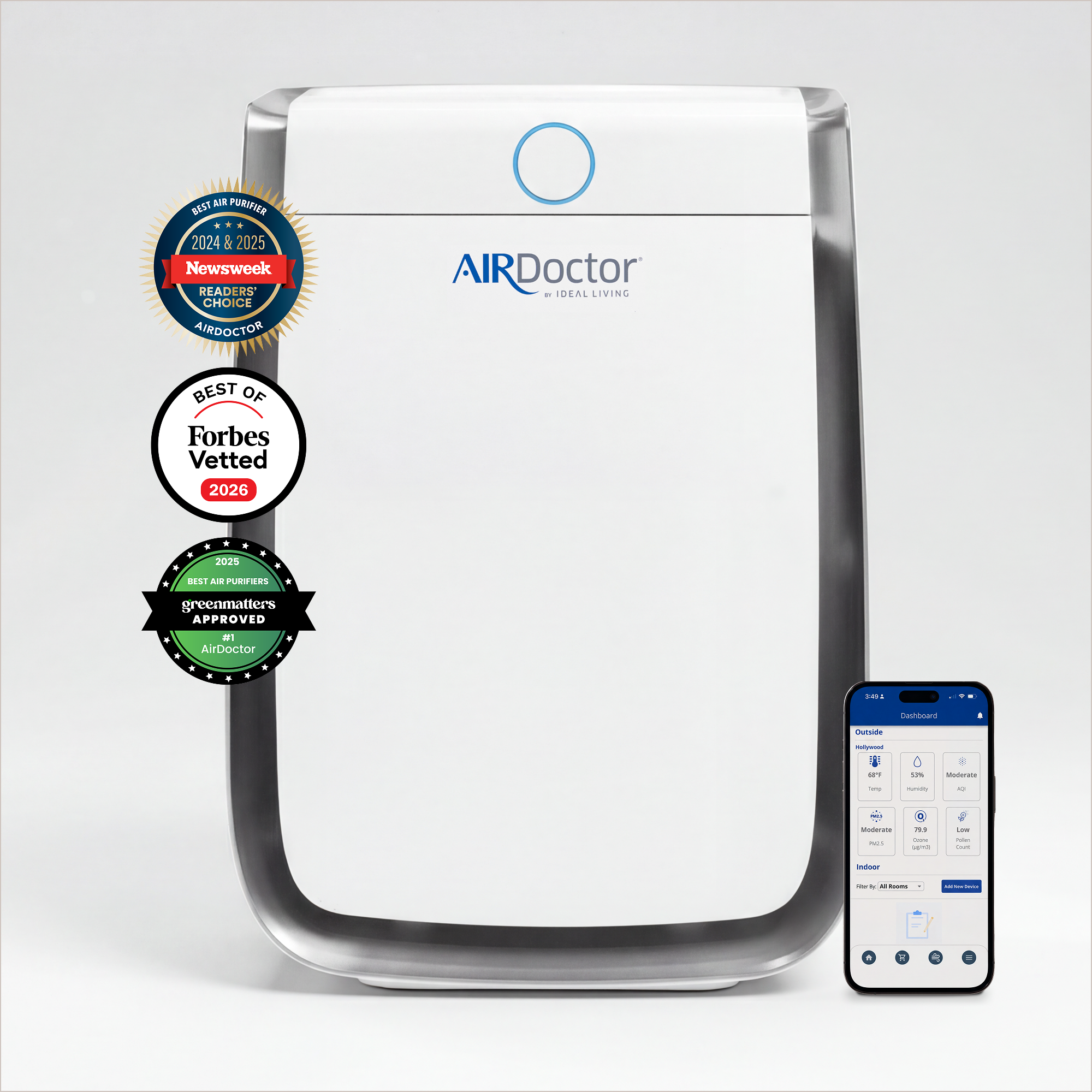
Explore this need in the finder →The AirDoctor 3500 Smart keeps the 3500’s sensor-based Auto mode and three-stage filtration, then adds Wi-Fi and mobile-app features. It is a useful choice when checking air-quality status or managing purifier settings from a phone is a real part of your routine. Do not pay attention to “Smart” as if it means a larger purifier: the current AirDoctor listing presents it as a control option alongside the AD3500 Classic, with a separate SKU and barcode, not as a higher-capacity size.
What the Smart option adds—and what it does not
AirDoctor’s current 3500 offer record lists AD3500 Smart as SKU 90AD350SC01, separate from AD3500 Classic SKU 90AD350AD01. The product page describes Wi-Fi connection and a mobile app with an air-quality forecast as Smart features. If you want app access, choose the Smart SKU; the Classic does not include those functions. The listing does not publish a Wi-Fi frequency, explain every app feature or show a separate app-only performance rating, so treat connected control as the advantage—not a different filtration or room-size class.
Local buttons remain useful for immediate operation. The product page shows the same basic 3500 control arrangement, and AirDoctor’s AD3500 manual describes fan selection, Auto, Dim, timer, ionizer and filter-reset controls. Auto uses the onboard air-quality monitor to change speed. Its blue/orange/red indicator is a qualitative status light; it does not put a numeric PM2.5 reading on the purifier. The unit also offers Low, Medium, High and Boost speeds. If you need a numeric reading, look for a model that explicitly lists one on its own display rather than assuming an app forecast is a direct measurement from this unit.
Do not overread the stated room area
The AirDoctor 3500 product page gives a 630-square-foot figure at four air changes per hour. A comparison table on the manufacturer’s collection page says 638 square feet at four changes. The product page is the lower of the two, but neither value establishes the 3500’s area at the 4.8-ACH benchmark used by this finder. A room requirement at 4.8 ACH should therefore not pass on the basis of this four-change claim.
AirDoctor lists a 340-CFM smoke CADR for the 3500. The 2000 page lists 162 CFM smoke CADR and 305 square feet at four changes; the 4000 page lists 370 CFM and 694 square feet at four changes. All are manufacturer-published figures, and the 3500 page does not provide matching dust and pollen values. These numbers help explain the brand’s size steps, but they do not prove that one unit can clean a connected, unusually shaped open floor plan at the same rate throughout.
Filter care stays the same across the control options
The current 3500 package listing names a pre-filter, a Premium Carbon/VOC filter and an UltraHEPA filter. The manual treats the carbon/gas-trap stage and the UltraHEPA cartridge as separate replaceable elements. AirDoctor’s schedule is approximately six months for the carbon filter and 12 months for UltraHEPA, with actual life dependent on conditions and the unit’s change indicators. The pre-filter is intended for regular vacuuming, not an assumption that it can be rinsed. That routine makes the 3500 a better fit for a household prepared to check and replace two filter types than for someone wanting a sealed, maintenance-free appliance.
When a change light appears, the manual’s procedure starts by unplugging the purifier, removing the front cover and lifting the filters out by their tabs. After replacement, it explains a panel-button reset. The manual’s instructions are for the AD3500; the separate Smart app setup is not detailed there, so use the current Smart-version support instructions for pairing rather than guessing from the Classic manual.
Footprint and overnight use
The listing describes the unit as 18 pounds, 15.75 inches wide and 23 inches tall. Its depth conflicts across two AirDoctor sources: 8.75 inches on the product page and 8.25 inches in the AD3500 manual. If a shelf or walkway leaves only a small margin, confirm the exact body measurement before ordering. The manual rates input at 11 watts on low and 110 watts on high. The official comparison table lists 32 dB and 59 dB at low and high, but it does not specify weighting, so do not treat that figure as a verified dB(A) ceiling.
For a bedroom, the Dim control turns off the panel lights, but the manual does not call it a dedicated Night fan mode. You can choose a lower speed, or leave Auto in charge, but those are not proof of a special sleep setting. The manual also documents an optional ionizer with a physical on/off control, a timer for one to 24 hours of shutoff and a lock to prevent accidental button changes. The ionizer can remain off if you do not want that function.
Pick the Smart version when remote status or app operation is worth its extra setup; otherwise, the Classic gives you the same stated 3500 room and filter profile without connected features. Move up to the 4000 only if its higher published smoke CADR and four-change area better suit the room. The 3500 Smart’s best use is a properly sized single room where app access is useful, not a substitute for a verified 4.8-ACH rating or a numeric on-unit particle display.
Sources: AirDoctor’s U.S. AirDoctor 3500 product listing, its exact offer record, the AD3500 U.S. owner manual, AirDoctor’s U.S. purifier collection and comparison table, and its 2000 and 4000 product pages.
Key details at a glance
| Clean air delivery rate (CADR) | 340 CFM |
|---|---|
| Published rated input power | 110 W |
| App control | Yes |
| Body width | 15.75 in |
| Body height | 23 in |
| Published product weight | 18 lb |
More specifications and setup details
| On-unit numeric PM2.5 display | No |
|---|---|
| Included Pet Allergy Filter with ARC Formula | No |
| On-unit lock for accidental control changes | Yes |
| Turbo fan setting | Yes |
| Automatic pre-filter scraper and dust tray | No |
| Manufacturer filter-check/replacement guidance | AD3500 manual gives approximately 6 months for Carbon/Gas Trap/VOC and 12 months for UltraHEPA; follow indicator and conditions. |
| Built-in bipolar ionizer | Yes |
| Local ionizer on/off control | Yes |
| Built-in heating mode | No |
| Built-in humidification mode | No |
Use the exact model’s instructions for operating limits, supplied equipment and version differences.
Sources for this assessment

Check the room rating against your actual space.
Compare room-area figures at 4.8 air changes per hour, then check their stated or calculated basis, placement and filter care.