
On this page
Your needs, this model
Does it fit your priorities?
Do you want Auto and local touch controls but no app-connected purifier?
Yes. The current exact AD4000 Classic is the no-app branch; the AD4000 manual documents the local touch panel and particle-sensor Auto.
Explore this need in the finder →Is a three-color good/moderate/poor signal enough instead of a numeric PM2.5 value on the unit?
Yes. The AD4000 manual describes blue/orange/red status, not a numeric on-unit PM2.5 concentration.
Explore this need in the finder →Is at least 606 square feet at exactly 4.8 ACH essential?
No. The page rates 694 square feet at 4 ACH; the separate 4.8-ACH value is unknown and cannot meet this essential minimum.
Explore this need in the finder →Do you want a locally switchable ionizer rather than an always-on ionizer?
Yes. The AD4000 manual documents a separate Ion control that turns the ionizer off or on.
Explore this need in the finder →Does the AD4000 Classic fit a specific maximum input-power ceiling?
The U.S. AD4000 manual lists 7 W on Low and 70 W on High. It supports a hard cap of 70 W or above, but not an Auto-mode average or annual-cost estimate.
Explore this need in the finder →The AirDoctor 4000 Classic is the app-free choice in the current 4000 family. It pairs local touch controls and sensor-based Auto with a three-part filter stack, and AirDoctor rates its room coverage at 694 square feet for four air changes per hour. That is a useful manufacturer benchmark for a large single room, not a verified 4.8-ACH rating. If your room-size requirement uses a 4.8-ACH minimum, do not treat the 694-square-foot headline as a match.
Choose the control version before comparing the number
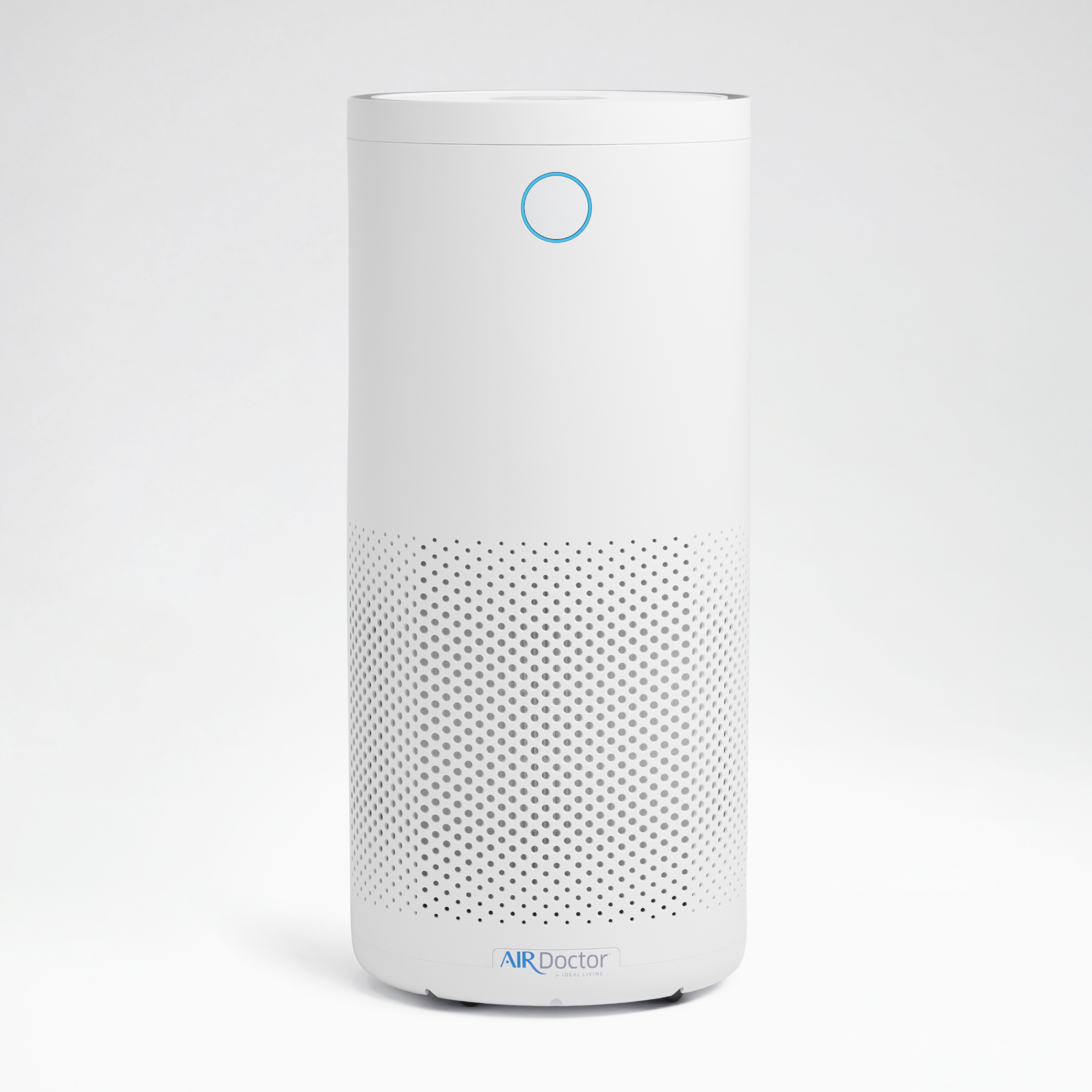
The current listing separates AD4000 Classic from AD4000 Smart. Classic is the manual, no-app configuration; the product options also offer it in matte white and black. The white Classic shown here is one finish of the same named option, not a separate performance model. You can run it from the touch panel, select among six fan speeds, or let Auto adjust airflow from the unit’s particle sensor. A three-color indicator communicates good, moderate, or poor air quality, but the manual does not describe an on-unit numeric PM2.5 reading.
Speed 1 is described as the quiet setting and speeds 2–3 as everyday options. AirDoctor reserves speeds 4–5 for more contamination and frequent allergy use, and says the sixth speed is best for a short high-output run. Those are operating suggestions, not independent sound measurements. There is a dim function, a timer that can be set up to 24 hours, a control lock, and a switchable ionizer. The ability to turn the ionizer off is useful if you prefer not to operate that feature; it does not turn the unit into a different particle filter.
What the 4000 filters—and what its rating means
The product page names a pre-filter, a Premium Carbon/VOC stage, and an UltraHEPA stage. It describes the carbon material as activated carbon with potassium permanganate and publishes a 370-CFM smoke CADR. Keep the pollutant qualifier attached to that figure: the reviewed listing did not provide dust and pollen numbers. The manufacturer also claims its UltraHEPA captures 99.99% of particles down to 0.003 microns. That is a filter claim, not proof that a room will reach a particular particle level or that the device treats a medical condition.
The 694-square-foot figure is explicitly four air changes per hour. The shared current product page’s room claim and smoke CADR are useful for comparing the 4000 with AirDoctor’s smaller 3500, whose product page lists 630 square feet at four changes per hour and 340 CFM smoke CADR. Those modestly different published figures do not establish performance at the questionnaire’s separate 4.8-ACH threshold. If that stricter cleaning rate is essential, choose a model with that exact rating rather than extrapolating from the 4000 headline. If even 694 square feet at four changes is too small for your room, compare the 5500’s higher published area claim, while keeping the same four-change caveat in view.
Placement and filter upkeep are part of the decision
At 13.9 inches in diameter and 28 inches tall, the 4000 is a floor-standing cylinder, not a desk purifier. The manufacturer lists it at 15.8 pounds and says the AD4000 support model has built-in wheels for moving it between rooms. The manual asks for more than a foot of clearance on both sides and says to keep the unit on the floor; avoid pushing its inlet or outlet against curtains. Measure the route and landing spot as well as the open floor area, especially if you plan to roll it between rooms.
AirDoctor’s manual says the combined UltraHEPA and Carbon/VOC filter can last up to six months, depending on use and the environment. The current listing puts the pre-filter and both main filter materials in the supplied filter arrangement; the replacement instructions call for turning the machine off and unplugging it before changing the filter. Treat filter replacement as a recurring ownership cost and check the current price and availability for the exact AD4000 set. The manual lists 7 W on Low and 70 W on High; use 70 W as the maximum listed setting, not as an Auto-mode average or an annual-cost estimate. The manual does not document washing the filter, so do not assume rinsing extends its life.
Who should pick Classic—and when to look elsewhere
Pick the AD4000 Classic if you want a large-room purifier that can adjust itself automatically but you would rather avoid app setup and manage it at the machine. Its most useful strengths are the published four-ACH area, the adjustable six-speed range, a switchable ionizer, and the combination of particle and gas/odor filtration. Its limits are just as important: no app in this SKU, no numeric on-unit PM2.5 display, no verified 4.8-ACH area, no complete noise range, and filter changes that may be needed about twice a year.
For a lower-capacity app-free option, compare the AirDoctor 3500 Classic. If phone-connected features matter, the current product listing’s Smart option is the relevant 4000 alternative, but its app details deserve a separate check. For a room-size decision, use the manufacturer’s stated air-change basis rather than a generic square-foot headline. The 4000 is a fit only when that published operating plan is appropriate to your actual room and you are comfortable replacing its filter on the manufacturer’s schedule.
Sources: AirDoctor’s U.S. 4000 product page and exact offer record; the AD4000 U.S. owner manual; AirDoctor’s filter replacement instructions, dimensions and weight, and wheel information. For comparison, see AirDoctor’s 3500 and 5500 listings.
Key details at a glance
| Clean air delivery rate (CADR) | 370 CFM |
|---|---|
| Published rated input power | 70 W |
| App control | No |
| Body width | 13.9 in |
| Body depth | 13.9 in |
| Body height | 28 in |
More specifications and setup details
| Published product weight | 15.8 lb |
|---|---|
| On-unit numeric PM2.5 display | No |
| Included Pet Allergy Filter with ARC Formula | No |
| On-unit lock for accidental control changes | Yes |
| Turbo fan setting | Yes |
| Automatic pre-filter scraper and dust tray | No |
| Manufacturer filter-check/replacement guidance | AD4000 manual says the combined UltraHEPA + Premium Carbon/VOC filter lasts up to six months, depending on conditions; manufacturer replacement FAQ says about six months under normal conditions. |
| Built-in bipolar ionizer | Yes |
| Local ionizer on/off control | Yes |
| Built-in heating mode | No |
| Built-in humidification mode | No |
Use the exact model’s instructions for operating limits, supplied equipment and version differences.
Sources for this assessment
- AirDoctor U.S. Air Purifiers collection
- AirDoctor 4000 U.S. product page
- AirDoctor 4000 exact Shopify offer record
- AirDoctor AD4000 U.S. owner manual, 07.25 R3
- AirDoctor 4000 filter replacement support article
- AirDoctor AD4000k wheels support article
- AirDoctor AD4000k dimensions and weight support article
- AirDoctor AD4000k connectivity support article
- AirDoctor app onboarding support article
Check the room rating against your actual space.
Compare room-area figures at 4.8 air changes per hour, then check their stated or calculated basis, placement and filter care.