
On this page
Your needs, this model
Does it fit your priorities?
Can you use AirDoctor’s stated 1,043 ft² at 4 ACH without requiring a verified 4.8-ACH room rating?
The exact 5500 listing gives 1,043 ft² at four changes per hour. Its 4.8-ACH area remains unknown, so it cannot meet a 4.8-ACH minimum.
Explore this need in the finder →Do you want physical operation with no app features, while keeping automatic speed changes and a local ionizer switch?
Yes. The exact AD5500 Classic SKU is the non-app option; the AD5500 manual documents the local panel, Auto and Ion toggle.
Explore this need in the finder →Is a true Night fan mode essential, or is turning panel lights off enough?
The AD5500 manual documents Dim for panel lights but not a dedicated Night mode. A buyer who requires Night mode should reject it.
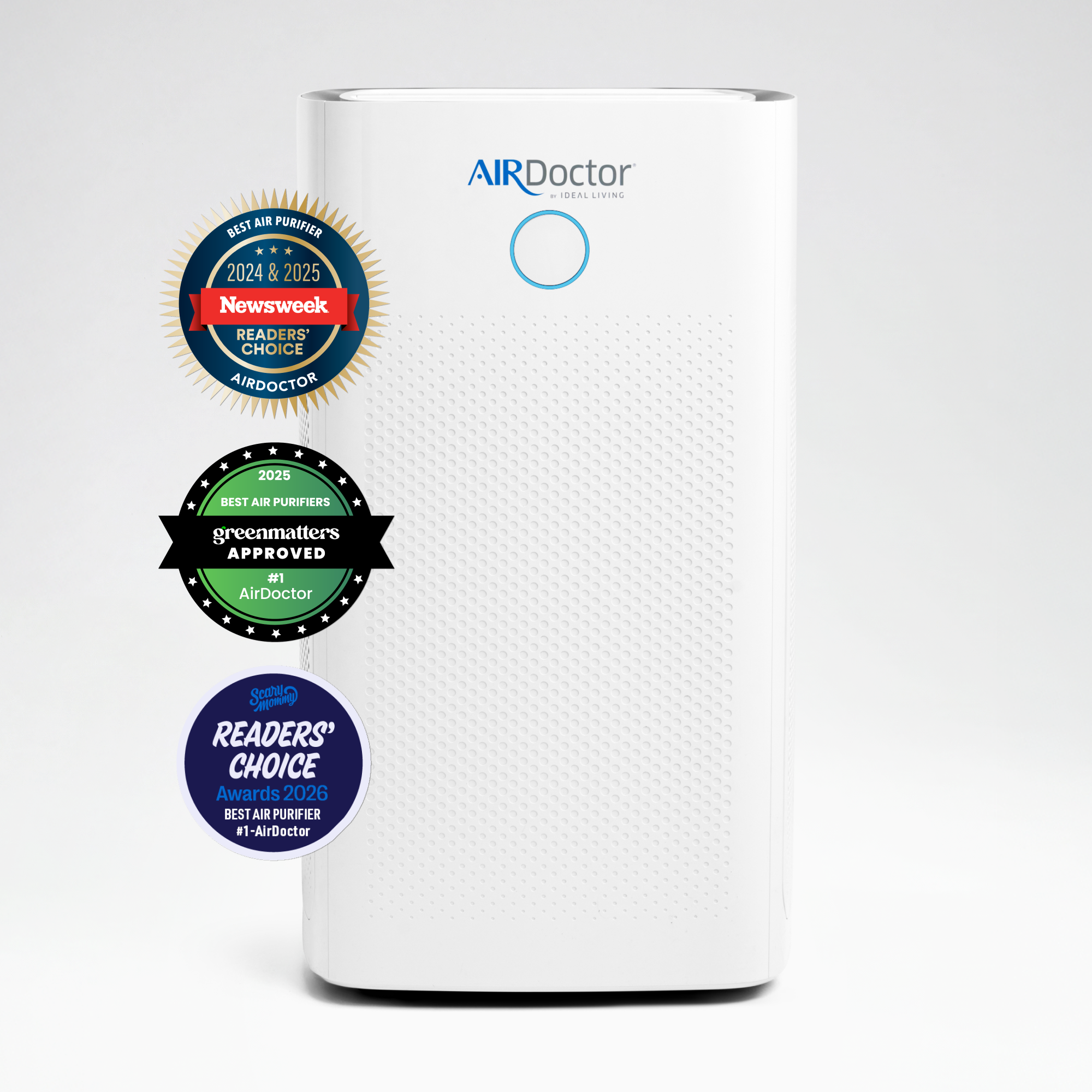
Explore this need in the finder →The AirDoctor 5500 Classic is the large-room member of the current AirDoctor household line: the company lists circulation for up to 1,043 square feet at four air changes per hour and a smoke CADR of 556 CFM. It is worth considering for an open living area, loft, or similarly broad single space where the smaller 3500’s 630-square-foot, four-change claim would leave less headroom. Those figures are not a 4.8-ACH rating. If a faster, independently comparable room-rate threshold is essential, this model does not have a confirmed area figure for that requirement.
Classic means local operation, not a connected purifier
The exact U.S. offer is AD5500 Classic, SKU 90AD550AD01. AirDoctor lists the Classic and Smart as separate options under the 5500 product; this version is the non-app choice. Its panel provides the everyday controls directly on the unit: power, six fan speeds, Auto, Dim, timer, Ion, and filter status. The manual explains that Auto uses an onboard air-quality monitor to adjust fan speed. A blue, orange, or red light gives a qualitative status; the purifier does not show a numeric PM2.5 concentration on its front panel.
Six levels are useful when you want to choose a steadier setting instead of relying on Auto. The manual says the highest level is best for shorter bursts, while lower levels suit routine operation. Auto is the recommended set-and-leave option in the manual, but its named sensor target is not given; do not buy it expecting a documented particle-only or gas-specific sensor. Dim turns off the panel lights, and the timer can stop operation after a selected period of up to 24 hours. Neither setting is a dedicated Night mode. A local Ion button switches the ionizer on or off, so it can be disabled rather than left running by default.
Use the four-change area claim carefully
The manufacturer’s current product page specifies 1,043 square feet at four changes per hour. It also gives 556 CFM for smoke CADR; that number is pollutant-specific, not a universal airflow score for dust and pollen. Keep the stated rate beside the area. A large floor plan with doorways, high ceilings, or several separate rooms may not behave like the single open area implied by a coverage headline, and this one appliance should not be treated as whole-house duct filtration.
For comparison, AirDoctor’s 3500 page gives 630 square feet at four changes per hour. The 5500 is the more plausible of those two if you need more documented circulation in one open room; the 3500 is a less imposing alternative when its own claim is adequate. The current 5500 manual and product page list a 16-inch-wide, 16-inch-deep, 28.75-inch-high body at about 33 pounds. AirDoctor’s comparison chart gives a different size and weight entry, so do not rely on a tight-fit assumption: verify the listing or placement dimensions before committing to a narrow corner.
Budget space for paired filter changes
The 5500 uses a three-stage stack on each side: a permanent pre-filter, a Carbon/Gas Trap/VOC filter, and an UltraHEPA filter. The current box list includes two of each. The manual says the two sides should be changed together to maintain performance. Its approximate schedule is six months for the Carbon/VOC pair and twelve months for the UltraHEPA pair, depending on use and conditions; the unit also lights the corresponding filter indicator. The pre-filters are vacuumed monthly or when dust has built up. The manual does not instruct washing them, so follow its vacuum-care procedure rather than improvising.
That arrangement is a practical strength if you want both particle filtration and a replaceable gas/odor-media stage. It is also more filter handling than a single-sided unit, and the carbon and particle media run on different schedules. Check replacement availability and the cost of the two-filter sets before making the 5500 your everyday choice; no future filter price is assumed here.
Who should choose it—and who should keep looking
Choose the Classic if you want the 5500’s published large-room claim, six local speeds, sensor-driven Auto, and an ionizer that can be toggled off, but you do not want an app connection. It is a purifier, not a heater, humidifier, or purifier-and-circulating-fan combination. Its 33-pound listed weight also favors choosing a stable location before setup over treating it as a frequent room-to-room appliance.
Keep looking if the required room-area evidence must be at 4.8 ACH, you need a numeric PM2.5 readout, a specific gas sensor, a quieter-than-specified dB(A) ceiling, or a real Night mode. The comparison chart’s 39-to-65 dB figures do not state a weighting method, so they are not a verified dB(A) promise. If app control is essential, compare the AD5500 Smart option instead; it is a different exact SKU, not a software setting on this Classic. For a smaller room, compare the 3500’s lower four-change claim and smaller listed body rather than buying excess capacity by default.
Sources: AirDoctor 5500 product page and the AirDoctor AD5500 owner’s manual. Room area, smoke CADR, box contents, app options, and current offer identity come from the product page; control and care details come from the AD5500 manual. The manual is the 2022 U.S. AD5500 edition and is not treated as a setup guide for another model’s connectivity.
Key details at a glance
| Clean air delivery rate (CADR) | 556 CFM |
|---|---|
| Published rated input power | 110 W |
| App control | No |
| Body width | 16 in |
| Body depth | 16 in |
| Body height | 28.75 in |
More specifications and setup details
| Published product weight | 33 lb |
|---|---|
| On-unit numeric PM2.5 display | No |
| Included Pet Allergy Filter with ARC Formula | No |
| On-unit lock for accidental control changes | Yes |
| Automatic pre-filter scraper and dust tray | No |
| Manufacturer filter-check/replacement guidance | AD5500 manual gives approximate life of 6 months for Carbon/Gas Trap/VOC and 12 months for UltraHEPA, depending on use and environment; replace both sides at the same time and follow the indicator. |
| Built-in bipolar ionizer | Yes |
| Local ionizer on/off control | Yes |
| Purifier also has a documented circulation-fan function | No |
| Built-in heating mode | No |
| Built-in humidification mode | No |
Use the exact model’s instructions for operating limits, supplied equipment and version differences.
Sources for this assessment
Check the room rating against your actual space.
Compare room-area figures at 4.8 air changes per hour, then check their stated or calculated basis, placement and filter care.