
On this page
Your needs, this model
Does it fit your priorities?
Will the P50 meet a small-room 4.8-ACH comparison threshold?
Its 177-CFM CADR calculates to about 277 sq ft at an assumed 8-ft ceiling, clearing the finder’s 219-sq-ft small-room threshold but not the 358-sq-ft medium tier.
Explore this need in the finder →Can you keep the P50 within a strict 35-W input cap?
Airdog lists 35 W for P50. A 35-W cap includes it; 34 W does not.
Explore this need in the finder →Do you need both the P50’s dedicated Sleep mode and app control?
The exact page documents a dedicated Sleep mode and app-control claim, so those two requirements can coexist in one household plan.
Explore this need in the finder →Can the P50 satisfy an essential sensor-driven Auto requirement?
Sleep and app are documented, but the exact P50 page does not establish AQI-responsive automatic fan-speed changes or identify its sensor. Unknown does not satisfy an essential sensor-Auto request.
Explore this need in the finder →Does the pet-focused P50 include the exact Pet Allergy Filter with ARC Formula?
No. The P50 uses Airdog TPA collection and its own pet-oriented layers; it is not the separately named ARC Formula filter package.
Explore this need in the finder →Airdog P50 Pet: a compact odor-focused purifier with reusable collectors
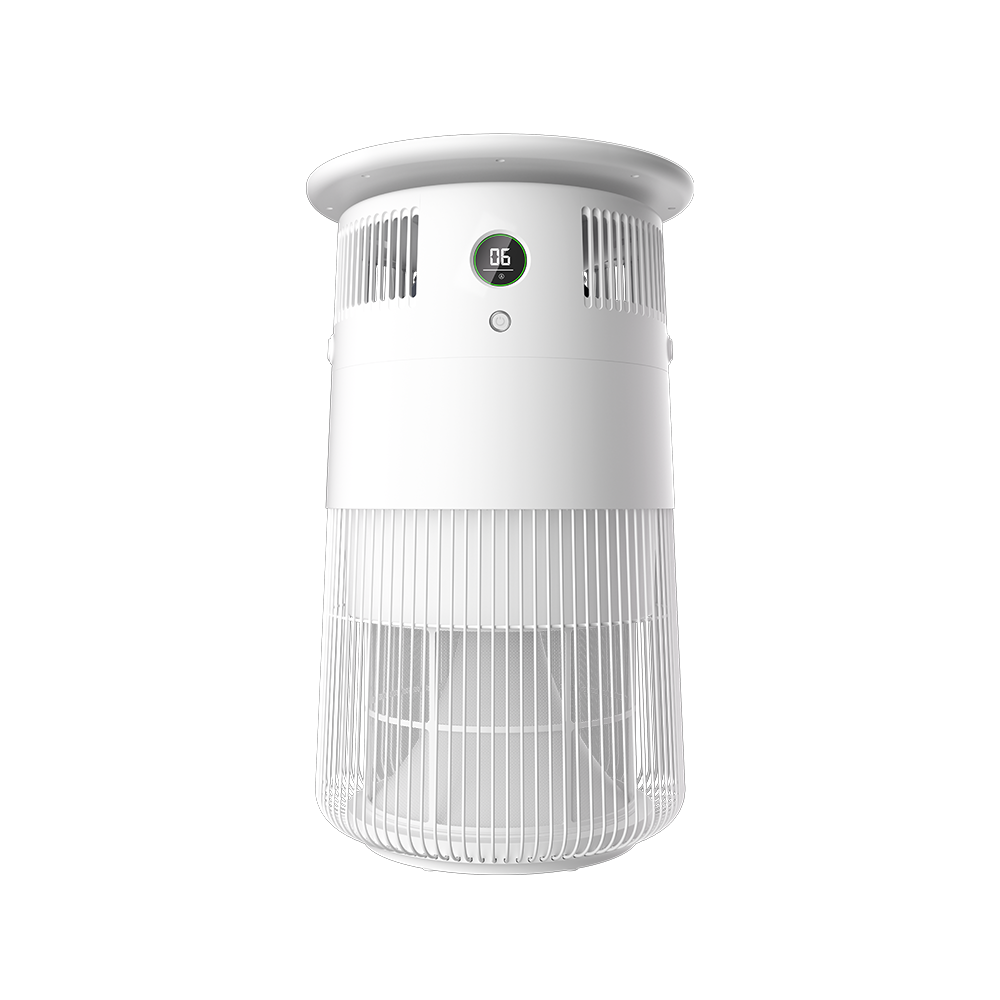
The Airdog P50 Pet is the smaller, lower-power member of Airdog’s pet-purifier pair. It is a distinct model from the larger Airdog Pet, which Airdog also calls X5 Pet in its comparison material. The P50 makes the most sense when the job is one bedroom, home office, or pet-related odor area—not when a single machine must turn over air throughout a large open floor plan. Its appeal is a combination of pet-oriented filtration, a washable electrostatic collector, and a documented Sleep mode rather than a promise that it can solve every pet, allergy, or odor problem.
Use the airflow figure, not the biggest area headline
Airdog lists 177 CFM CADR, 35 W, and a 17.31-pound body measuring 22 by 13 by 9.5 inches. Its page gives 1,290 square feet as maximum coverage at one air change per hour and 323 square feet as recommended coverage; a product image separately claims 323 square feet in 15 minutes. Those are not interchangeable room ratings. Using the stated CADR at an assumed eight-foot ceiling, a 4.8-air-change comparison is about 277 square feet (177 × 60 ÷ (4.8 × 8)). That is a calculation, not Airdog’s rated room size, and a high ceiling or open layout reduces the practical fit. It clears the finder’s 219-square-foot small-room threshold on that basis but not its 358-square-foot medium threshold.
The distinction matters when comparing it with the Airdog Pet/X5 Pet. Airdog’s direct comparison chart lists 323 square feet for P50 versus 450 for X5 Pet, while other Airdog material gives the larger unit a 404–540-square-foot range at three to four air changes per hour. The brand does not reconcile every advertised area basis. The useful takeaway is that X5 Pet has more airflow for a larger room; neither 1,290 nor 1,600 square feet is a high-rate allergy-room promise.
Pet-focused filtration has tradeoffs
Airdog describes a 360-degree intake, a high-density pre-filter for visible hair and dust, an electrostatic collection stage, and an activated-carbon/photocatalytic odor layer. The exact product page says the collecting plates can be washed and describes water or vacuum care for the pre-filter; the wire frame needs dry cleaning. This is not a throwaway HEPA cassette, but reusable does not mean maintenance-free: you still need to remove parts, clean them correctly, let them dry, and put them back. I found no P50-specific manual or published cleaning interval in the saved model materials, so use the P50 instructions from Airdog before deciding how often to clean it. Do not wash an emitter wire just because another removable part is washable.
The P50 page promotes odor and dander-removal percentages and describes a carbon-plus-photocatalytic approach. Treat those percentages as manufacturer claims, not independent home testing or a medical result. A purifier may reduce airborne particles; it cannot remove fur already on a rug, clean a litter box, or guarantee allergy relief. The pet-oriented pre-filter is most relevant to airborne hair and dander, while the odor layer is the more unusual distinction from the standard X-series. It is not a replacement for cleaning the source of a persistent smell.
Controls and quiet operation
The exact page advertises app control and a Sleep mode rated at 22 dB. That sleep-mode number is not a maximum-noise measurement for every fan setting, and the manufacturer does not give a noise range in the material reviewed here. App support also does not by itself prove that every function can be controlled remotely. I could not verify an AQI-responsive Auto mode, a particular sensor type, or the number of selectable P50 fan speeds from its exact model page; those fields should not be assumed from larger Airdog models. If sensor-driven operation or an exact sound cap is essential, choose a model with those values documented rather than filling in a guess.
The page also describes a child lock and an automatic power-off when the rear cover is removed. That is a useful design detail, not proof the machine is safe to sit on or leave accessible to a curious animal. Leave the intake and discharge clear, place the unit where pets cannot tip it, and follow the model’s own service instructions.
Who should compare alternatives?
Choose the P50 over the larger Airdog Pet when the measured room fits its airflow and a smaller pet-odor focus matters more than the extra 33 CFM of the X5 Pet. For a room that needs a stronger 4.8-ACH comparison, the X5 Pet’s 210 CFM works out to about 328 square feet with the same eight-foot-ceiling assumption, though that still falls short of the finder’s 358-square-foot medium tier. A standard non-pet purifier may be enough if washable electrostatic collection and the P50’s particular odor stage are not priorities; compare its documented CADR and filter replacement routine instead. The P50 is a focused household option, not an automatic choice for every pet household.
The captured product page showed a sold-out notice while its official offer feed reported the variant available. Stock can change, so this review makes no availability promise. Airdog does not provide an exact P50 model code in the observed offer; the product title, product ID, barcode, and dedicated P50 page identify this listing without borrowing the X5 Pet’s name or manual.
Key details at a glance
| Room area at 4.8 ACH (stated or calculated) | 276.6 sq ft |
|---|---|
| Published room area at 1 air change per hour | 1290 sq ft |
| Clean air delivery rate (CADR) | 177 CFM |
| Published rated input power | 35 W |
| App control | Yes |
| Published product weight | 17.31 lb |
More specifications and setup details
| Included Pet Allergy Filter with ARC Formula | No |
|---|---|
| On-unit lock for accidental control changes | Yes |
| Automatic pre-filter scraper and dust tray | No |
| Manufacturer filter-check/replacement guidance | The exact page gives cleaning methods for different components but no P50-specific cleaning interval or directly inspectable P50 manual was found in the saved official downloads directory. |
| Built-in bipolar ionizer | Yes |
| Purifier also has a documented circulation-fan function | No |
| Built-in heating mode | No |
| Built-in humidification mode | No |
| Unqualified manufacturer room-size claim (no ACH basis) | 323 sq ft |
Use the exact model’s instructions for operating limits, supplied equipment and version differences.
Sources for this assessment

Check the room rating against your actual space.
Compare room-area figures at 4.8 air changes per hour, then check their stated or calculated basis, placement and filter care.