
On this page
Your needs, this model
Does it fit your priorities?
Does the Airdog Pet meet the small-room 4.8-ACH comparison tier?
The 210-CFM CADR calculates to about 328 sq ft at an assumed 8-ft ceiling, clearing 219 sq ft but not the 358-sq-ft medium threshold.
Explore this need in the finder →Can the Airdog Pet fit a strict 55-W input cap?
The manufacturer’s exact comparison lists 55 W; a cap of 55 W includes it, while 54 W excludes it.
Explore this need in the finder →Can you require both app control and AQI-responsive Auto?
The exact page documents app control and an Auto mode that adjusts from the AQI index, so both requirements fit the same household plan. The sensor type itself remains unspecified.
Explore this need in the finder →Does “Pet” in the model name establish an app-based Pet Mode cycle?
No. The exact page describes pet-oriented filtration but does not document the specific timed app Pet Mode cycle; that essential feature remains unknown and cannot be assumed from the product name.
Explore this need in the finder →Does the Airdog Pet include the exact Pet Allergy Filter with ARC Formula?
No. Its pet-focused Airdog TPA system is a different configuration from the named ARC Formula filter package.
Explore this need in the finder →Airdog Pet Air Purifier: higher airflow for pet households
Airdog’s current U.S. page calls this product the Airdog Pet Air Purifier; its comparison copy calls it X5 Pet, and the official offer SKU is “x5 pet.” Those records establish a pet-specific current listing, not permission to merge it into the standard X5 or X5+ review. The practical reason to look at it is more airflow than the smaller P50: the manufacturer lists 210 CFM CADR and 55 W, alongside a pet-focused pre-filter and reusable electrostatic collection. That makes it a more plausible single-room option for heavier pet traffic than the P50, but room size still needs to be judged at an air-change rate that matches the task.
What its room numbers mean
Airdog’s comparison material gives the Pet/X5 Pet model a maximum area of 1,600 square feet at one air change per hour and a recommended range of 404–540 square feet at three to four air changes per hour. The product page and its P50 comparison also use a 450-square-foot recommended figure. The brand does not put the same rate basis next to every headline, so do not read the 1,600-square-foot maximum as a strong allergy or smoke-cleaning rating. From the 210-CFM CADR, a separate calculation at 4.8 changes per hour and an assumed eight-foot ceiling gives about 328 square feet. That is enough for the finder’s 219-square-foot small-room tier but not the 358-square-foot medium tier. Treat it as a consistent comparison estimate, not a manufacturer guarantee; ceiling height, room connections, placement, and speed change the result.
The exact page lists a 25.5-by-12.5-by-12.5-inch body, 22.5 pounds, and 55 W. This is a full-size upright appliance rather than a travel unit. If you need a larger coverage area, compare the actual CADR of larger purifiers; if the space is closer to a bedroom or office, the lower-power P50 may be adequate and its manufacturer comparison emphasizes odor control. The Pet unit has more airflow, while the P50’s own chart claims somewhat stronger results for some pet dander and odor measures. Both are manufacturer comparisons, not independent household tests.
A useful reusable system, with hands-on care
Airdog describes the Pet’s filtration stack as a pre-filter, wire frame, electrostatic field and collecting plates, with a pet-oriented catalyst layer for odor. It says the redesigned pre-filter is intended to catch visible hair and dander; the exact page also says the collecting plates can be washed with soap and water, the wire frame should be cleaned dry, and the pre-filter can be rinsed or vacuumed. The catalyst/carbon stage has its own care description. The parts do different jobs, so “washable” is not permission to soak every component. Cleaning and complete drying are part of ownership, and the exact page does not provide a Pet-specific interval that I can safely substitute for a manual.
The Pet-specific name does not make it a disposable Pet Allergy Filter with ARC Formula, which is a separate filter requirement in this finder. Nor does it establish the app-based Pet Mode cycle used by some other products. Airdog describes the pet-focused filtration, not a timed high/medium pet program. If either exact capability is essential, this is not a supported match.
App, Auto, and nighttime settings
The exact product page describes app control, an AQI display, Auto operation that adjusts speed from its AQI index, four manual fan speeds, and Sleep mode with auto-dimming. Those are more useful distinctions than the word “smart” alone. The page does not identify the sensor’s actual sensing element, establish a numeric on-unit PM2.5 reading, or give a verified maximum-noise figure for this Pet variant. Do not treat the AQI label as proof of a VOC or odor sensor. If you want a specific sensor target or a strict decibel cap, leave the requirement unresolved unless a model-specific source documents it.
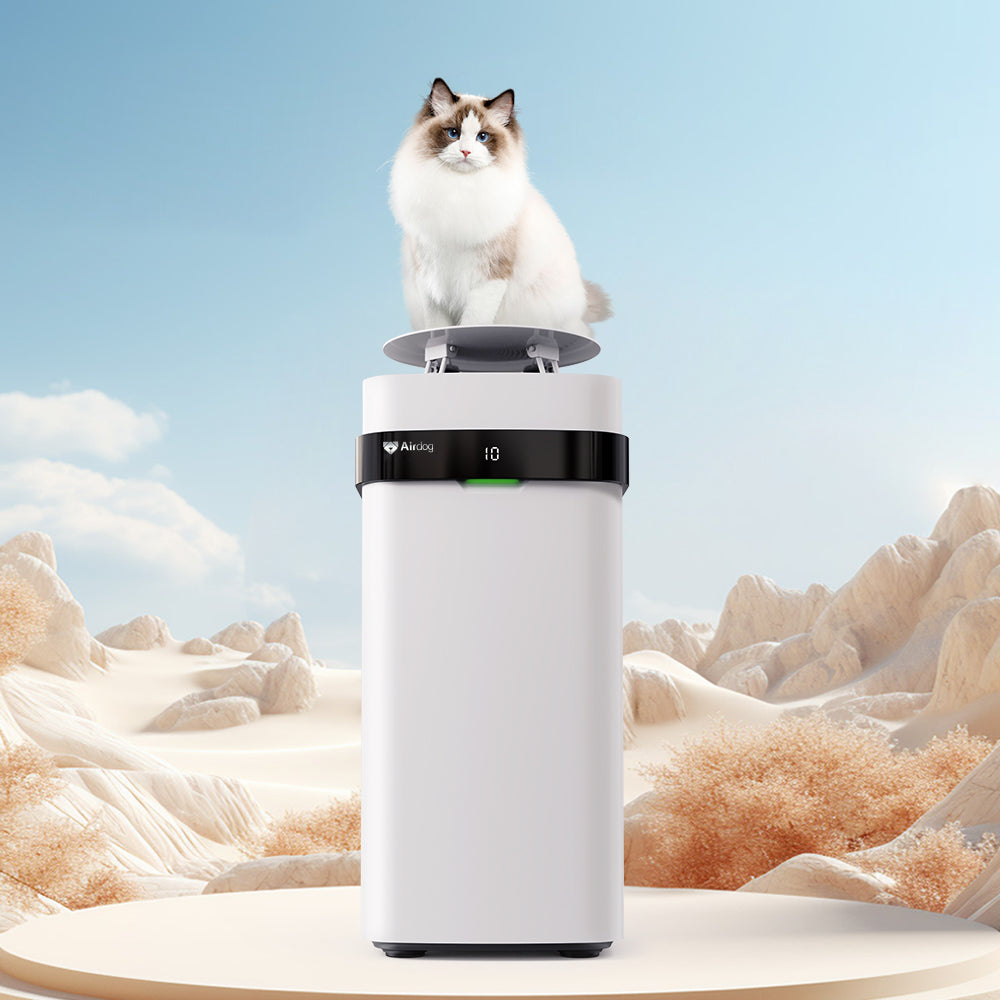
The exact page also describes a child lock and power-off when the rear cover is removed. That is a safety feature, not evidence the machine can be left where a pet can climb, scratch, or block the intake. Its product image shows a cat on top as promotional artwork; do not take that as an operating instruction. Keep airflow clear and place the unit on a stable surface.
Where it fits—and where it does not
For a pet household with a measured room below the high-rate comparison threshold, the Pet/X5 Pet is worth comparing when a dedicated hair-and-dander pre-filter plus more airflow than the P50 are priorities. It is not the right shortcut for a large connected floor plan simply because its one-change headline reaches 1,600 square feet. A standard X5 may suit an ordinary room if the pet-specific pre-filter is not important; a larger purifier may be a better choice if CADR is the limiting factor; the P50 remains a smaller alternative for a room where its lower 177-CFM airflow is sufficient. Compare the cleaning workload as carefully as the air-area headline.
I found no model-specific Pet manual in Airdog’s captured downloads materials. A separate X5 manual exists, but the observed Pet page identifies redesigned pet filtration and does not clearly cross-reference that manual as its exact service guide; I have not transferred its maintenance interval or electrical data. The product page showed sold out while the Shopify offer record reported available, so stock is not promised here. This is an evidence-grounded fit assessment, not a claim that the manufacturer’s performance percentages were reproduced in a home test.
Key details at a glance
| Room area at 4.8 ACH (stated or calculated) | 328.1 sq ft |
|---|---|
| Published room area at 1 air change per hour | 1600 sq ft |
| Clean air delivery rate (CADR) | 210 CFM |
| Published rated input power | 55 W |
| App control | Yes |
| Body width | 12.5 in |
More specifications and setup details
| Body depth | 12.5 in |
|---|---|
| Body height | 25.5 in |
| Published product weight | 22.5 lb |
| Included Pet Allergy Filter with ARC Formula | No |
| On-unit lock for accidental control changes | Yes |
| Automatic pre-filter scraper and dust tray | No |
| Manufacturer filter-check/replacement guidance | Exact page describes washable parts but gives no clearly Pet-specific cleaning interval; do not import a routine from the standard X5 manual. |
| Built-in bipolar ionizer | Yes |
| Purifier also has a documented circulation-fan function | No |
| Built-in heating mode | No |
| Built-in humidification mode | No |
| Unqualified manufacturer room-size claim (no ACH basis) | 450 sq ft |
Use the exact model’s instructions for operating limits, supplied equipment and version differences.
Sources for this assessment

Check the room rating against your actual space.
Compare room-area figures at 4.8 air changes per hour, then check their stated or calculated basis, placement and filter care.