
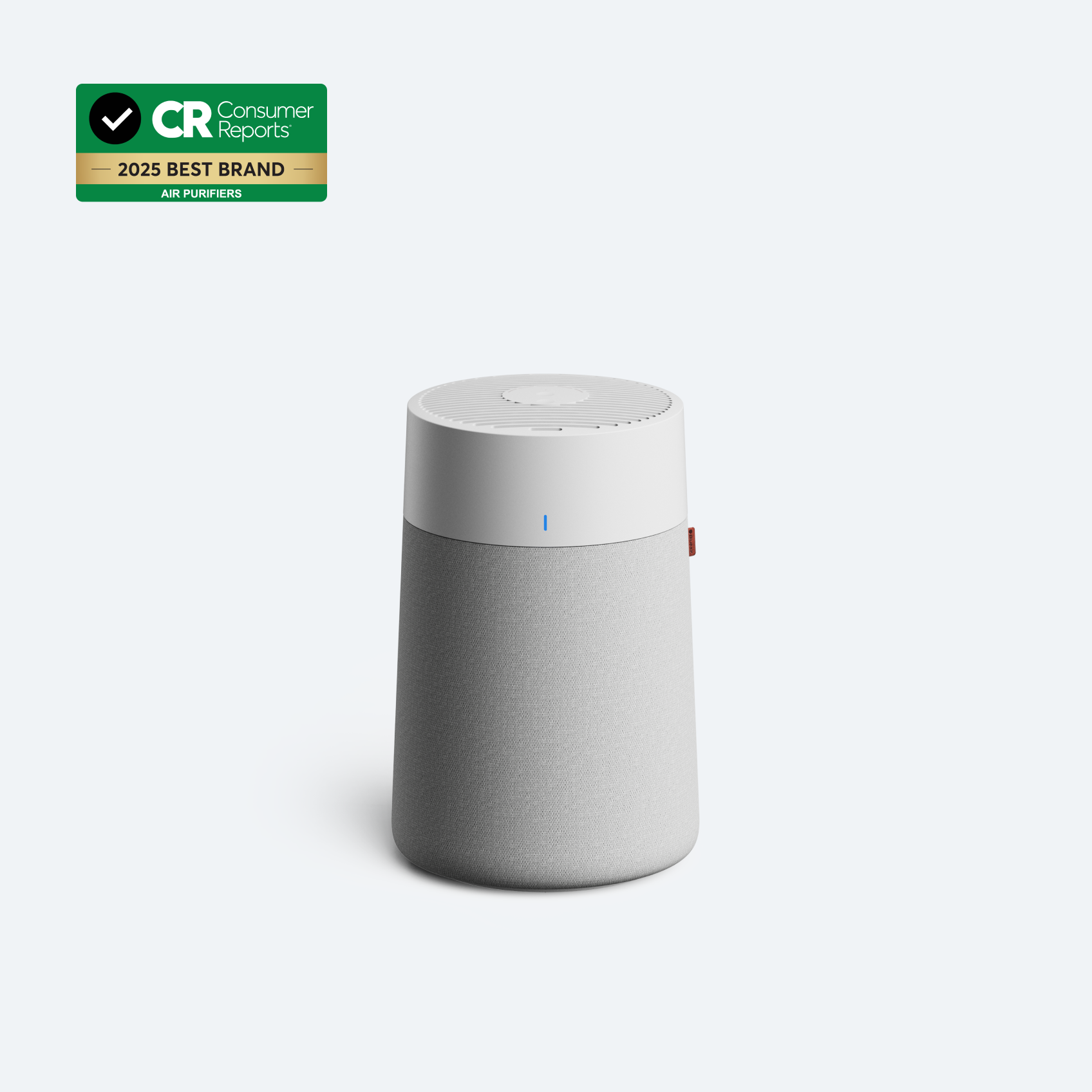
Your needs, this model
Does it fit your priorities?
Will one Blue Pure 511i Max meet the 219-ft² small-room threshold at the current 4.8-ACH rating?
Yes. Blueair's current detailed product table and FAQ list 237 ft² at 4.8 ACH. The page separately gives 569 ft² in 30 minutes and 1,138 ft² in one hour; those slower figures are not 4.8-ACH room ratings.
Explore this need in the finder →Is a five-color PM2.5 status indicator enough, or must the purifier show a numeric reading on its own panel?
The model-specific manual documents PM2.5 sensing and a five-color status light, but not a numeric concentration on the unit. Choose color-only feedback if that is enough; a numeric on-unit requirement excludes it.
Explore this need in the finder →Do I need the fan to adjust automatically from indoor particle levels?
Yes. Auto mode adjusts from the PM2.5 sensor. The manual also documents Night and three numbered speeds; it does not confirm the product page's additional listed speed 4.
Explore this need in the finder →Must I have both app control and local buttons, and a compatible odor-targeted replacement option?
The model has local on/standby and fan-speed controls plus Wi-Fi/app functions; the exact F5MAX filter page confirms Particle & Carbon, AllergenBlock and SmokeBlock replacements. These optional cartridges are separate from the one base filter included.
Explore this need in the finder →Will the body fit below a 15-inch height limit?
Blueair lists the purifier body at 14.5 inches high. Leave space around its intake and top outlet; this is not the full clearance envelope.
Explore this need in the finder →Can I impose a strict maximum dB(A) limit on this model?
Not from the published data: the detailed table says 48 dB maximum, the FAQ says 42 dB high, and neither says the measurement is A-weighted. A strict dB(A) cap remains unknown.
Explore this need in the finder →The Blue Pure 511i Max is a small-room purifier with local buttons, app control and a PM2.5 sensor that can change the fan in Auto mode. Blueair’s current U.S. page gives it a 237-square-foot room rating at 4.8 air changes per hour. It is the compact Blue Pure Max choice when your actual enclosed room fits that rating; it is not a substitute for the larger 311i Max family simply because the page also lists much larger one-hour coverage figures.
Use the 237-square-foot number for a faster-cleaning comparison
Blueair’s current detailed table and FAQ repeat 237 ft² at 4.8 ACH. The same page gives 569 ft² in 30 minutes and 1,138 ft² in one hour—slower intervals corresponding to roughly two and one air changes per hour, not equivalents to the 4.8-ACH rating. Room shape, ceiling height and blocked airflow still affect a real installation.
The U.S. sources disagree: the product page title retains 465 ft², while Blueair’s May 2026 support table lists 194 ft². The current page says its DOE-updated detailed figures are most accurate, so I use its rate-labeled 237-ft² value and preserve the older conflicting claims. Its CADR figures are pollutant-specific: 174 CFM pollen, 159 dust and 153 smoke, not one generic value.
Simple controls with PM2.5 Auto response
The purifier can be switched on and cycled through its modes at the unit, and the manual also describes remote control through Blueair’s app. First-time pairing uses Bluetooth, and the manual says the product connects to 2.4-GHz Wi-Fi. That makes it an app-capable machine even when you plan to use the physical buttons; it does not meet a requirement for a model with no app functions at all.
The manual identifies a particle sensor for PM2.5 and a five-color air-quality status. It does not document a numerical PM concentration on the machine itself. Auto mode adjusts the fan using this particle signal, while Night is the low, dimmed setting and the manual documents numbered speeds 1 through 3. The current page’s feature list says 1–2–3–4–Auto–Night, but neither the manual’s control diagram nor its description explains a separate level 4. The actual operating guidance is clearer than that summary, so I would not choose this on the assumption that an extra speed exists.
A particle sensor is not a gas sensor. The standard filter includes activated carbon for light household odors, but Auto is not described as detecting a particular smell, VOC or gas and reacting to it. If odor control is your priority, the replacement-filter page offers a SmokeBlock option with more activated carbon; it is not a second sensor or an included specialty cartridge.
Filter options and the real maintenance steps
The one-unit offer includes one F5MAX Particle & Carbon main filter and a washable Stockholm Fog fabric pre-filter. Blueair’s exact F5MAX page says it fits the 511i Max only, and offers Particle & Carbon, AllergenBlock and SmokeBlock as separate replacement choices. This exact fit evidence matters: the 511i’s replacement cartridge is not interchangeable just because another Blue Pure model also uses a cylindrical filter. If pollen and dust allergen treatment is important, AllergenBlock is an available replacement; for smoke and stronger odors, choose SmokeBlock. The page says filter life can be up to nine months, but the manual gives a six-to-nine-month range depending on use and air conditions. Treat the red filter indicator and your actual use as the cue, not a guaranteed subscription interval.
For routine care, Blueair says to turn the unit off and unplug it first. The manual shows the top twisting off, followed by removal of the cloth pre-filter and noise shield so the cartridge can be lifted out. Remove the replacement filter’s plastic wrap, rebuild the stack, and hold the fan-speed button for about 15 seconds to reset the indicator. Vacuum the washable cloth when dusty; if washing is needed, follow its label and let it dry before reinstalling. The main cartridge is replaced, not washed.
A small footprint does not mean silent or measurable
The shell is listed at 14.5 inches high and 9.3 inches across, weighs 4.2 pounds and uses 17 watts. Its top outlet and surrounding intake still need open space, so do not squeeze it into a tight alcove just because the body dimensions fit. For a room above the 237-square-foot repeated-cleaning rating, compare the 311i Max (439 ft² at 4.8 ACH) or 311i+ Max (525 ft² at 4.8 ACH) instead of relying on the 511i’s larger, slower interval claims.
Noise needs similar care. The current detailed technical table says 19–48 dB, while the FAQ says the high setting is 42 dB. Neither statement specifies A-weighting, so neither is a sound-test result nor a safe match for a strict dB(A) ceiling. Its low setting and Night mode may appeal in a bedroom, but a household that needs a verified maximum should consider a model with consistent, weighted documentation.
The 511i Max is most useful for a modest closed room where its compact body, physical controls, PM2.5-based Auto mode and replaceable filter choices solve the actual need. Choose a larger reviewed Blue Pure when the room rating is the constraint; choose a model with a numeric on-unit display if color status is not enough. This unit’s best case is not “largest room claimed,” but small-room coverage on Blueair’s current repeated-cleaning basis.
Sources: Blueair’s U.S. Blue Pure 511i Max product page, its 24-page user manual, model 3132111100, the exact F5MAX replacement-filter page, Blueair’s 511i Max pre-filter page, and its Product Specs support table. The manufacturer’s room-area, sound and listed speed-count differences are preserved above.
Key details at a glance
| Room area at 4.8 ACH (stated or calculated) | 237 sq ft |
|---|---|
| Published room area at 1 air change per hour | 1138 sq ft |
| Room area at 2 ACH (stated or calculated) | 569 sq ft |
| Published rated input power | 17 W |
| App control | Yes |
| Body width | 9.3 in |
| Body depth | 9.3 in |
| Body height | 14.5 in |
| Published product weight | 4.2 lb |
| On-unit numeric PM2.5 display | No |
| Included Pet Allergy Filter with ARC Formula | No |
| On-unit lock for accidental control changes | Yes |
| Turbo fan setting | No |
| Automatic pre-filter scraper and dust tray | No |
| Separate TVOC sensor | No |
| Manufacturer filter-check/replacement guidance | The manual says the replacement indicator turns red after roughly six to nine months depending on use and air conditions; the PDP and F5MAX page say up to nine months. Treat the red indicator and actual conditions as the cue, not a guaranteed fixed interval. |
| Placement and care | Place indoors on a stable floor or surface, keeping the 360-degree intake and top outlet clear. Unplug before cleaning or moving. Vacuum the washable fabric pre-filter; wash only by its care label and let it dry. Replace the main cartridge, remove its plastic wrap, restore the noise shield and cloth cover, then hold the fan-speed button about 15 seconds to reset the indicator. The main filter is not washed. |
Use the exact model’s instructions for operating limits, supplied equipment and version differences.
Sources for this assessment
- Blueair U.S. air-purifier collection, visible pagination pages 1–3
- Blueair U.S. Blue Pure 511i Max product page
- Blueair exact standalone Blue Pure 511i Max U.S. offer record
- Blueair Blue Pure 511i Max U.S. English user manual
- Blueair Blue Pure Max support directory listing user manuals and replacement filters
- Blueair support Product Specs table
- Blueair exact F5MAX 511i Max replacement-filter page
- Blueair exact 511i Max washable fabric pre-filter page
- CPSC recall API query for Blue Pure 511i Max product name
- CPSC recall API query for Blueair 511i Max description text
Check the room rating against your actual space.
Compare room-area figures at 4.8 air changes per hour, then check their stated or calculated basis, placement and filter care.