
Your needs, this model
Does it fit your priorities?
Is the purifier for a personal area no larger than the maker's 105-ft²-at-4.8-ACH recommendation?
Yes. Blueair's exact U.S. table lists 105 ft² at 4.8 ACH. It meets the finder’s 47-ft² personal tier but not the 140-ft² compact tier or larger thresholds.
Explore this need in the finder →Do you want local controls without requiring an app, while keeping particle-based Auto available?
The manual documents On/Standby, speeds 1–3, Night and Auto. Blueair support says Mini purifiers cannot connect to the app; Auto responds to PM2.5 locally.
Explore this need in the finder →Is a five-color PM2.5 status enough, or is a numeric on-unit reading essential?
The manual identifies a five-color status light but no numeric on-unit PM2.5 value. Color-only is supported; a numeric-display requirement rules it out.
Explore this need in the finder →Will the body fit inside a 12-inch height and 7-inch width/depth opening before allowing airflow clearance?
Blueair lists a 12-inch height and 6.7-inch width/depth. The manual still requires four inches of clearance around it, so body fit alone does not guarantee the location works.
Explore this need in the finder →Must an exact SmokeBlock or AllergenBlock replacement be confirmed before choosing this unit?
The exact purifier page presents those options, but the dedicated Mini Max filter page omits Auto in its compatibility statement. A specialty-filter essential condition is not counted as met until Blueair confirms the exact Auto replacement.
Explore this need in the finder →Is a 10-watt rating enough, and is the listed sound ceiling an A-weighted maximum?
Blueair lists 10 W; the product page gives 19–44 dB without stating A-weighting. A 10-W ceiling is supported, but a strict dB(A) limit remains unknown.
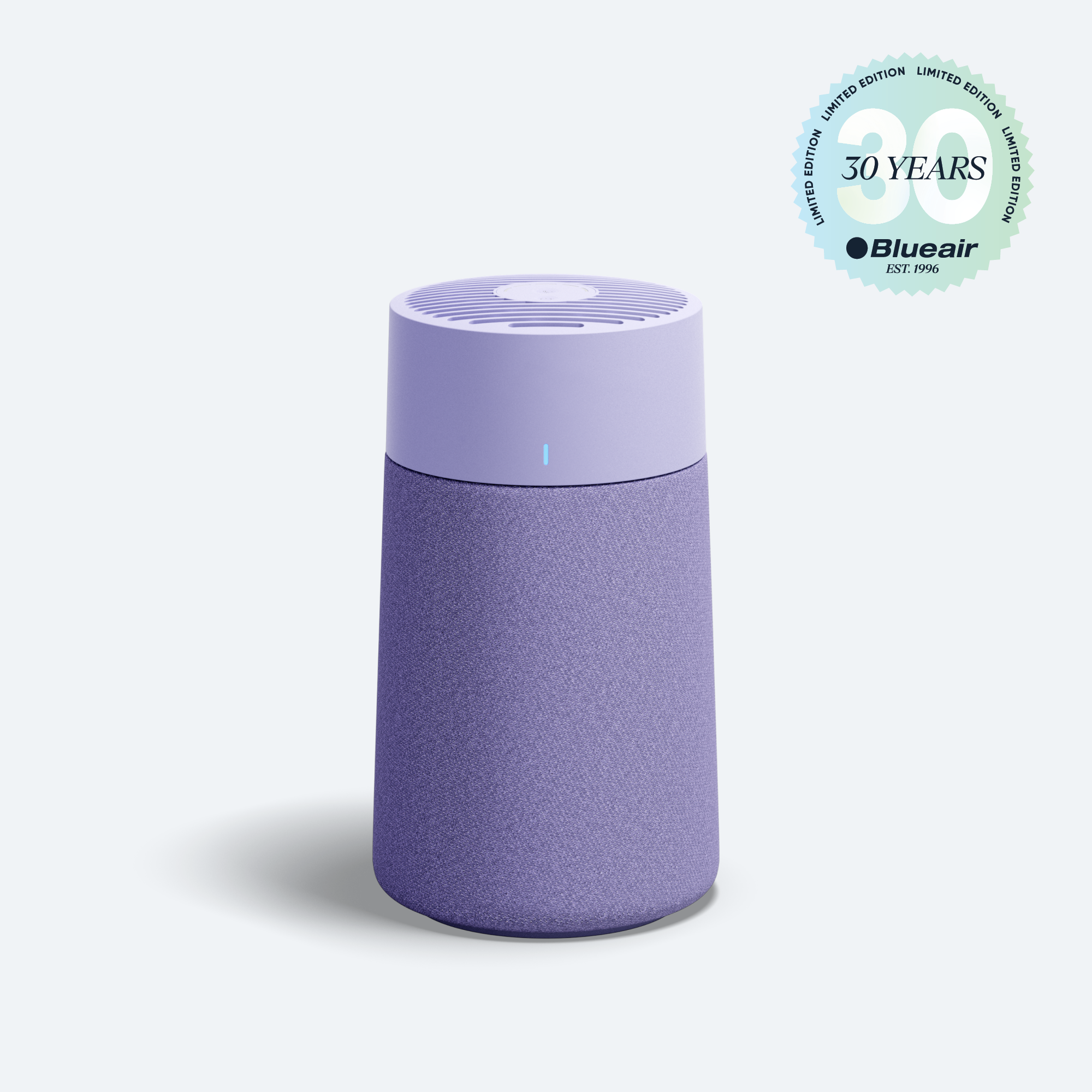
Explore this need in the finder →The Blue Pure Mini Max Auto is Blueair’s small, locally controlled purifier for a very small enclosed room or a personal space. Its U.S. product page rates it for 105 square feet at 4.8 air changes per hour; the model-specific manual adds a PM2.5 sensor, Auto and Night modes, and a washable fabric pre-filter. It is not the app-connected version of Blueair’s small-room range: Blueair support says the Mini models do not connect to the Blueair app. The U.S. offer is SKU 114602, while its manual lists two model numbers without mapping either one to that offer.
Keep the room-size claim in perspective
Use the direct 105-square-foot figure when deciding whether one unit fits a room. It is explicitly paired with 4.8 ACH, a repeated-cleaning rating rather than a slower one-change area. This fits the finder’s personal tier, not its 140-square-foot compact tier. Do not stretch the rating across an open plan or adjoining room just because the housing is easy to carry.
The cylindrical body is listed at 12 inches high and 6.7 inches across, weighs 2.8 pounds, and draws 10 watts. Blueair describes 360-degree intake with a top outlet. The manual asks for at least four inches (10 cm) of clearance around the unit and advises keeping doors and windows closed while it runs. So the easy-to-move size is useful for a desk, nightstand or dorm-room corner, but it still needs a clear breathing space. A shelf cubby or a tight slot beside furniture defeats that placement advantage.
Auto means particle response, not an app
The Auto setting changes fan speed according to indoor PM2.5 levels. A five-color indicator goes from blue through green, yellow and orange to red; the manual does not document a numeric PM2.5 value on the purifier. If a glanceable color is enough, sensor-led operation and local buttons are available together. If you want to read a number on a display, view history or change settings from across the room, this model is not a match. Blueair’s U.S. support article says Mini models cannot connect to the app, and the manual describes the controls on the purifier itself.
The fan button cycles through speeds 1–3, Auto and Night. Night mode uses the lowest fan speed and brightness; the separate power button also supports a display lock. These are useful details in a small bedroom, but Night mode is not a separate night-light function, and the lock is not a pet-specific filter or cleaning mode. Blueair lists 19 dB on low and 44 dB on high. The page does not specify A-weighting, so those plain-dB figures cannot satisfy a strict dB(A) limit or stand in for an independent sound test.
One important high-speed detail
The manual says the unit has an ionizer that runs automatically at fan speed 3. It turns off when you choose another speed or switch the unit off; there is no separate ionizer-only button in the two-button control description. This gives a user a way to avoid that operating mode, but it does not mean the hardware is absent. If your requirement is a purifier with no ionizer, do not treat this as one. The manual also repeats an ozone-concentration compliance statement; that is not a measurement of this particular unit’s emissions in a home.
Budget time for filter care
The manual identifies one replaceable Particle & Carbon main filter and a washable fabric pre-filter. Blueair’s product page recommends a six-month replacement interval, while the manual says the RealTrack indicator estimates remaining life from usage and indoor pollution and gives an expected six-to-nine-month range. Treat the red replacement light and actual conditions as the cue, not a guaranteed calendar life. The page’s exact offer does show a Particle & Carbon filter; it also presents specialty filter selections, but the separate replacement page says its Mini Max filter is compatible only with the Blue Pure Mini Max and does not name “Auto.” I would not make an AllergenBlock or SmokeBlock cartridge an essential buying condition without confirming that exact fit with Blueair.
For routine care, switch off and unplug first. The manual describes lifting off the top, removing the fabric sleeve and noise shield, and replacing the main cartridge after removing its plastic wrapper. The main filter is not washable or reusable. Vacuum the cloth with a soft brush or wash it according to the sleeve label, then reinstall it completely dry. After replacement, hold the fan-speed button for about 15 seconds to reset the red indicator. That is a straightforward routine, but it still means recurring filter purchases and a little hands-on care.
When a larger model is the better call
Choose the Mini Max Auto when its 105-square-foot, 4.8-ACH rating fits a closed room and local controls, Auto response and a color status are enough. The 511i Max is the step up if you need more area at that same rate: Blueair lists 237 square feet and app connectivity for it, with a separate F5MAX filter family. If the room exceeds that rating too, choose a larger model rather than relying on a slower headline area.
The page does not publish a CADR for this model, and its noise values are not identified as A-weighted. Those limits matter if you choose by a numeric airflow or sound threshold rather than a small-room routine. Blueair’s own 105-square-foot rating, the local-only controls, the color-based PM2.5 feedback and the replacement-filter wording are the useful decision points—not the anniversary color or a vague promise that a mini unit will cover an entire open living space.
Sources: Blueair Blue Pure Mini Max Auto U.S. product page, model-specific manual, Blueair Mini support article, Mini Max replacement-filter page and the 511i Max page. Manufacturer information only; no owner, laboratory or independent performance test is claimed.
Key details at a glance
| Room area at 4.8 ACH (stated or calculated) | 105 sq ft |
|---|---|
| Published rated input power | 10 W |
| App control | No |
| Body width | 6.7 in |
| Body depth | 6.7 in |
| Body height | 12 in |
| Published product weight | 2.8 lb |
| On-unit numeric PM2.5 display | No |
| Included Pet Allergy Filter with ARC Formula | No |
| On-unit lock for accidental control changes | Yes |
| Turbo fan setting | No |
| Automatic pre-filter scraper and dust tray | No |
| Separate TVOC sensor | No |
| Manufacturer filter-check/replacement guidance | The product page says six months; the model-specific manual uses a red usage/pollution-based indicator and gives an expected six-to-nine-month change interval. Follow the indicator and local conditions, not a guaranteed calendar life. |
| Placement and care | Place indoors with at least 4 in/10 cm clearance and keep the top outlet/intake clear. The manual recommends closed doors and windows while operating. Turn off/unplug before moving or servicing. Vacuum the fabric pre-filter with a soft brush or wash to its label and reinstall completely dry; do not wash or reuse the main cartridge. Replace it when the indicator turns red, remove plastic from the new cartridge, reassemble the noise shield/sleeve/top and hold the fan-speed button about 15 seconds to reset. |
| Built-in bipolar ionizer | Yes |
| Local ionizer on/off control | Yes |
| Purifier also has a documented circulation-fan function | No |
Use the exact model’s instructions for operating limits, supplied equipment and version differences.
Sources for this assessment
- Blueair U.S. air-purifier collection, visible pagination pages 1-3
- Blueair U.S. Blue Pure Mini Max Auto product page
- Exact U.S. Blue Pure Mini Max Auto Shopify offer record
- Blueair Blue Pure Mini Max Auto English/French user manual, 28 pages
- Blueair U.S. support article distinguishing Mini purifier variants
- Blueair U.S. Blue Pure Mini Max replacement-filter page
- Blueair exact Lavender Haze Blue Pure Mini Max Auto main studio render

Check the room rating against your actual space.
Compare room-area figures at 4.8 air changes per hour, then check their stated or calculated basis, placement and filter care.