
On this page
Your needs, this model
Does it fit your priorities?
Will particle-responsive Auto and a color cue be useful if a numeric reading is not required?
The exact 11071 page documents sensor-responsive Auto and a color-coded quality light. The matching guide gives PM2.5 bands for green/yellow/orange/red feedback, while the product page explicitly lists PM2.5 Display: No.
Explore this need in the finder →Is a 215-square-foot five-change room boundary enough for your space?
The exact page states 215 ft² at 5 ACH and 1,000 ft² at 1 ACH. Its conservative comparison fits the compact tier, not the 219-ft² small tier; do not use the slower one-change headline for a repeated-cleaning requirement.
Explore this need in the finder →Do you need a number at the purifier rather than a color category?
The exact specification lists a color air-quality light but no numeric PM2.5 display. A color-only preference may fit; an essential on-unit numeric value does not.
Explore this need in the finder →The Clorox Medium Room Turbo+ True HEPA Air Purifier, model 11071, pairs the brand’s medium-room cylinder with particle-responsive Auto and a color air-quality light. The exact U.S. page lists the same room ratings and CADRs as the manual-control 11070: 215 square feet at five air changes per hour, 1,000 square feet at one, and 138/144/145 CFM for smoke/dust/pollen. Choose this version for its additional sensor feedback, not for a larger published cleaning area.
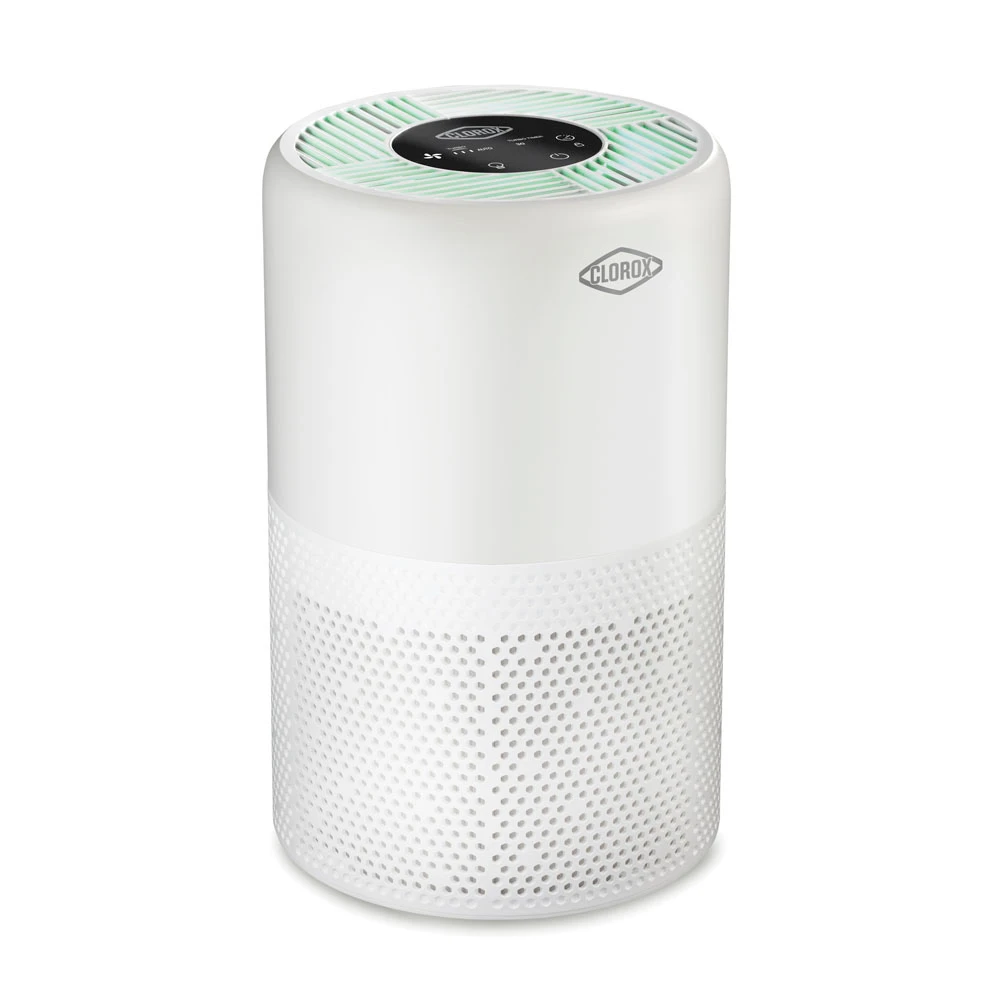
Image source and model notes

Read the room rating before choosing Auto
Although Clorox calls it a medium-room purifier, the careful repeated-cleaning comparison is 215 square feet at five air changes per hour. Its 1,000-square-foot statement is for one air change per hour, a much slower cadence. The finder uses 215 square feet as a conservative lower bound when comparing its 4.8-ACH tier because the manufacturer does not publish a separate 4.8-ACH area. This puts it above the 140-square-foot compact threshold but below the 219-square-foot small-room threshold. The three listed CADRs—138 CFM smoke, 144 dust and 145 pollen—are identical to the standard Turbo 11070 and materially higher than the 79/87/81 values on the smaller Clorox 11101/11102. A tall room, an open doorway or a faster-than-rated cleaning expectation can still make the floor-area label overoptimistic.
Its signature addition is the Auto control. The exact listing says the air-quality sensor adjusts fan speed as conditions change; the matching Clorox Turbo/Turbo+ use-and-care guide names 11071 as a Turbo+ model and recommends Auto for continuous operation. That guide maps PM2.5 ranges to green, yellow, orange and red light bands. The 11071 therefore provides a useful at-unit trend cue and particle-responsive speed changes, but it does not show a numeric PM2.5 value on the purifier itself. Do not treat its color as a calibrated reading, and do not mistake it for a gas or VOC measurement. If precise numeric values are essential, select a model with a documented numeric display rather than interpreting the Turbo+ light as one.
The difference from 11070 is not just a screen decoration: it changes who can set-and-forget the machine. The regular Turbo 11070 has manual fan selection and a timer but no Auto or air-quality light; the 11071 can change speed automatically and signal a color category. Both remain non-app products with on-unit controls. If an app connection is essential, neither is a fit. If you simply need local controls without Auto, the less elaborate 11070 may be preferable; if sensor-led adjustment and color feedback are worthwhile, the 11071’s added control has a clear purpose. The manufacturer also lists 8.5-by-8.5-inch footprint, 13.8-inch height and 5.2-pound weight—slightly shorter and lighter than the standard Turbo, but not a different size class.
Filter ownership, light settings and limits
The 11071 uses a three-layer 360-degree filter: pre-filter, True HEPA and active carbon. Clorox lists model 12070 as the replacement and includes one filter, with a typical six-to-twelve-month interval that depends on air quality. The manual tells you to unplug the unit before removing the filter, vacuum lint from the filter exterior and housing with a brush attachment about monthly, and avoid wetting or spraying the filter. Its red check-filter indicator means inspect; it is not an exact remaining-life measurement. Replace when the filter is clogged, airflow has fallen or odor suggests it is spent, and follow the manufacturer’s interval. No current filter price is asserted, so verify 12070 availability and recurring cost before buying.
For night use, the manual offers On, Dim and Off panel brightness, and the page says the lowest setting can be as low as 24 dB. That is a manufacturer-reported low-speed claim, not an independent test or a maximum noise value across Auto and Turbo. The purifier has no dedicated named Night mode; dimming the display does not automatically set a quieter fan. The Turbo timer offers 10, 20 or 30 minutes and, per the guide, returns to the prior fan setting after the countdown. Those are practical manual controls even if you mostly leave the unit in Auto.
One placement issue deserves attention. Clorox promotes a Turbo timer for odor episodes after cooking, but the same model-family manual warns against operating the purifier in a greasy environment such as a kitchen and says it is not for oil or grease. Treat the purifier as a room appliance away from direct grease exposure, not as exhaust ventilation. The manual also warns against placement near open flame or in garages and other chemical-storage areas. The three-stage carbon layer is described for general VOCs and odors; the manufacturer does not identify the 12070 as a Pet Allergy Filter with ARC Formula or as a high-capacity gas medium.
Choose Auto only for the feature it provides
Choose the Turbo+ 11071 when a compact room needs the 215-square-foot five-change floor, Auto is an important daily convenience and color-only feedback is enough. The ordinary questionnaire should keep it for compact spaces, local controls, particle-responsive Auto and a color indicator. A 219-square-foot small-room minimum, numeric display, app control, dedicated Night mode, heating or a purifier-plus-fan requirement should remove it. It is not a stronger-room version than the 11070, and the Auto mode should not be read as guaranteeing uniform results across an open plan or a polluted source. If you want the same core medium-room output but manually choose every speed, compare the 11070. If you want Auto and a numerical PM2.5 display, compare a model with an actual numeric screen instead of upgrading solely for the Turbo+ name.
Key details at a glance
| Room area at 4.8 ACH (stated or calculated) | 215 sq ft |
|---|---|
| Published room area at 1 air change per hour | 1000 sq ft |
| Clean air delivery rate (CADR) | 138 CFM |
| App control | No |
| Body width | 8.5 in |
| Body depth | 8.5 in |
More specifications and setup details
| Body height | 13.8 in |
|---|---|
| Published product weight | 5.2 lb |
| On-unit numeric PM2.5 display | No |
| Included Pet Allergy Filter with ARC Formula | No |
| Turbo fan setting | Yes |
| Manufacturer filter-check/replacement guidance | The exact page lists one included Clorox 12070-family filter with typical 6–12-month life depending on air quality. The matching guide recommends monthly exterior vacuuming with a brush attachment; its red check-filter light prompts inspection rather than giving an exact remaining-life reading. Replacement cost is unknown. |
| Purifier also has a documented circulation-fan function | No |
| Built-in heating mode | No |
| Built-in humidification mode | No |
| Separate adjustable fan in exact offer | No |
Use the exact model’s instructions for operating limits, supplied equipment and version differences.
Sources for this assessment
Check the room rating against your actual space.
Compare room-area figures at 4.8 air changes per hour, then check their stated or calculated basis, placement and filter care.