
Your needs, this model
Does it fit your priorities?
Can the Airmega 300 serve a medium-size room at the 4.8-ACH comparison benchmark with local Auto and a color category instead of an app or numeric PM display?
Yes on its single recorded plan: the calculated comparison is about 523 square feet and the manual documents sensor-driven Auto with color feedback. It does not meet the large-room tier, app-control requirement or numeric on-unit PM requirement.
Explore this need in the finder →Does the exact 1,256-square-foot rating at two ACH meet a 1,250-square-foot minimum, but not 1,260?
Coway lists 1,256 square feet at two air changes per hour. The 2,512-square-foot headline is for one change per hour and cannot satisfy a higher two-ACH requirement.
Explore this need in the finder →Will the 13.6-inch body width meet a 14-inch limit when space is left open around both side intakes?
The manufacturer lists 13.6 inches wide, so the body fits a 14-inch cap, but that dimension is not an installation clearance and the two intakes and top outlet must stay open.
Explore this need in the finder →Does the Airmega 300 satisfy an essential app-control requirement?
No. This exact non-S Airmega 300 is explicitly not Wi-Fi or app-enabled; the separate 300S has different connected functions.
Explore this need in the finder →Can its color-only indicator satisfy a requirement for numeric PM2.5 on the purifier itself?
No. Coway describes a real-time color signal, not a numeric PM2.5 readout on the appliance.
Explore this need in the finder →Can the listed smoke CADR alone qualify it for a generic CADR minimum of 285 CFM?
No. Coway gives separate smoke, dust and pollen values but does not publish one pollutant-independent CADR; the generic matcher field stays unknown.
Explore this need in the finder →The Coway Airmega 300 is a large cabinet purifier for one roomy home space when you want sensor-led Auto, physical controls and a color signal without Wi-Fi or an app. Its room-area headline needs careful reading: 2,512 square feet is at one air change per hour, not the faster repeated-cleaning rate used for a useful room comparison here. At the 4.8-ACH comparison basis, the 300 is a medium-room candidate, not a match for a strict large-room minimum.
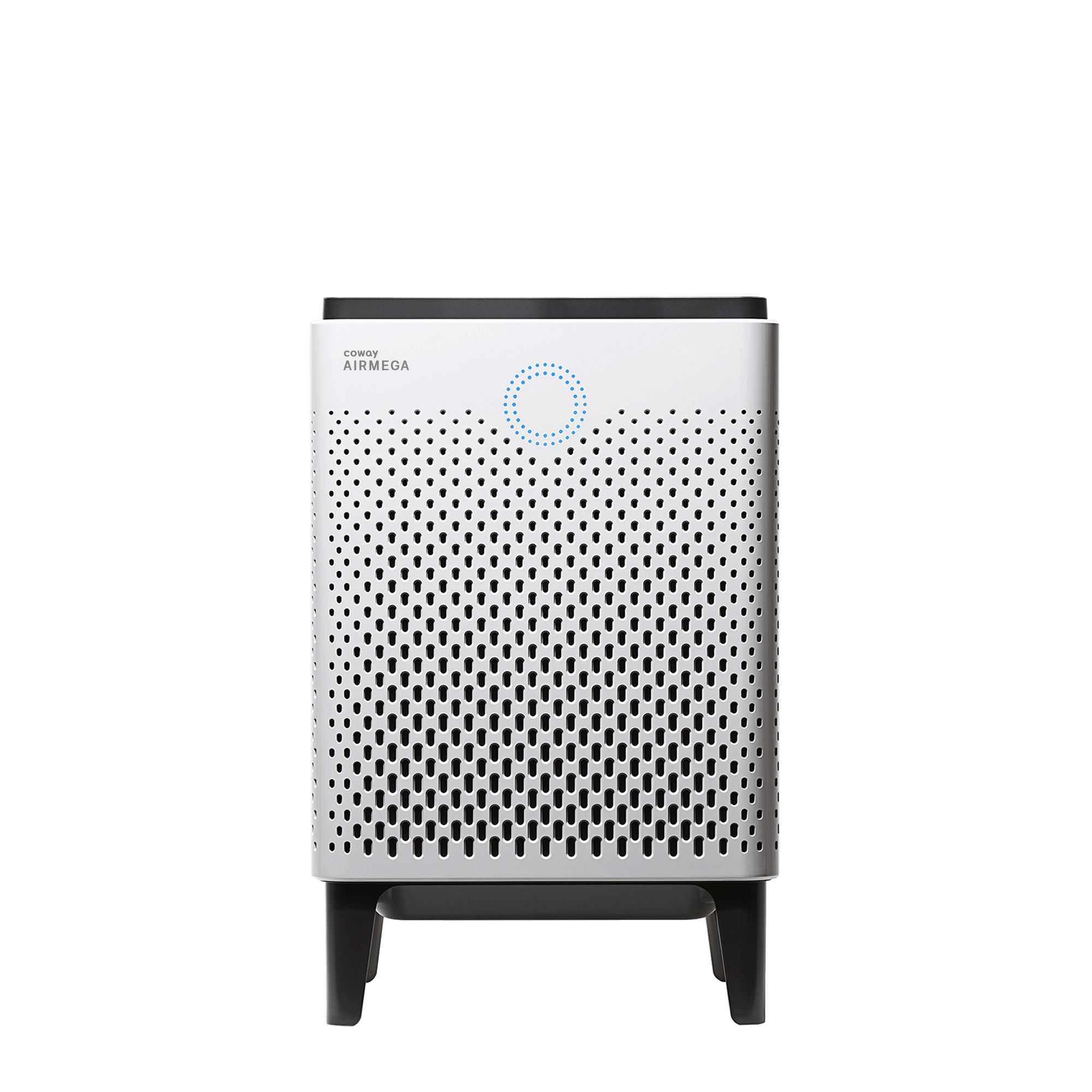
Three room figures describe different cleaning rates
Coway lists 2,512 square feet at one air change per hour, 1,256 at two changes per hour and 628 at four. Its linked manual assumes an eight-foot ceiling and identifies the 300 as AP-1515H. For a consistent 4.8-ACH comparison, scaling the 1,256-square-foot two-ACH area gives about 523 square feet: 1,256 × 2 ÷ 4.8. That is a rate-based comparison, not an independent test or a room size Coway directly labels at 4.8 ACH. An open layout, high ceiling, blocked intake or a lower fan setting can weaken the fit in a real room, so do not use the one-change headline as a substitute for the faster rate you actually need.
The product page separates Clean Air Delivery Rate into smoke (285 CFM), dust (306 CFM) and pollen (339 CFM). Those pollutant-specific numbers are not interchangeable versions of one generic CADR. If your shopping rule requires a single unspecified CADR minimum, the 300 should not pass by selecting whichever pollutant figure looks convenient. CADR and room area describe related but different questions, and both figures come from Coway rather than independent measurements.
Auto is local; the feedback is not a number
The exact Airmega 300 page says this model is not Wi-Fi or app-enabled. It has physical controls, sensor-based Auto, three manually selected airflow levels, Sleep and Eco. A one-, four- or eight-hour shutoff timer is selected on the local panel. This suits someone who would rather set the machine directly and does not need remote checks or phone scheduling. The 300 is not the connected 300S or 400S; the S-series functions should not be inferred for the exact non-S offer reviewed here.
The sensor signal is a color category, not a numeric PM1.0, PM2.5 or PM10 reading on the appliance. Coway documents particle-based monitoring, not a TVOC or gas sensor. Activated carbon in the Max2 filter does not turn the light into chemical monitoring. If a numeric on-unit value or a separate TVOC reading is essential, this model should fail that requirement rather than receive credit for an adjacent feature.
Auto raises or lowers the fan with the sensed air-quality category; it does not guarantee the 4.8-ACH comparison airflow. In Smart/Eco the manual says the fan can stop after Good air persists more than ten minutes, restart when pollution is detected and also restart periodically after thirty minutes. Sleep is also nuanced: the product specification labels it manual, while the shared manual describes Smart-mode Sleep after a dark room and Good air for three minutes. The sources do not clearly reconcile that sequence for this exact 300, so do not assume a particular overnight automation schedule. Use manual airflow when the control level matters more than automatic adjustment.
Plan for two sides of filter care
The cabinet takes air through both sides. It includes two washable pre-filters and two Max2 combination filters, one per side; Coway lists HEPA plus activated carbon. Before the first run, unplug the unit and remove the shipping plastic from both Max2 filters. The manual says to vacuum the pre-filters first and gently wash them if needed, then shade-dry them fully. Refit both sides and covers correctly, and reset the Pre Wash indicator. The Max2 filters are replaced as a pair rather than washed, with their own reset. Coway also recommends cleaning the pollution sensor about every two months.
Filter-life language varies across the exact page: introductory copy says six to twelve months, the specifications say one year, and later copy ties life estimation to use. The manual uses the indicators. Use the gauges and household conditions instead of treating any one interval as guaranteed. Coway's replacement set contains two filters for the 300/300S family; it is an accessory, not a second purifier. There is no planned saving from replacing just one side while the other Max2 filter is overdue.
Check the shell and alternatives
The current page lists a 13.6-inch width, 13.6-inch depth, 21.2-inch height and 21.4-pound weight. The manual table for Airmega 300/AP-1515H instead says 20.1 inches high; Coway's family one-sheet repeats 21.2 inches. Because the height mismatch remains unresolved across manufacturer sources, treat strict height fit as unknown. Width and depth are 13.6 inches, but those are body measurements, not installation clearance. Keep both intakes and the top outlet open. Coway lists 57 watts and 22–52 dB(A); these are manufacturer ratings, not independent noise or energy tests.
Choose the 300 when your room fits roughly 523 square feet at the 4.8-ACH comparison, the cabinet can breathe and local Auto with color feedback is enough. If your room needs more repeated-cleaning capacity but app control is unnecessary, the reviewed non-Wi-Fi Airmega 400 compares at about 650 square feet. The Airmega 400S is a larger connected alternative if remote control matters; it is a separate machine, not a feature you can add to the 300. Smaller spaces may not need this cabinet. In each case, use the room-rate figure, filter routine and required controls together instead of treating the largest printed area as a guarantee.
Primary references: Coway's Airmega 300 U.S. page, the linked Airmega 300/300S/400/400S manual (300/AP-1515H), the 300/300S one-sheet, and the 300/300S Max2 replacement set.
Key details at a glance
| Room area at 4.8 ACH (stated or calculated) | 523.3 sq ft |
|---|---|
| Published room area at 1 air change per hour | 2512 sq ft |
| Room area at 2 ACH (stated or calculated) | 1256 sq ft |
| Published rated input power | 57 W |
| App control | No |
| Body width | 13.6 in |
| Body depth | 13.6 in |
| Published product weight | 21.4 lb |
| On-unit numeric PM2.5 display | No |
| Included Pet Allergy Filter with ARC Formula | No |
| Turbo fan setting | No |
| Automatic pre-filter scraper and dust tray | No |
| Separate TVOC sensor | No |
| Manufacturer filter-check/replacement guidance | The exact page's top feature text says six–twelve months, the specification says one year, and a later manufacturer description ties life estimation to use. The manual uses indicators; use them and household conditions rather than treating any one calendar interval as guaranteed. |
| Important specification note | Room ratings are stated at different air-change rates; 523.3 ft² at 4.8 ACH is calculated from the 1,256-ft² 2-ACH rating. Generic CADR is unknown because only pollutant-specific values are listed. Height is unknown for strict matching because the product page/one-sheet and manual disagree. |
Use the exact model’s instructions for operating limits, supplied equipment and version differences.
Sources for this assessment
- Coway U.S. Airmega 300 product page
- Coway official Shopify Airmega 300 product and offer record
- Coway English Airmega 300/300S/400/400S family manual
- Coway 2025 Airmega 300/300S one-sheet
- Coway Airmega 300/300S Max2 replacement-set accessory page
- Coway official Shopify Airmega 300/300S filter accessory record
- Targeted CPSC Airmega 300 recall-name query
- Coway Airmega 300 exact product image

Check the room rating against your actual space.
Compare room-area figures at 4.8 air changes per hour, then check their stated or calculated basis, placement and filter care.