
Your needs, this model
Does it fit your priorities?
Can a local, app-free Airmega 400 serve a 606-square-foot room at the 4.8-ACH comparison basis and show a color sensor category?
Yes, on the one recorded local-control plan: its 1,560-ft² 2-ACH area scales to 650 ft² at 4.8 ACH, and the manual documents sensor-led Auto with four color-coded categories. This is not a direct 4.8-ACH manufacturer rating or a numeric PM2.5 display.
Explore this need in the finder →Does the Airmega 400 meet a strict two-ACH room minimum of 1,560 square feet, but not 1,570?
Coway directly lists 1,560 ft² at two air changes per hour. The 3,120-ft² headline is for one change per hour and cannot satisfy the larger two-ACH choice.
Explore this need in the finder →Will the non-Wi-Fi Airmega 400 be a fit if an app becomes essential?
No. Coway explicitly describes this exact Airmega 400 as not Wi-Fi or app-enabled; its local physical controls remain available when connected operation is not needed.
Explore this need in the finder →Can the body fit a 15-inch-wide space if open clearance beyond the shell is available?
The published body is 14.8 inches wide, so it meets a 15-inch body cap. Both side intakes and the top outlet still need to remain unobstructed; body width is not a full installation clearance.
Explore this need in the finder →Can the four-color indicator stand in for an essential numeric PM2.5 reading?
No. The unit provides four color-coded particle-air-quality categories, not a numeric PM2.5 value. Choose the numeric-reading option only when an exact model documents the value on the appliance.
Explore this need in the finder →The Coway Airmega 400 is a large-room purifier for someone who wants local controls and a colored air-quality signal, not an app. It is the non-Wi-Fi 400, not the Airmega 400S. Its strongest case is a spacious, single room where a high-airflow machine can stand with both side intakes and its top outlet clear. Read its room numbers at the rate you actually need: the largest headline is not the repeated-cleaning figure.
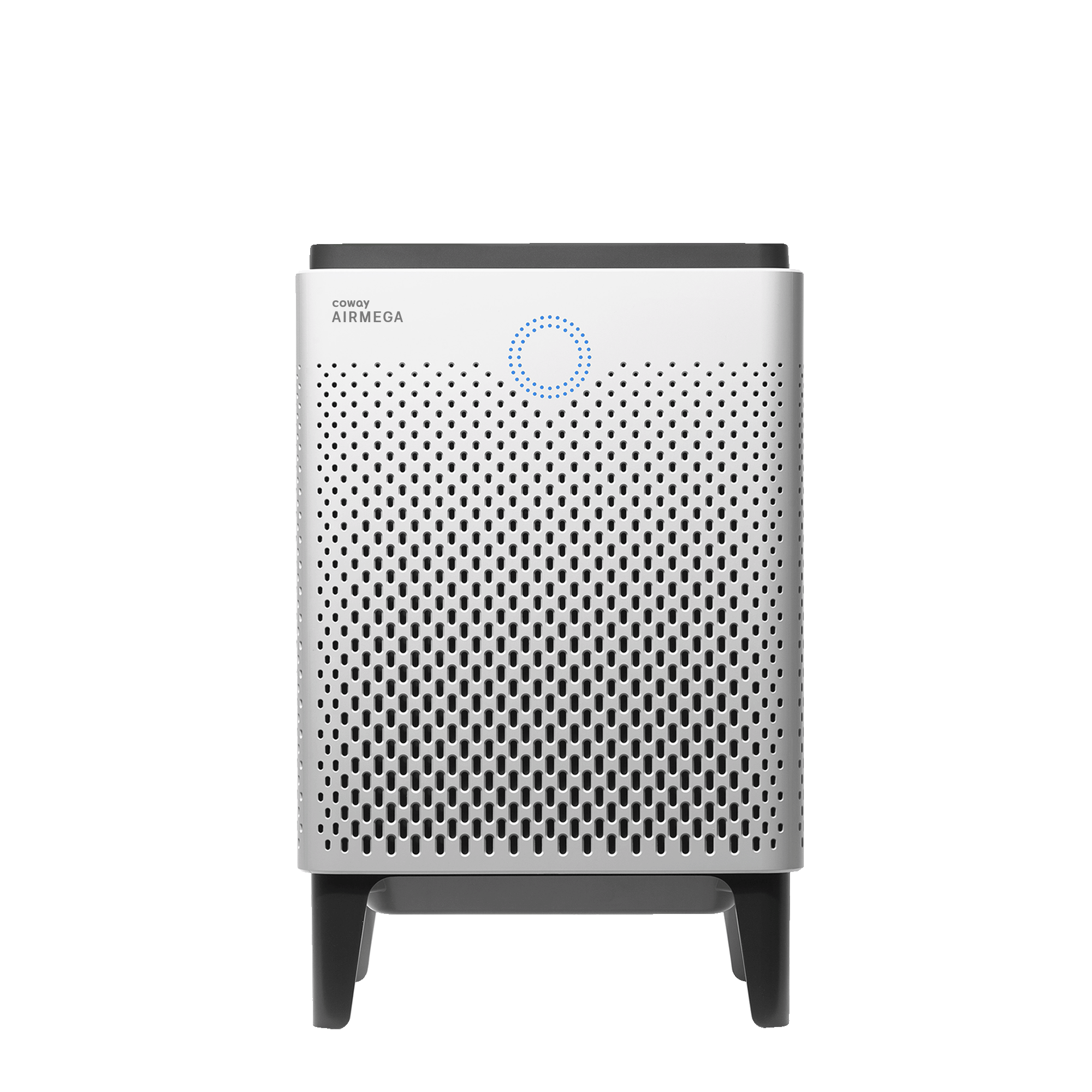
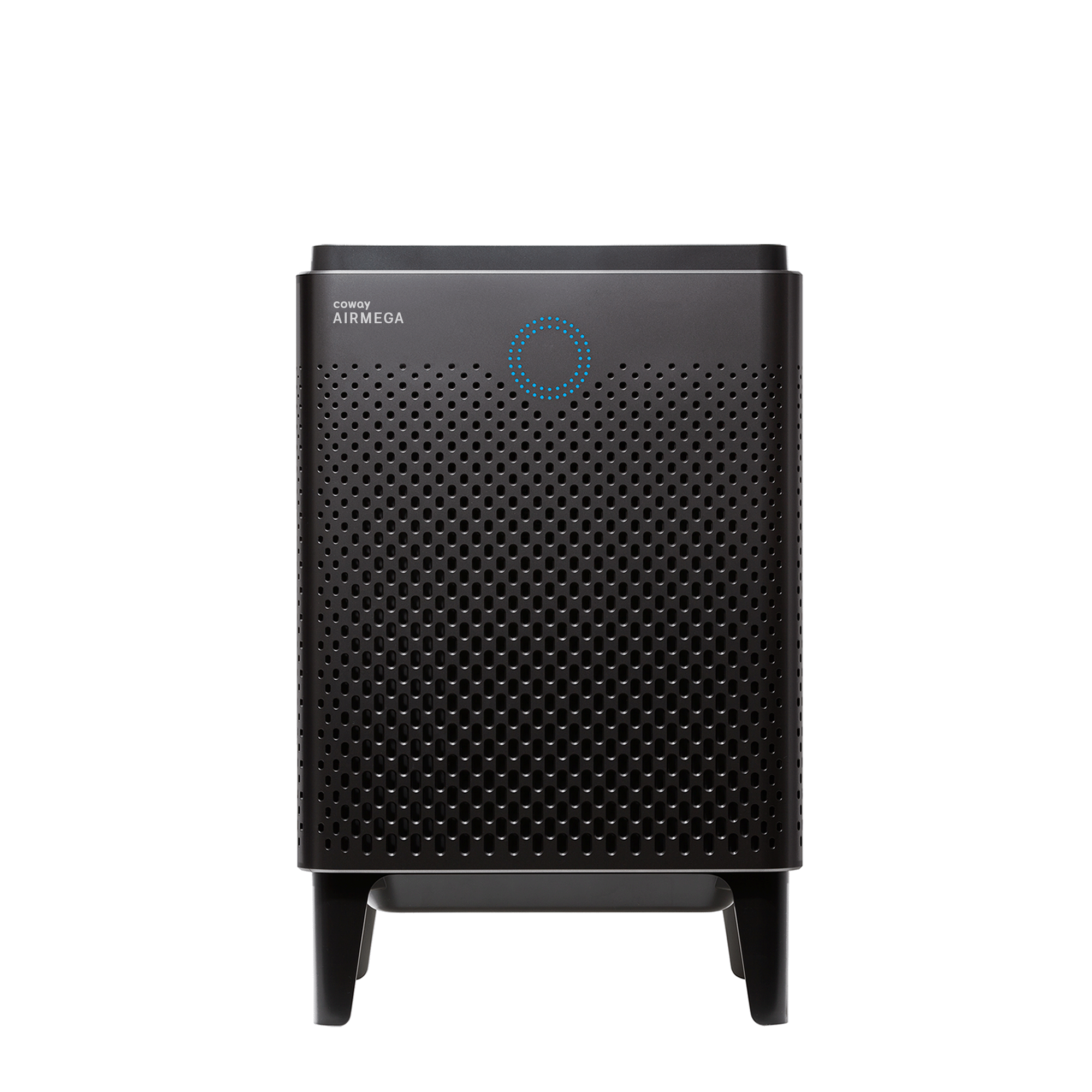
Size the room at the rate, not the headline
Coway lists the Airmega 400 at 3,120 square feet for one air change per hour and 1,560 square feet for two. Its manual assumes an eight-foot ceiling and gives 780 square feet at four changes per hour. For a consistent 4.8-ACH comparison, 1,560 × 2 ÷ 4.8 equals 650 square feet. That 650-square-foot value is a rate-scaled comparison, not a room rating Coway directly prints. It clears the 606-square-foot large-room tier used here, but leaves little buffer for an open-plan space, high ceiling or airflow blocked by furniture. The one-change headline is not a substitute for repeated cleaning.
Coway also publishes separate CADRs of 328 CFM for smoke, 328 for dust and 400 for pollen. Those pollutant-specific values are not one universal CADR; a strict generic-CADR requirement should not treat any one as interchangeable with the others. The room-area calculation and CADR answer related but different questions, and both are manufacturer figures rather than results from independent testing.
Local automation, with color instead of a number
The 400 has direct controls, a particle sensor, automatic airflow and four color-coded air-quality categories. In Auto, the fan changes among three levels as the sensor’s air-quality category changes. The display is a quick signal, not a numeric PM2.5 reading, and the manual identifies a particle sensor rather than a TVOC or gas-sensing system. Carbon in a filter does not turn this light into a chemical monitor.
Manual operation offers three fan speeds and Sleep. The product page calls out Auto, Eco and Sleep; in Eco, the manual says the fan can stop after air quality remains Good for more than ten minutes, then restart if pollution is detected. Sleep can engage automatically in a dark room when air quality is Good. These settings are convenient for a home routine but can run below the airflow basis behind the room-area comparison. If a 4.8-ACH-equivalent level is essential through the night, do not assume Auto or Eco holds the top room rating continuously. A one-, four- or eight-hour timer is available on the local panel. There is no app or Wi-Fi operation on this exact 400.
Plan for the two-sided filter routine
The machine comes with two washable pre-filters and two Max2 filters, one of each on either side. Coway describes the Max2 set as HEPA filtration paired with activated carbon. The pre-filters collect larger debris such as hair and dust and can be vacuumed or gently washed; Coway says to dry them in the shade before refitting. Both Max2 elements are replaced together, are not washable, and need their protective plastic removed before first use. Seat both covers correctly after servicing or the machine will not run. The indicators for cleaning the pre-filters and replacing the Max2 pair have separate resets.
Filter timing is less exact than one calendar claim suggests: the page’s introductory feature copy says six to twelve months, the specification table says one year, and a later filter description says roughly twelve months based on use. The manual’s indicator also tracks use. Treat the indicator and your conditions as the practical guide, budget for a paired filter set, and do not count on a guaranteed interval. Coway also recommends cleaning the particle sensor about every two months, an easy-to-forget task if the colored feedback begins to look implausible.
Check the footprint before bringing it home
The body measures 14.8 inches wide, 22.8 high and 14.8 deep and weighs 24.7 pounds. Its width is manageable on paper for a large purifier, but it is a boxy floor-standing appliance rather than a hidden corner device. The manual says not to block either side of the unit or the air outlet and calls for a firm, flat, dry indoor surface; it does not provide a numeric wall clearance in the cited instructions. Measure the working space, not just the shell. At 66 watts and a published 22–52 dB(A) range, the machine also has a meaningful everyday footprint beyond its room-area headline.
This model suits someone who values direct controls, sensor-led Auto and a simple color signal in a large room, and is comfortable maintaining two washable pre-filters plus a matched filter pair. It is a poor fit when app scheduling, numeric PM2.5/PM10 readings, a TVOC sensor, a pet-specific filter or a narrow alcove is essential. The reviewed Levoit Core 600S-P offers app control and a similar 606-square-foot 4.8-ACH comparison area, while the reviewed Airmega ProX raises the calculated comparison to 885 square feet and adds numeric particle readings. The ProX is much larger and heavier at 51 pounds; neither one substitutes for a gas sensor or a documented pet mode.
Primary references: Coway’s Airmega 400 U.S. page, its linked Airmega 300/400-family manual (Airmega 400 model AP-2015F), and the separate 400/400S Max2 replacement-set page.
Key details at a glance
| Room area at 4.8 ACH (stated or calculated) | 650 sq ft |
|---|---|
| Published room area at 1 air change per hour | 3120 sq ft |
| Room area at 2 ACH (stated or calculated) | 1560 sq ft |
| Published rated input power | 66 W |
| App control | No |
| Body width | 14.8 in |
| Body depth | 14.8 in |
| Body height | 22.8 in |
| Published product weight | 24.7 lb |
| On-unit numeric PM2.5 display | No |
| Included Pet Allergy Filter with ARC Formula | No |
| On-unit lock for accidental control changes | No |
| Turbo fan setting | No |
| Automatic pre-filter scraper and dust tray | No |
| Separate TVOC sensor | No |
| Manufacturer filter-check/replacement guidance | The exact product page's upper feature text says the Max2 filter lasts 6–12 months, its specifications list 1 year, and a later feature states approximately 12 months based on usage. The manual uses processed-air filter indicators but does not give one fixed calendar interval. Use the model's indicators and conditions; replacement is for the pair, not one side alone. |
| Important specification note | The room comparison at 4.8 ACH is calculated from the 1,560-ft² 2-ACH value; the manufacturer directly lists 780 ft² at 4 ACH. CADRs remain pollutant-specific and the generic CADR is unknown. Product-page noise, wattage and dimensions are not independent measurements. |
Use the exact model’s instructions for operating limits, supplied equipment and version differences.
Sources for this assessment
- Coway U.S. Airmega 400 product page, selected White offer
- Coway official Shopify Airmega 400 product and offer record
- Coway Airmega 400S/400/300S/300 family U.S. user manual, linked from Airmega 400 page
- Coway official Product Manuals directory, Large Spaces section
- Coway Airmega 400/400S Max2 filter replacement set page
- Coway Shopify Max2 filter accessory offer record
- CPSC targeted Airmega 400 recall query
- CPSC targeted Coway 400 recall query
- Coway Airmega 400 exact White offer render
- Coway Airmega 400 exact Graphite offer render


Check the room rating against your actual space.
Compare room-area figures at 4.8 air changes per hour, then check their stated or calculated basis, placement and filter care.