
Your needs, this model
Does it fit your priorities?
Will the Halo cover a medium room at the common 4.8-air-changes benchmark without treating its 1,898-ft² one-change headline as a fast-cleaning rating?
Its lowest listed pollutant CADR, smoke at 253.3 CFM, calculates to about 395 ft² at 4.8 ACH using an eight-foot ceiling. That clears the 358-ft² medium threshold; it does not reach the 606-ft² large threshold. The 1,898-ft² page figure is at 1 ACH.
Explore this need in the finder →Can the Halo run local sensor-led Auto while giving me a color air-quality indicator, without requiring an app or a numeric PM2.5 readout?
Yes. The AP-1526D manual documents Smart/Auto, local airflow buttons and four color categories. It does not show numeric PM2.5 concentration, app control or a Wi-Fi setup procedure; an essential phone-control or numeric-display need should reject this model.
Explore this need in the finder →Will the Halo suit a 358-ft² room if I need Turbo, a selectable night light and an opening at least 11 inches wide?
It meets those documented choices in one local-control configuration: 10.6 inches wide, a distinct Turbo mode, a separate Light button with night-light selection, and a conservative 395-ft² 4.8-ACH smoke-CADR calculation. A 10-inch opening is too narrow for the body before adding any room for airflow.
Explore this need in the finder →Does the purifier provide a washable pre-filter or an included Pet Allergy Filter with its annual cartridge?
No. Its combined filter is not washable or reusable; Coway says to vacuum or dry-wipe dust from the pre-filter surface. The documented replacement is a model-named three-in-one cartridge, and a separate included Pet Allergy Filter or pet-specific cartridge profile is not established.
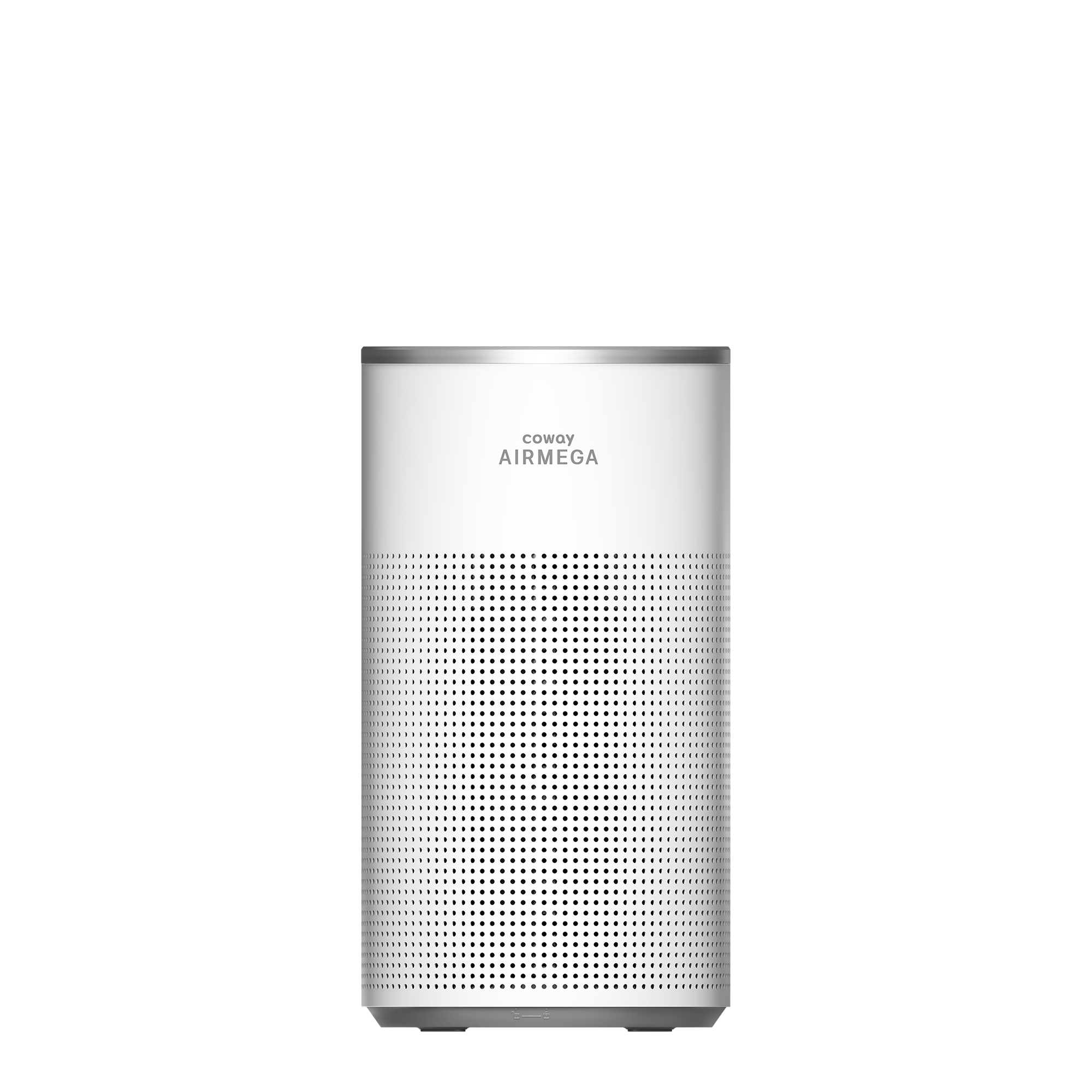
Explore this need in the finder →The Coway Airmega Halo is the model AP-1526D, offered in the current U.S. product record as one default configuration (SKU 826439001858). It is a compact, upright cylinder with a local control panel, PM2.5-responsive Smart mode, a selectable night light and a three-in-one replacement cartridge. Its strongest fit is a modest room where you want a dedicated high-speed setting and automatic operation without relying on a phone. The product page’s 1,898-square-foot headline needs its air-change basis kept in view.

Read the room figure at the rate it describes
Coway lists 1,898 square feet at one air change per hour, not at the more demanding 4.8 changes per hour. Its product page also gives pollutant-specific CADR values: 253.3 CFM for smoke, 259 for dust and 294.4 for pollen. For a comparable 4.8-ACH screen, the smoke value works out to about 395 square feet using the standard CADR-area formula and an assumed eight-foot ceiling; the corresponding two-change figure is about 949 square feet. Those are calculations, rounded down, not room sizes Coway directly labels at those rates. The page’s one-change figure remains 1,898 square feet. Treat the 395-square-foot result as a conservative smoke-CADR equivalent at high airflow, not a promise at every speed or pollutant. These manufacturer values are not measurements made for this review.
That distinction changes a questionnaire result: a 358-square-foot medium-room threshold fits this calculated basis, while a 606-square-foot threshold does not. Selecting Sleep or letting Eco stop the fan is not the same operating condition as using maximum airflow for the CADR comparison. Open doorways, unusually high ceilings and a room that is not enclosed can also change the practical fit.
Useful automatic behavior, with a local fallback
The manual identifies Airmega Halo model AP-1526D and documents buttons for power, mode, three numbered airflow speeds, timer, light and filter reset. Smart mode adjusts among airflow levels from the particle sensor. The four color categories are blue, green, yellow and red; there is no numeric PM2.5 concentration display on the panel. Smart operation can also shift into its low Sleep behavior after the light sensor sees darkness for three minutes, then return when the room brightens or a button is pressed. A 1-, 4- or 8-hour timer, mute function and control-panel lock are also documented. Coway’s model page and manual do not document app or Wi-Fi control, so treat it as a local-control model rather than expecting remote settings.
Turbo is a separate high-airflow choice for a shorter clearing run. Coway’s manual warns that maximum airflow uses more energy and can be noisier. Its page lists 17.8–52.13 dB and 38 watts; those are manufacturer figures, not an independent sound or power test. The page’s Sleep-mode claim of 17.8 dB is attractive for a bedroom, but that quiet setting is not evidence that the purifier delivers its high-speed CADR while running quietly. If both room capacity and quiet are essential, compare the maximum-noise limit with the actual speed you expect to use rather than assuming the best of each mode at once.
One combined filter keeps the routine simple
The included 3-in-1 cartridge combines a pre-filter, HEPA stage and deodorizing carbon stage. Coway lists a one-year filter expectancy and sells a model-named replacement Halo filter (SKU 826439001896). The manual says the filter indicator illuminates after estimated use reaches 95 percent; after replacement, hold the reset button for three seconds. Do not wash or reuse the cartridge. The pre-filter surface can be vacuumed or wiped with a dry cloth as dust accumulates. That is simpler than keeping separate carbon and HEPA replacement calendars, but there is no separately documented washable pre-filter or alternate pet/smoke carbon profile here. A carbon stage is not a TVOC sensor, and a PM2.5 sensor does not identify gases.
Measure the cabinet and leave the air path open
The body is 10.6 inches wide and deep and 19.7 inches high; the manual lists product weight as 9.68 pounds (the page rounds it to 9.7). A centered cylindrical footprint is easier to place than a wide console, but the manual warns against blocking both surrounding sides or the outlet. Use a firm, flat, dry indoor surface, avoid humid areas, direct sun and a nearby window, and keep the cord out of a walking path. The U.S. manual specifies 120 V, 60 Hz. It does not publish quantified wall clearances, so do not invent one from another Airmega model.
Who should shortlist it—and what would change that choice
Shortlist the Halo if you value a small cabinet, direct buttons, sensor-led Auto, selectable light settings, a lock and a simple one-piece annual filter routine. For a 358-square-foot 4.8-ACH requirement, this review’s calculated smoke-CADR area is enough; a stricter 606-square-foot need is not. An 11-inch body-width cap fits the 10.6-inch shell, while a 10-inch cap does not. If app control or a numeric on-unit PM2.5 reading is nonnegotiable, this documented configuration is the wrong match. It also is not the choice for built-in wheels, an adjustable outlet, a dedicated Pet Mode, white noise or an included Pet Allergy Filter.
For a nearby Coway alternative with a directly stated manual room schedule, compare the Airmega Mighty Beige AP-1512HHC: its U.S. manual lists 347 square feet at 4.8 ACH, but its controls and filter package differ and it does not have the Halo’s Turbo setting or night light. If you need app control and a numeric display, the Levoit Core 400S-P review addresses those specific features. The best choice depends on whether you trust a transparent CADR-derived area or prefer a model whose manual prints the room rate directly. Read the Coway Airmega Halo product page and its AP-1526D manual for the exact configuration before purchase.
Key details at a glance
| Room area at 4.8 ACH (stated or calculated) | 395 sq ft |
|---|---|
| Published room area at 1 air change per hour | 1898 sq ft |
| Room area at 2 ACH (stated or calculated) | 949 sq ft |
| Published rated input power | 38 W |
| App control | No |
| Body width | 10.6 in |
| Body depth | 10.6 in |
| Body height | 19.7 in |
| Published product weight | 9.68 lb |
| On-unit numeric PM2.5 display | No |
| Included Pet Allergy Filter with ARC Formula | No |
| On-unit lock for accidental control changes | Yes |
| Turbo fan setting | Yes |
| Automatic pre-filter scraper and dust tray | No |
| Separate TVOC sensor | No |
| Manufacturer filter-check/replacement guidance | The manual and page give a one-year filter expectancy. A filter-use indicator illuminates at 95% or more estimated use. Do not wash or reuse the cartridge; vacuum or wipe dust from its pre-filter surface with a dry cloth. Reset the indicator by holding its button for 3 seconds after replacement. Genuine model-named replacement SKU 826439001896 is listed separately. |
| Important specification note | The product page directly gives 1,898 ft² at 1 ACH and pollutant-specific CADR. The 395-ft² 4.8-ACH and 949-ft² 2-ACH matcher values are smoke-CADR calculations using an assumed 8-ft ceiling, rounded down; the manual does not print these areas. |
| Placement and care | The combined cartridge has a one-year stated expectancy, not a washable filter stage. Keep the whole cartridge dry; remove surface dust from the pre-filter by vacuum or dry cloth, heed the filter-use lamp, and reset it after fitting the genuine model-named replacement. |
Use the exact model’s instructions for operating limits, supplied equipment and version differences.
Sources for this assessment
- Coway U.S. Airmega Halo exact selected offer page
- Coway official Shopify Airmega Halo product and offer record
- Coway Airmega Halo / AP-1526D U.S. user manual
- Coway official product manuals directory, Airmega Halo entry
- Coway Airmega Halo 3-in-1 replacement filter page
- Coway official Shopify Halo filter offer record
- Coway AP-1526D product-page image
- CPSC targeted AP-1526D recall query
- CPSC targeted Coway Airmega Halo recall query
Check the room rating against your actual space.
Compare room-area figures at 4.8 air changes per hour, then check their stated or calculated basis, placement and filter care.