
Your needs, this model
Does it fit your priorities?
How much closed-room area does the exact Mighty2 support at the common repeated-cleaning rate?
Its manual gives 450 ft² at a four-change rate in 15 minutes; scaling to 4.8 ACH yields a 375-ft² comparison, not the 1,800-ft² one-change headline.
Explore this need in the finder →Can the AP-1512N show numeric particle readings locally without requiring a phone?
Yes. Its exact manual documents local PM1.0, PM2.5 and PM10 readings; it documents panel controls rather than an app pairing path.
Explore this need in the finder →Does the Mighty2 satisfy a required app-control path?
No model-specific app or Wi-Fi control path is documented for the AP-1512N; this local operating plan should fail an essential app requirement.
Explore this need in the finder →Can pollutant-specific CADR numbers meet a strict generic CFM minimum?
No. Coway lists smoke/dust/pollen values but the reviewed page omits units beside those values; generic CADR CFM remains unknown for a hard threshold.
Explore this need in the finder →What should an owner do when the pre-filter needs care?
The product page calls it washable, but the exact manual instructs vacuuming or wiping it dry every 2–4 weeks and does not provide a rinse procedure; follow the detailed manual.
Explore this need in the finder →Does the AP-1512N have a local control/display lock, while remaining a non-app plan?
Yes. Its exact manual describes a local control-panel lock; that does not create an app or remote-control path.
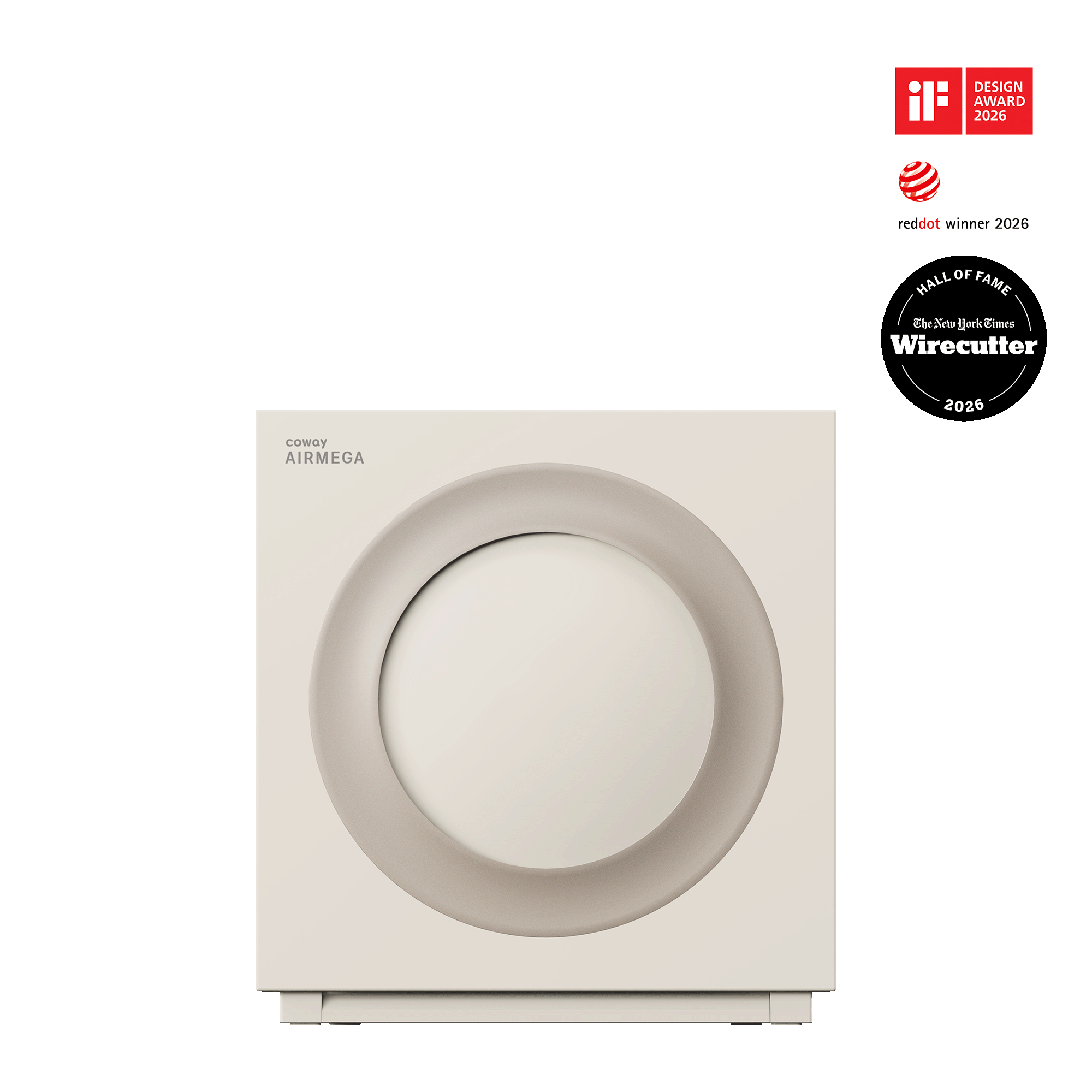
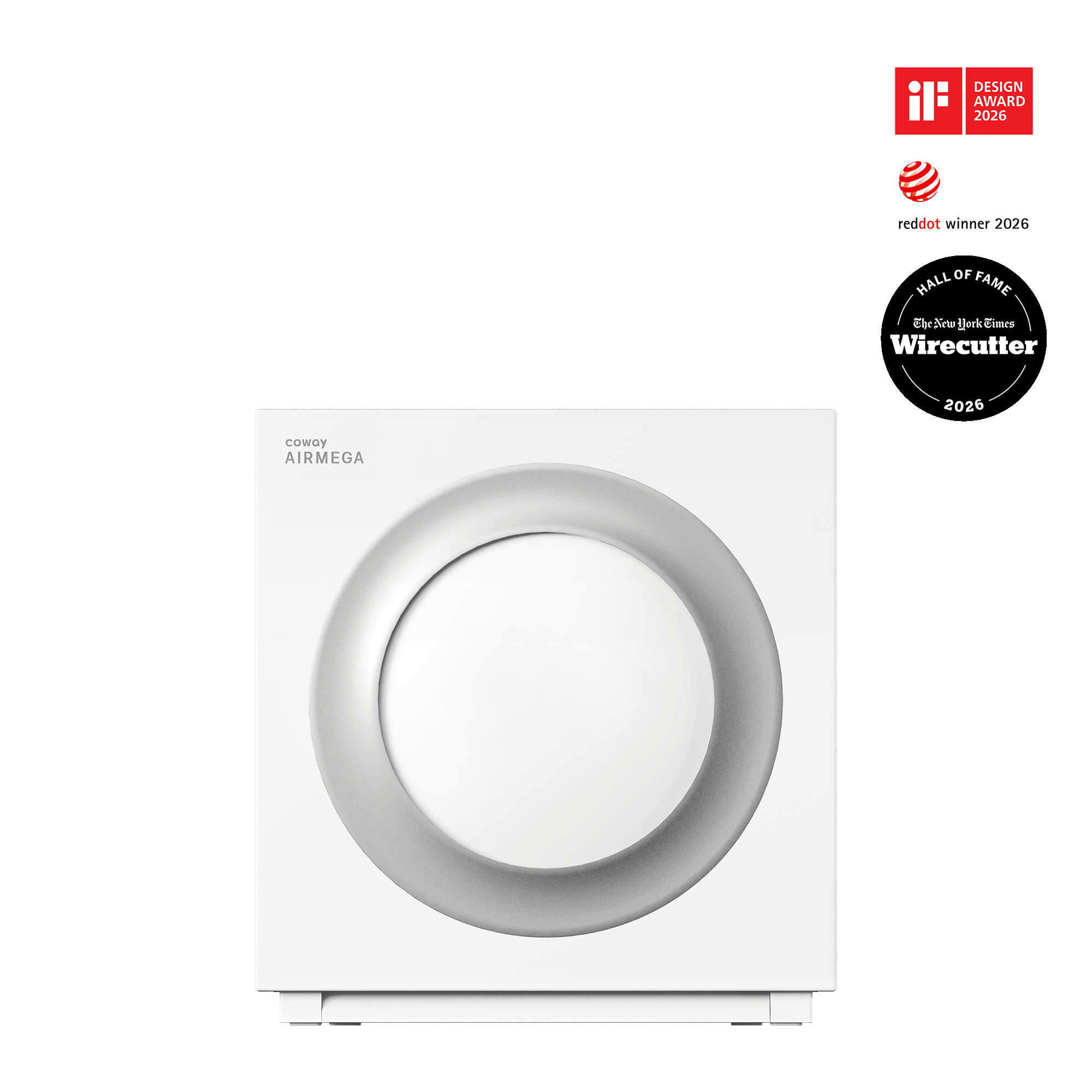
Explore this need in the finder →The Coway Airmega Mighty2 is the AP-1512N, a medium-room purifier for someone who wants automatic fan response, direct controls and a live particle number on the appliance itself. It is a different machine from the older Airmega Mighty AP-1512HH: the Mighty2 changes the display, modes and filter-care instructions, so do not use an older Mighty manual or replacement schedule to plan this one.
Read the room rating at the right cleaning rate
Coway's page headlines 1,800 square feet at one air change per hour. That is a slow turnover and should not be used as a fast-cleaning bedroom or living-room limit. The exact AP-1512N manual lists 450 square feet in 15 minutes, 900 in 30 minutes and 1,800 in 60 minutes, assuming an eight-foot ceiling. Fifteen minutes corresponds to four air changes per hour; scaling that stated figure to this site's 4.8-ACH comparison gives 375 square feet: 450 × 4 ÷ 4.8. This is calculated, not Coway-labeled or independently tested. It clears a modest medium-room threshold, but not the larger 606-square-foot tier. A high ceiling, open plan, blocked intake or quiet setting all reduce the comfort of relying on a headline area.
Coway also lists separate CADR figures for smoke, dust and pollen: 240, 242 and 249. The page labels them as pollutant-specific clean-air-delivery values but supplies no unit beside them. I have not turned one of those into a generic CADR, so the Mighty2 should not satisfy a hard minimum-CFM choice based on a guess. Those listed values are not proof of a room result at every speed.
A useful number, but only for particles
The manual describes a laser particle sensor and an on-unit display that cycles through PM1.0, PM2.5 and PM10 readings. That is more informative than the color-only feedback on the older AP-1512HH, and helps if you want to see the particle category the purifier is reacting to without opening an app. A PM reading does not identify a particular source, measure every particle equally or report a gas concentration. Coway's general copy mentions odors and VOCs, and the replaceable filter includes activated carbon, but neither makes the numeric display a TVOC sensor.
Smart/Auto adjusts fan levels in response to sensed air quality. The manual also documents three manual speeds, Sleep, Turbo and Eco within Smart mode. Sleep runs at the lowest airflow with display lighting off; in Smart mode the light sensor can enter Sleep after the room is dark for three minutes and return to the previous setting after it brightens. Eco is not a steady low speed: after the sensed condition stays Good for ten minutes the fan stops, restarts when pollution is detected, and also wakes after thirty minutes before checking again. If you require continuous airflow or want to choose the fan level yourself, use a manual setting rather than assuming Auto/Eco will run continuously. You can adjust sensor sensitivity, dim or switch off the display, set a one-to-twelve-hour shutoff timer, and lock the panel locally.
Make its maintenance routine realistic
The physical layout is familiar but the maintenance guidance is not identical to every older Mighty. The manual directs owners to slide the pre-filter out to the right every two to four weeks and vacuum or wipe it with a dry cloth; it also advises unplugging first and resetting the indicator afterward. Coway's product-page summary calls the pre-filter washable, but the detailed model manual gives a dry-cleaning method and no washing procedure. Follow the manual rather than assuming that rinsing is permitted. The right-side slide-out is convenient for service but needs space beside the purifier when you clean it.
The installed MAX2 assembly combines HEPA media and activated carbon; the manual recommends replacing it at twelve months, says not to wash it and notes that pollution load may shorten service life. Coway separately sells three Mighty2 filter choices—Fresh Starter+ for everyday pet dander, Allergen+ for pollen and Intense Smoke+ for smoke. These are alternative replacement accessories, not three filters included in the standard purifier box. The accessory listing gives a six-to-twelve-month interval for its custom and HEPA filter components, so treat the exact replacement schedule as dependent on the chosen set and actual use. There is no separately scheduled deodorization cartridge and HEPA cartridge in the manual's basic MAX2 assembly.
Who should shortlist it—and who should not
Shortlist the Mighty2 when your closed room fits the roughly 375-square-foot 4.8-ACH comparison, you want local Auto plus manual override, and the on-unit particle numbers are valuable. The white and beige offer records map to the AP-1512N family: Coway's current Shopify record lists white SKU 826439001629 and beige SKU 826439001643. Check that exact code and the replacement-filter family on a listing; the AP-1512HH and Airmega 200M are separate observed models even when a filter listing mentions cross-compatibility.
Skip it as a confident match if the room needs the large tier, a hard generic CFM floor, gas/TVOC sensing, remote app control, or a guaranteed washable pre-filter. The page and manual document local controls and particle readings, not an app-pairing path or a gas sensor. Coway lists a 16.9 × 9.3 × 17.9-inch body and 15.2-pound weight, with 56 W rated power and a 19–50 dB noise range on the product page. Those are manufacturer specifications, not independent acoustic or energy measurements; the manual also asks owners not to block airflow but provides no numeric furniture clearance that would make a tight recess automatically safe. Choose a larger verified room plan for an open living area, and compare the older AP-1512HH only if its different display and maintenance routine suit you better.
Primary references: Coway's Airmega Mighty2 U.S. product page, the linked AP-1512N manual, and Coway's Mighty2 replacement-filter listing.
Key details at a glance
| Room area at 4.8 ACH (stated or calculated) | 375 sq ft |
|---|---|
| Published room area at 1 air change per hour | 1800 sq ft |
| Room area at 2 ACH (stated or calculated) | 900 sq ft |
| Published rated input power | 56 W |
| App control | No |
| Body width | 16.9 in |
| Body depth | 9.3 in |
| Body height | 17.9 in |
| Published product weight | 15.2 lb |
| On-unit numeric PM2.5 display | Yes |
| Included Pet Allergy Filter with ARC Formula | No |
| On-unit lock for accidental control changes | Yes |
| Turbo fan setting | Yes |
| Automatic pre-filter scraper and dust tray | No |
| Separate TVOC sensor | No |
| Manufacturer filter-check/replacement guidance | Manual recommends MAX2 replacement at 12 months subject to conditions; the custom-filter accessory page gives 6–12 months for its separate filter components. |
| Important specification note | A single 4.8-ACH comparison value is calculated from the manual’s 450-ft²/15-minute (4-ACH) figure. One-change 1,800-ft² headline is not the fast room rating. Pollutant CADR values are listed without a stated unit, so generic CFM is unknown. Pre-filter page/manual washability discrepancy remains. |
| Placement and care | The pre-filter is a frequent 2–4-week dry-clean routine by the detailed manual; the MAX2 replacement has a separate use-dependent replacement reminder. Leave space beside the right-hand rail for pre-filter removal and avoid blocked air paths. |
Use the exact model’s instructions for operating limits, supplied equipment and version differences.
Sources for this assessment
- Exact Coway U.S. Airmega Mighty2 AP-1512N product page
- Official Shopify Airmega Mighty2 offer record
- Coway exact AP-1512N user manual
- Coway-linked Airmega Mighty2 four-page one-sheet PDF
- Coway separate Mighty2 replacement-filter page
- Coway Shopify Mighty2 replacement-filter variants
- Targeted SaferProducts exact-model query
- Exact white Airmega Mighty2 offer render
- Exact beige Airmega Mighty2 offer render


Check the room rating against your actual space.
Compare room-area figures at 4.8 air changes per hour, then check their stated or calculated basis, placement and filter care.