
Your needs, this model
Does it fit your priorities?
Is the unqualified 203-square-foot room claim enough if it has no ACH basis?
The U.S. product page gives up to 203 sq ft without a 1-, 2- or 4.8-ACH basis; use it only if you accept that limitation.
Explore this need in the finder →Does the HJ10 meet a minimum published CADR of 131 CFM?
Dyson’s U.S. launch article separately states 131 CFM; the 203-sq-ft claim is not its CADR.
Explore this need in the finder →Must a 4.8-ACH room area be documented?
If yes, the HJ10 does not meet the requirement because its current U.S. sources do not give a 4.8-ACH area.
Explore this need in the finder →Do you need app access while keeping the ability to operate the purifier at the unit?
HJ10 offers MyDyson app control, but the manual also documents physical buttons for local operation.
Explore this need in the finder →Must the unit display numerical particle information rather than only a color indicator?
The exact HJ10 guide describes PM2.5 and PM10 readings in the unit information menu.
Explore this need in the finder →Is a 9.5-inch maximum body width enough?
Dyson lists the body at 9 inches wide and the outlet diameter at 9.06 inches; a narrower 8.5-inch limit is not met.
Explore this need in the finder →Would you reject a purifier if its strict A-weighted maximum is unknown?
The product page lists 41 dB maximum without weighting; the maximum dB(A) value is therefore unknown.
Explore this need in the finder →Would a dedicated named Pet Allergy Filter be essential?
The HJ10 has a general activated-carbon stage advertised for pet odor, but no named Pet Allergy Filter or Pet Mode is listed.
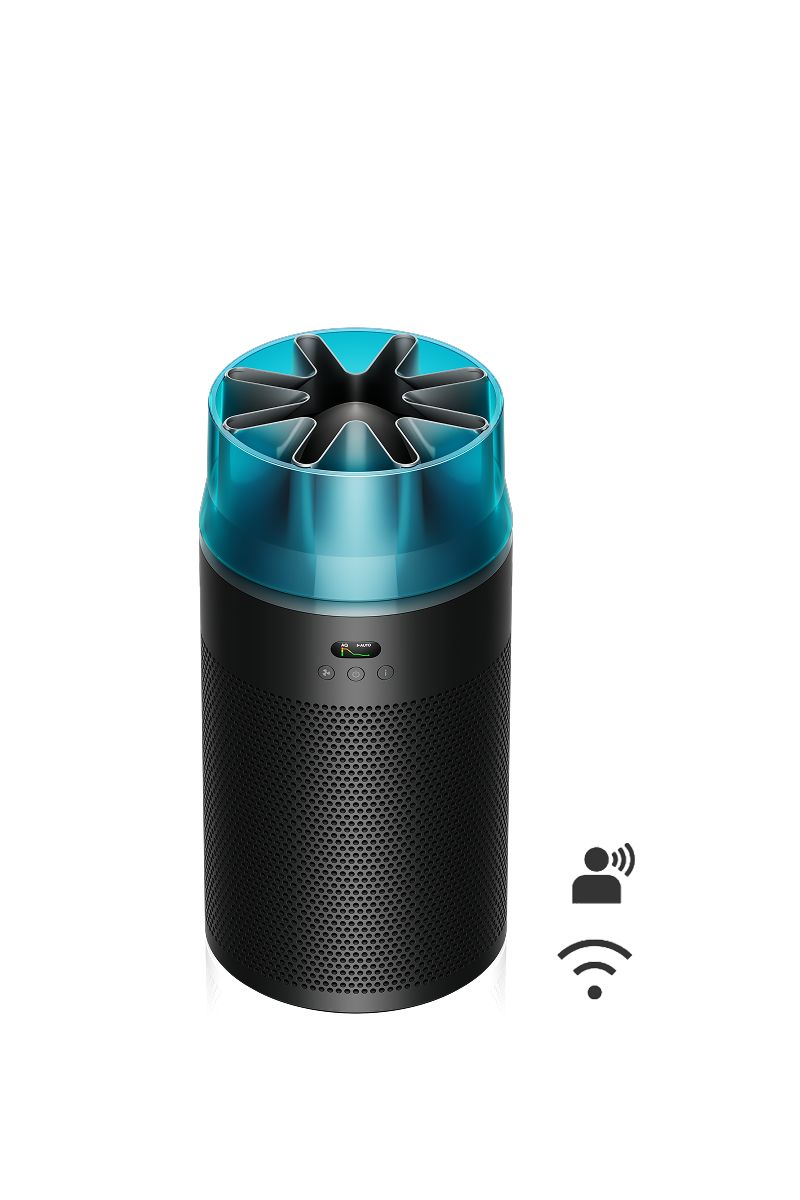
Explore this need in the finder →The HJ10 is a small, dedicated room purifier built around a distinctive star-shaped outlet rather than a purifier-and-cooling-fan combination. Its strongest case is a bedroom, desk area, or other room where a compact body, particle-responsive Auto mode, and a quieter sleep setting matter more than a high-throughput room rating. The Black/Teal and White/Silver listings are finish choices within the same HJ10 function, not different purifier capacities.
First check the room-size basis
Dyson's U.S. product page says the HJ10 cleans a room up to 203 square feet, but it does not identify an air-changes-per-hour basis for that size. Dyson's U.S. launch article separately states a CADR of 131 cubic feet per minute. Those are not interchangeable figures: the 203-square-foot headline is not proof of a 4.8-ACH room rating, and the CADR is more useful when compared with other purifiers using the same test and room assumptions. If repeated, faster cleaning is essential for smoke, pets, or a larger space, do not infer an ACH result from the area headline. Prefer a model with a clearly stated rating at the air-change rate you need. (Dyson U.S. HJ10 product page; Dyson U.S. launch specifications.)
What the HushJet design changes
The cylindrical body pulls room air through its filter assembly and sends the cleaned stream upward through a removable, star-shaped nozzle. Dyson says the nozzle concentrates the outlet flow and reduces turbulence; that is a plausible design distinction, but the practical choice is still to give the intake and outlet room and to judge the purifier by its published cleaning figures, not by a claim that a jet carries clean air to every corner. The product page lists 90-degree oscillation and a 9.06-inch outlet diameter. This is not a Dyson purifier fan for cooling, and it does not add heating or humidification. The nozzle moves purified air; it is not a substitute for a cooling appliance. (Dyson U.S. product details.)
Two filter jobs, with different limits
Dyson lists a 360-degree electrostatic filter and a separate 360-degree activated-carbon gas-and-odor filter in the HJ10 box. The electrostatic stage is advertised to capture 99.97 percent of particles as small as 0.3 microns; the U.S. page calls it electrostatic, while the regional HJ10 manual labels its particle filter “HEPA.” Neither source establishes an H13 grade for this model, so an H13 requirement is a reason to look elsewhere. Dyson describes the carbon stage as reducing pet and cooking odors and gases such as nitrogen dioxide, while warning that gas capture can vary. A carbon filter is not a gas sensor, and it cannot remove the pollution source itself. (Dyson U.S. filter claims; Dyson replacement-filter compatibility.)
The electrostatic filter is advertised for up to five years, but that figure is conditional: Dyson's test note is based on 12 hours of daily use to a 50-percent CADR decline and says actual life varies with pollution. It is not a five-year guarantee. The HJ10's display reports filter life, and the manufacturer directs owners to replace the media when prompted. The manual's service steps require unplugging the unit, lifting off the purifier body, replacing the filter stage, and resetting its counter. This is more convenient than a monthly wash-and-dry routine, but both filter types are proprietary replacements; check current availability and compatibility before buying.
Automatic sensing and useful controls
Auto mode responds to particles including PM2.5. The front display can show air-quality information, PM2.5 and PM10 readings, filter life, and Wi-Fi status according to the HJ10 user guide. Physical buttons allow local operation; the MyDyson app adds remote control, scheduling, and finer one-to-ten airflow settings. Sleep mode keeps the purifier running at a lower flow with a dimmed screen. Dyson lists 24 dB in Sleep mode and 41 dB at maximum on the U.S. product page, but it does not state the weighting there. A separate launch article calls the night-mode value 24 dBA. Treat them as manufacturer-listed claims, not an independent sound test, and do not use the maximum as a strict dB(A) comparison unless Dyson clarifies the measurement basis. (Dyson HJ10 user guide (regional edition); Dyson U.S. product details; Dyson launch specifications.) The linked guide is a regional manual; use Dyson's current U.S. documentation for electrical requirements.
Size, setup, and who should pass
Dyson gives the body as 9 inches wide and 18.5 inches high on the U.S. product page, while the U.S. launch article lists a 17.7-inch height and 9-by-9-inch footprint; the sources do not agree on height. The listed weight also differs slightly. Measure your intended spot, but treat strict height or weight limits as unresolved until Dyson confirms which specification applies. At roughly nine inches across, it is more compact than many tower-style purifier-fans, yet its small footprint does not make it a strong fit for an oversized room.
Choose the HJ10 if the 203-square-foot claim is acceptable for your use, you want particle-responsive Auto mode plus local buttons, and you value a compact dedicated purifier with a sleep setting. Consider another model if you need a verified 4.8-ACH area, a known dB(A) maximum, an integrated cooling fan, heat, humidification, or a filter class explicitly stated as HEPA H13. The black/teal or white/silver finish changes the look, not the operating plan. Review the room rating first, then confirm that the available carbon and electrostatic replacements suit your ongoing maintenance budget.
Key details at a glance
| Clean air delivery rate (CADR) | 131 CFM |
|---|---|
| App control | Yes |
| Body width | 9 in |
| On-unit numeric PM2.5 display | Yes |
| Included Pet Allergy Filter with ARC Formula | No |
| Manufacturer filter-check/replacement guidance | No U.S. replacement interval for carbon is retained. Electrostatic up-to-five-year performance claim is conditional, not a guarantee. |
| Placement and care | Use Auto or local controls; read current U.S. manual for setup/electrical details. Wipe the body, keep sensor inlets clear, unplug before cleaning, and remove/wash the nozzle only as described in the HJ10 user guide. |
| Built-in bipolar ionizer | No |
| Local ionizer on/off control | No |
| Purifier also has a documented circulation-fan function | No |
| Built-in heating mode | No |
| Fan-driven cooling mode | No |
| Cooling mode is air conditioning | No |
| App can activate and set heating | No |
| Built-in humidification mode | No |
| Unqualified manufacturer room-size claim (no ACH basis) | 203 sq ft |
Use the exact model’s instructions for operating limits, supplied equipment and version differences.
Sources for this assessment
- Dyson U.S. HushJet Purifier Compact HJ10 (Black/Teal)
- Dyson U.S. HushJet Purifier Compact HJ10 (White/Silver)
- Dyson U.S. air purifier category and featured models
- Official Dyson HJ10 user guide (ANZ regional edition)
- Dyson U.S. HushJet Purifier Compact launch specifications
- Dyson U.S. purifier replacement-filter compatibility
- Dyson original HJ10 Black/Teal product render
- Dyson original HJ10 White/Silver product render


Check the room rating against your actual space.
Compare room-area figures at 4.8 air changes per hour, then check their stated or calculated basis, placement and filter care.