
Your needs, this model
Does it fit your priorities?
Would Dyson’s up-to-1,000-square-foot claim be enough if it has no ACH basis?
The official U.S. launch story gives an up-to-1,000-sq-ft claim but no air-change rate. BP04 meets only an unqualified area threshold, not a 1-, 2- or 4.8-ACH requirement.
Explore this need in the finder →Must the purifier have a documented room-area figure at 4.8 air changes per hour?
No 4.8-ACH area is published for BP04 in the reviewed U.S. sources. If that rate is essential, do not use its 1,000-sq-ft launch headline as a substitute.
Explore this need in the finder →Do you want the purifier itself to direct air as a room-circulation fan?
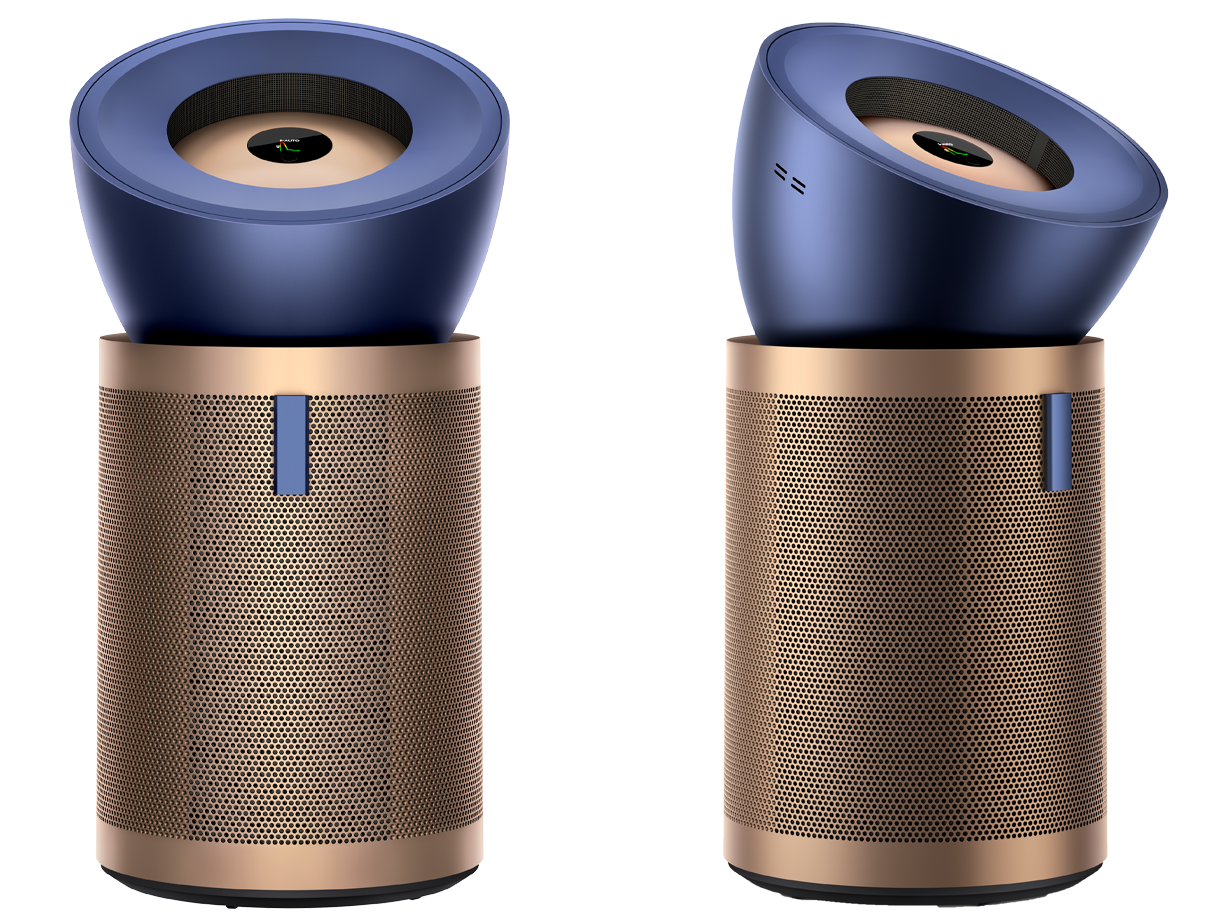
BP04 is both a purifier and a fan; its cone airflow can be aimed at 0, 25 or 50 degrees. It moves air but is not air conditioning.
Explore this need in the finder →Is a separate adjustable fan in the exact offer essential in addition to the purifier?
This BP04 package is one purifier, filters and remote, not a separate fan appliance. Do not choose it if a second fan is required.
Explore this need in the finder →Do you require app control while retaining physical/local operation?
The exact guide supports MyDyson app control and a magnetic remote; the machine also has an on-unit standby/power control and LCD.
Explore this need in the finder →Must the purifier show a numeric PM2.5 reading at the unit?
The linked U.S. guide documents PM2.5 and PM10 information on the LCD menu; it is a local reading, not a room-wide guarantee.
Explore this need in the finder →Would a documented CO2 monitor and ventilation alert change your choice?
BP04 has a named CO2 sensor and alert. That feature tells you when to ventilate; filtration does not remove indoor CO2.
Explore this need in the finder →Is a separate TVOC sensor essential?
BP04 documentation names PM, NO2, formaldehyde and CO2 sensing, but a separate total-VOC sensor is not established. If strict TVOC is essential, treat BP04 as unconfirmed.
Explore this need in the finder →Can the roughly 17.1-inch wide BP04 fit a maximum body width of 18 inches?
Dyson lists body width at 17.09 inches; separately leave room for the outlet and the manual’s placement margin.
Explore this need in the finder →Would built-in wheels help move the purifier across a hard floor?
The manual describes hidden wheels for easier movement on hard floors; the 26.24-pound appliance is still large to carry.
Explore this need in the finder →The Dyson Purifier Big+Quiet Formaldehyde BP04 is a floor-standing purifier with a fan function, not a compact filter cylinder. Its unusually long-range outlet, several gas sensors, and formaldehyde-focused filter stage make it a distinctive fit for a large open living area where occupants also want moving air. The tradeoff is that the manufacturer’s large-room headline is not an air-changes-per-hour rating, and the machine needs substantial open floor space. Its scale and sensor suite only make sense if those features solve a real room problem.
Large-space claims need a careful reading
Dyson’s U.S. launch article says the Big+Quiet range was designed for spaces up to 1,000 square feet and projects purified air more than 32 feet. The current BP04 product page repeats the long projection claim, but the sources do not state a CADR or a 1-, 2-, or 4.8-air-changes-per-hour area for that room-size headline. Projection distance and area are not the same as the number of times a room’s air passes through a purifier. If your essential requirement is a verified fast air-change rate, treat those large-space claims as unqualified rather than translating them into an ACH figure. A rate-specific purifier may be easier to compare for a bedroom or a smaller enclosed room. (Dyson U.S. BP04 product page; Dyson range launch article.)
What the BP04 adds beyond a particle-only purifier
BP04 combines an H13-grade HEPA filter, a potassium-carbonate-impregnated K-Carbon filter, and a permanent selective catalytic oxidation stage. Dyson says the K-Carbon stage adsorbs three times more nitrogen dioxide than its standard carbon filter, while the catalytic stage destroys formaldehyde. Those are manufacturer claims, not independent room measurements, and carbon filtration is not a substitute for removing the source of smoke, fuel exhaust, or household chemicals. The formaldehyde monitor reports a detected pollutant; it does not guarantee that every furnishing-related emission has been eliminated. BP04’s CO₂ sensor is a different kind of feature: it can alert you when ventilation is needed, but the purifier does not remove CO₂ or supply outdoor air. (BP04 filtration and sensor details.)
A purifier that also moves air
The cone-shaped outlet can direct air at 0, 25, or 50 degrees, and Dyson describes a Breeze mode. That makes BP04 a purifier with a circulation-fan function, unlike the dedicated HushJet Compact HJ10. It may be useful when you want cleaned air projected across a room and a fan-like breeze in warmer weather. It is not an air conditioner: it moves room air but does not refrigerate it. Nor is the separate fan included in some bundle offers; this exact BP04 package is one purifier with its filters and magnetic remote, not a second appliance. Think about where the stream will point before choosing a floor location. (BP04 product details; BP02/BP03/BP04 U.S. user guide.)
Monitoring and control are part of the purchase
The product page identifies particle, nitrogen-dioxide, formaldehyde, and carbon-dioxide sensing. Its LCD and MyDyson app present pollutant and room information; Auto mode responds to sensed pollution. The manual also documents the remote and app for changing airflow direction, Auto operation, Night mode and sleep-timer settings. App control supports reports and schedules, while the manual describes setup and control through a phone and connected home services. The screen’s CO₂ information is most useful as a prompt to ventilate. It should not be read as a purifier removing a gas that HEPA media is designed to capture as particles. Dyson’s page does not establish a separate numeric TVOC sensor for BP04, so choose a model with that exact measurement if it is essential. (Dyson BP04 support and replacement-filter page; Dyson U.S. user guide.)
Measure the footprint and plan filter care
Dyson lists a body about 32.7 inches high, 17.1 inches wide, and 16.3 inches deep, with weight listed at 26.24 pounds. Hidden wheels are designed for moving it across hard floors, not carrying it up stairs. The manual recommends placing it level near a room edge with 3.5 feet from the wall and directing its outlet along a wall or diagonally across the room. A separate product-page FAQ says at least three feet from a wall, so treat the clearance as a placement recommendation with a source difference, not a precision fit specification. This machine takes more space than a small tower purifier; confirm both its body and the outlet path will fit your room. (U.S. user guide; BP04 specifications and FAQ.)
The included filters are not all maintained on the same timetable. Dyson’s exact support page lists a replaceable HEPA filter and K-Carbon replacement, while the SCO stage is described as permanent. Official HEPA-life guidance conflicts: the current product FAQ says up to 11 years, the support replacement page recommends five years, and the launch material gives 2.5 years under continuous highest-speed use. The K-Carbon stage is listed for replacement every two years. Rather than budget on one favorable longevity figure, check the machine’s own filter alerts and confirm the replacement recommendation for your use. Filter changes are physical tasks, but the manual gives separate steps for HEPA and carbon and tells owners to reset each filter-life counter.
Who should choose it—and who should compare alternatives
BP04 is most compelling if you want a large-format purifier that also circulates air, value a formaldehyde and NO₂ sensor/filtration combination, and will use its app, remote, or display. It is less convincing when the priority is a documented ACH rating, CADR comparison, small footprint, or a strict sound ceiling: current household sources do not provide a CADR, a rate-specific room-area figure, or a directly comparable maximum dB(A). For room-rate fit, compare the Coway Airmega ProX, whose review discusses its stated 2-ACH area, or the Blueair Classic Pro CP7i, whose review covers its direct 4.8-ACH claim. For a smaller dedicated purifier without a fan function, compare the Dyson HushJet HJ10. BP04’s feature list is unusually broad, but its large unqualified room headline should not decide the purchase by itself.
Key details at a glance
| App control | Yes |
|---|---|
| Body width | 17.09 in |
| Body depth | 16.34 in |
| Body height | 32.68 in |
| Published product weight | 26.24 lb |
| On-unit numeric PM2.5 display | Yes |
| Included Pet Allergy Filter with ARC Formula | No |
| Manufacturer filter-check/replacement guidance | Check the app and machine filter-life prompts and verify the conflicting HEPA replacement guidance; K-Carbon is listed at two years. |
| Placement and care | Keep the sensor inlets and cone free of dust, wipe with a damp lint-free cloth, use a soft brush where the guide directs, and do not use detergents or polishes. Replace HEPA and carbon separately and reset each counter. |
| Purifier also has a documented circulation-fan function | Yes |
| Built-in heating mode | No |
| Fan-driven cooling mode | Yes |
| Cooling mode is air conditioning | No |
| App can activate and set heating | No |
| Built-in humidification mode | No |
| Separate adjustable fan in exact offer | No |
| Separate appliances in box | 1 |
| Unqualified manufacturer room-size claim (no ACH basis) | 1000 sq ft |
Use the exact model’s instructions for operating limits, supplied equipment and version differences.
Sources for this assessment
- Dyson U.S. Purifier Big+Quiet Formaldehyde BP04, Prussian Blue/Gold
- Dyson U.S. support page for Purifier Big+Quiet Formaldehyde BP04
- Dyson U.S. BP02/BP03/BP04 Big+Quiet purifier user guide 394809-01
- Dyson U.S. introduction of the Purifier Big+Quiet range
- Dyson BP04 Prussian Blue/Gold exact product image

Check the room rating against your actual space.
Compare room-area figures at 4.8 air changes per hour, then check their stated or calculated basis, placement and filter care.