
On this page
Your needs, this model
Does it fit your priorities?
Is 837 sq ft at 4.8 ACH enough?
Yes, at 4.8 ACH; the distinct 4,050-sq-ft claim is only at 1 ACH.
Explore this need in the finder →Do you require particle-responsive Auto and a numeric PM display?
The manual identifies PM2.5 responsive Auto and a numeric AQI/particle readout.
Explore this need in the finder →Must app control be available?
No app is documented for AP6100; local controls are confirmed.
Explore this need in the finder →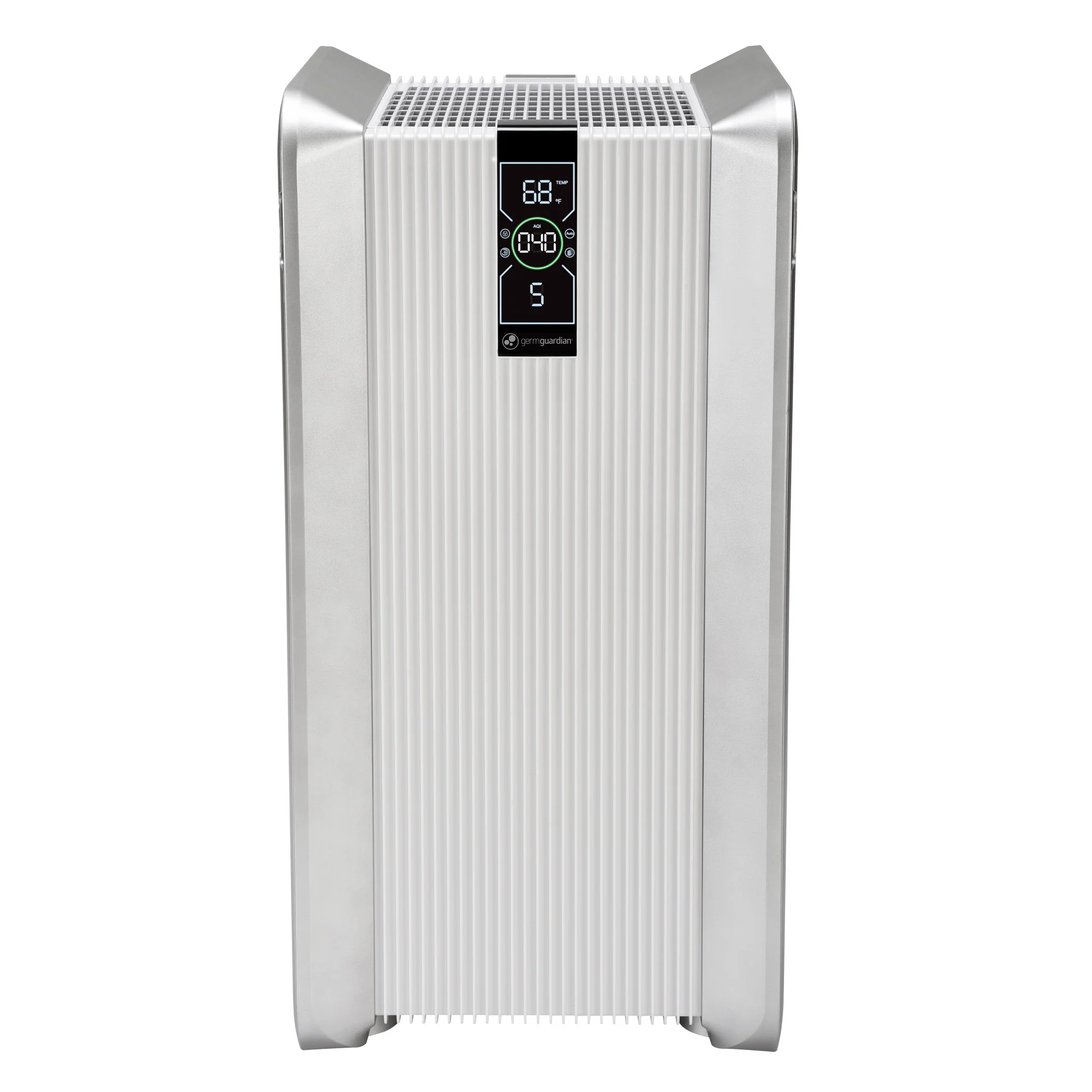
Image source and model notes
The GermGuardian AP6100 PRO is the high-throughput, wheeled console for a large room where moving a substantial purifier is acceptable. Guardian publishes 837 square feet at 4.8 air changes per hour and 4,050 square feet at one air change per hour. Those are not competing estimates of one practical room size: the faster 4.8-ACH figure is the more useful basis when you want repeated circulation. The manual confirms the 120-volt supply, 120-watt rating, 30.5-inch height, 15.3-inch width, 17.7-inch depth and 37.1-pound weight. Wheels make repositioning easier; they do not make it a lightweight portable device.
Three operating layers, dual-side service
The product page describes two washable pre-filter screens, two granulated charcoal filters and two HEPA filters. The manual’s diagrams show filter access on both sides. That gives the AP6100 a larger service job than a one-cartridge tower: check both sides, keep the washable screens clean and replace the non-washable carbon and HEPA elements as directed. Guardian says the filter indicator comes on at six months and recommends replacement every six to eight months depending on use and conditions. Treat that as a reminder and an approximate interval, not a guaranteed life. The product page calls the arrangement “4-stage,” but its descriptive text and the manual describe a three-layer combination. I describe the actual layers rather than repeating the disputed stage count.
Controls are local and comparatively clear. The manual documents five fan speeds, Auto operation based on sensed particulate matter, an AQI reading and color indicator, a temperature display, Child Lock and Night Mode. The AQI screen presents a number on an EPA-style scale and a green/yellow/red status. A separate Sleep Mode combination lowers the fan and turns off most lights. That is useful if the unit will run in a bedroom, but there is no confirmed app-control path in the exact manual or captured manufacturer specification. Someone who wants remote scheduling or app access should shortlist a different model rather than infer it from the air-quality display.
The manual’s Auto response is based on air quality in the room; it is not a time-based shutoff timer. The available control diagram and operating instructions do not identify a timed stop feature. I therefore do not treat Auto as a timer or promise one. Maximum noise is listed by the manufacturer at 54 dBA, but a captured low-noise field reads zero and is not a meaningful acoustic specification. The low-speed number remains unknown here. In a sleeping room, use the documented Night/Sleep modes but do not rely on an unsupported minimum dBA figure.
Compare by the rate you need
If an essential room threshold is 750 square feet at 4.8 ACH, the AP6100’s published 837-square-foot figure clears it. If a threshold is above 837 square feet, the 4,050-square-foot one-change headline does not rescue the faster-rate requirement. The AP3250 is much smaller and adds app control, but its 348-square-foot repeated-air-change claim is less than half the AP6100’s. The CDAP5500 is a slim tower with switchable UV-C and a timer, but its 171-square-foot 4.8-ACH claim suits a far smaller room. These are real differences in area and operation rather than a simple overall ranking.
Choose the AP6100 when the room-rate claim and on-unit particulate readout justify a 37-pound footprint and dual-side filter maintenance. Skip it if a quiet numeric specification, app control, a small footprint, or a confirmed 4.8-ACH figure above 837 square feet is essential. The manual identifies no UV-C stage, so do not select it for a UV-C requirement. It comes with a one-year limited warranty according to the exact manual. The product page and manual are a stronger buying basis than the loose “4-stage” title because they explain what is actually inside and how the filter reminders work.
Make space and noise tradeoffs explicit
The AP6100 is a large, roughly 37-pound wheeled console, so its casters help with room-to-room repositioning but do not make it a small bedroom unit. The reviewed page lists up to 120 watts and a maximum noise figure of 54 dBA; the quietest setting's noise is not established here. If your priority is a compact bedside purifier or a known quiet minimum, do not infer that from its high room rating. Compare the AP3250 for a smaller, connected 348-square-foot 4.8-ACH claim, or choose another model only after checking the capacity and sound level that matter in your room.
Sources: Guardian Technologies’ AP6100 product page, official offer record and AP6100 use-and-care manual (Model AP6100, REV0322, especially pp. 4–7). Area, CADR and noise are manufacturer claims, not independent tests.
Key details at a glance
| Room area at 4.8 ACH (stated or calculated) | 837 sq ft |
|---|---|
| Published room area at 1 air change per hour | 4050 sq ft |
| Clean air delivery rate (CADR) | 540 CFM |
| Published rated input power | 120 W |
| App control | No |
| Body width | 15.3 in |
More specifications and setup details
| Body depth | 17.7 in |
|---|---|
| Body height | 30.5 in |
| Published product weight | 37.1 lb |
| On-unit numeric PM2.5 display | Yes |
| Direct wall-outlet plug-in form | No |
| Separate units in the exact offer | 1 |
| Separately switchable UV-C lamp | No |
Use the exact model’s instructions for operating limits, supplied equipment and version differences.
Sources for this assessment

Check the room rating against your actual space.
Compare room-area figures at 4.8 air changes per hour, then check their stated or calculated basis, placement and filter care.