
Your needs, this model
Does it fit your priorities?
Does the HFD360 meet a small-room 4.8-ACH minimum while staying below the medium-room tier?
Honeywell lists 260 sq ft at 4.8 ACH, above the 219-sq-ft small tier but below the 358-sq-ft medium threshold.
Explore this need in the finder →Do I need automatic fan adjustment from a VOC sensor, rather than a particle sensor?
The HFD360 manual describes VOC sensing with green/amber/red status and changes among fan levels. No PM2.5 particle sensor is established; this is gas/VOC response only.
Explore this need in the finder →Can I use the HFD360 without relying on a currently supported phone app?
Honeywell’s current product page and support page say the HFD360 is no longer connected. Its physical controls remain; a current app-control requirement is not supported by the manufacturer’s present guidance.
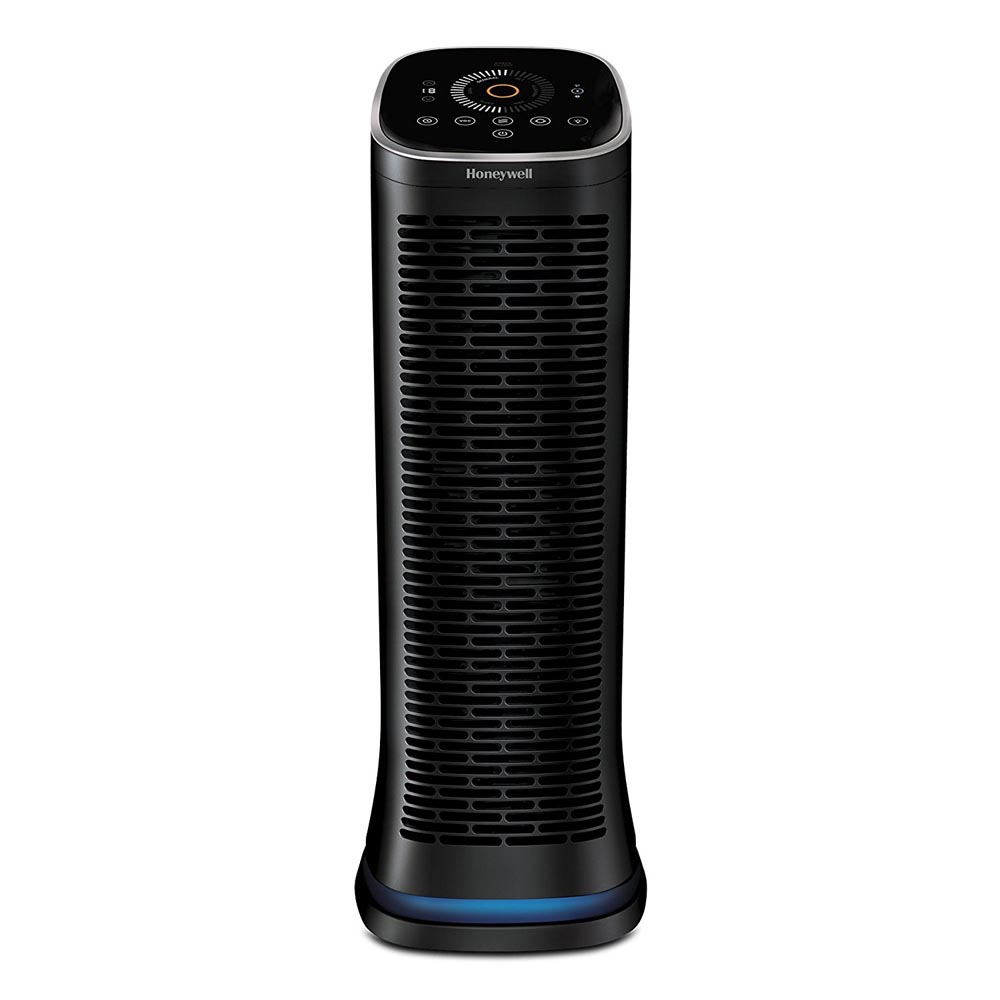
Explore this need in the finder →The Honeywell Air Genius 6 HFD360 is the most feature-heavy earlier member of this Air Genius group, but its distinctive automatic mode watches for volatile organic compounds (VOCs), not PM2.5 particles. It is rated for 260 square feet at 4.8 air changes per hour, has six manual cleaning levels, oscillation and a VOC-sensing Auto choice. Honeywell now explicitly lists the exact HFD360B as discontinued, and its current product/support pages say the unit is no longer connected. This remains useful for an owner or used-model comparison, not a current buying recommendation or a route to supported app control.
Room-size rating and automatic sensing are different questions
Honeywell’s exact HFD360 page gives 260 square feet at 4.8 ACH, based on smoke CADR at the highest level. The “1268Ft²” text in the title is not the 4.8-ACH room figure; the specification paragraph makes that distinction clear. The maker also cautions that actual circulation depends on room layout and does not guarantee that all room air passes through the unit. In a repeated-cleaning comparison, 260 square feet clears the small tier but not the 358-square-foot medium tier.
The control panel has Max, Allergen, Pet, General, Germ and Sleep settings. Separately, VOC Auto adjusts among low, medium and high fan levels when its VOC sensor detects changes in the room. The green, amber and red indicator corresponds to that VOC mode; it is not a numeric particle display, and it should not be mistaken for an on-unit PM2.5 reading. The manual describes VOCs emitted by some cleaning, home-improvement and household-decor products. It does not establish a particle-sensing Auto mode or a separate PM2.5 sensor.
Connected status changed; local operation remains
The HFD360 manual from 2021 describes a smartphone application and includes Bluetooth controls. Honeywell’s current product page now states “This is no longer a connected device,” and the support page repeats that the HFD360 is no longer supported as a connected device. The current practical setup is its on-unit panel, not a phone schedule. A manual-only preference can therefore make sense, but anyone requiring an app should choose another model whose app support is currently documented.
The local timer can shut the purifier off after one to eighteen hours. A dimmer reduces the panel lighting and can turn most of it off, but the manual says the power and Bluetooth icons remain illuminated. The exact Honeywell Store page lists 9.97 × 9.92 × 26.81 inches (L × W × H) and 13.05 pounds; those are body measurements, not clearance. The power and Bluetooth symbol may still glow even though connectivity is no longer supported. No maximum dB(A) figure or rated wattage is established in the exact sources reviewed.
A filter routine with a required K stage
Unlike the HFD280, HFD300 and HFD320, the HFD360’s product details and manual describe an odor/VOC-reducing K pre-filter as part of the supplied arrangement, with the maker recommending that it stay in use. It sits ahead of the permanent washable ifD filter and is not washable; Honeywell recommends changing it about every three months. The ifD element should also be cleaned at roughly three-month intervals. Switch off the purifier, allow the manual’s waiting period before removing the rear grille, rinse the filter and let it dry completely before putting it back. Do not put it in a dishwasher or reinstall it damp.
The manufacturer says the ifD filter can capture up to 99.9 percent of listed particles 0.1 microns and larger from air that passes through it, when operated with the odor-reducing pre-filter. That is a pass-through filtration claim, not proof that every pollutant is removed from a room. The product page explicitly says it does not reduce or absorb carbon monoxide; it is not a substitute for safe appliance ventilation or source control. The manual describes an electronic ionizer stage and states that the product complies with the federal ozone-emissions limit and is ARB-certified. That compliance statement is manufacturer documentation, not independent exposure testing by this site.
When the HFD360 is worth considering
Use this information if you already own one or are comparing a used HFD360B and understand that the Store marks it discontinued. If your priority is a washable ifD filter and manual settings in a currently listed model, compare HFD300, HFD310 or HFD320; all three offer a washable pre-filter choice or optional K in the same slot. If you need a larger room, a numeric PM2.5 display, particle-responsive Auto or a currently supported phone schedule, the HFD360 does not meet that requirement on the evidence reviewed. It is an earlier odor-sensing tower with a recurring K-filter cost and a retired connected feature, not a smart app purifier with a generic particle sensor.
Sources: Honeywell HFD360 product page, Honeywell Store HFD360B exact listing, HFD360 Series owner’s manual, Honeywell air-purifier support page, and Honeywell Air Genius filter-care page. The manual predates Honeywell’s current connectivity status; this review distinguishes that older documentation from current support.
Key details at a glance
| Room area at 4.8 ACH (stated or calculated) | 260 sq ft |
|---|---|
| Clean air delivery rate (CADR) | 169 CFM |
| App control | No |
| Body width | 9.92 in |
| Body depth | 9.97 in |
| Body height | 26.81 in |
| Published product weight | 13.05 lb |
| On-unit numeric PM2.5 display | No |
| On-unit lock for accidental control changes | No |
| Turbo fan setting | No |
| Manufacturer filter-check/replacement guidance | Washable ifD media and washable pre-filter are checked/cleaned about every three months. Optional K pre-filter is not washable and should be replaced about every three months; more frequent care may be needed in a high-particle room. |
| Purifier also has a documented circulation-fan function | No |
| Built-in heating mode | No |
| Fan-driven cooling mode | No |
| Cooling mode is air conditioning | No |
| Built-in humidification mode | No |
| Separate adjustable fan in exact offer | No |
Use the exact model’s instructions for operating limits, supplied equipment and version differences.
Sources for this assessment
- Honeywell U.S. room air purifier directory page 2
- Air Genius 6 Tower Air Purifier w/ Permanent Washable Filter, HFD360
- HFD360 Series owner’s manual A003403R0 revision 7, dated 13 August 2021
- Exact manufacturer image candidate linked from Honeywell product-support page; bytes unavailable
- Honeywell Air Genius support and filter-care page
- CPSC narrow exact-name recall query for HFD360
- Honeywell Store exact U.S. product page for HFD360B
- AirGenius 6 Air Cleaner/Odor Reducer owner manual, HFD360 Series
Check the room rating against your actual space.
Compare room-area figures at 4.8 air changes per hour, then check their stated or calculated basis, placement and filter care.