
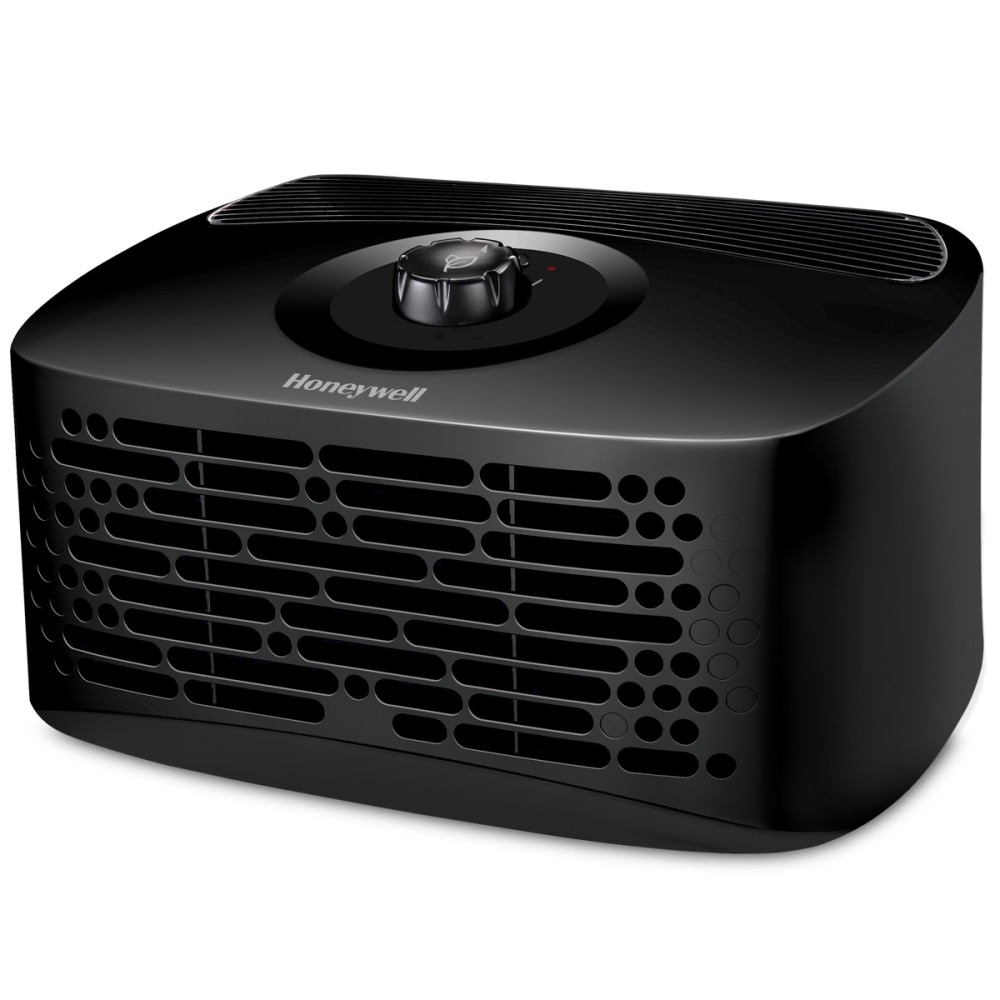
Your needs, this model
Does it fit your priorities?
Is a 90-sq-ft rating at 4.8 ACH enough for a small tabletop purifier, rather than a compact-room minimum?
Honeywell publishes 90 sq ft at 4.8 ACH. That meets the finder’s personal-room threshold but falls short of 140 sq ft; the separate 450-sq-ft figure is stated at 1 ACH and is not an equivalent repeated-cleaning rating. HPA020B is discontinued, so use this to identify an existing unit or specific offer, not as a stock promise.
Explore this need in the finder →Do you want a direct physical speed knob instead of app control or sensor-driven Auto?
The HPA020 manual shows a power knob for Low, Medium and High and an hour-based filter reminder. It does not document app control or a particle-sensor Auto mode.
Explore this need in the finder →Does a smoke CADR of 53 CFM meet your minimum without requiring a higher smoke figure?
The exact HPA020B Store page lists smoke CADR 53 CFM. It meets 53 and not 54; dust CADR 63 is a different pollutant figure.
Explore this need in the finder →The Honeywell HPA020 is a compact tabletop HEPA purifier for a genuinely small, enclosed space, not a smaller-bodied substitute for a full-room console. Honeywell gives it a 90-square-foot rating at 4.8 air changes per hour (ACH), plus a separate 450-square-foot figure at 1 ACH. Those are different cleaning rates: for a small bedroom or office where repeated air turnover matters, use the 90-square-foot number as the relevant comparison. The 450-square-foot statement is not evidence of the same cleaning intensity across a much larger room.
Read the room rating before the headline area
The manufacturer’s product title highlights 450 square feet, but the detailed product text makes the slower 1-ACH basis explicit. It also describes 90 square feet at 4.8 ACH, based on third-party CADR testing. That smaller number is the useful boundary for comparing this purifier with other models on a repeated-cleaning basis. A 90-square-foot room meets the documented 4.8-ACH claim; a 140-square-foot minimum does not. A large open-plan room, tall ceiling or space with open doorways should not be treated as though the title area were a guarantee for every layout.
Honeywell Store lists smoke CADR of 53 CFM, dust CADR of 63 and pollen CADR of 53. Keep the pollutants separate rather than substituting the larger dust number for smoke. If a smoke-CADR threshold is essential, the HPA020 meets 53 CFM but not 54. These are manufacturer-published test figures, not measurements made for this review and not a promise that all particles or gases in a room will be removed.
A small two-stage filter routine
The HPA020 uses one replaceable Type G HEPA filter and one Type A odor-reducing pre-filter. The pre-filter handles larger particles and helps reduce household odors; the HEPA stage is described for particles in the air that passes through it. The manual recommends checking conditions, with replacement guidance of about every three months for the pre-filter and every 12 months for the HEPA filter. Heavy dust, smoke or pet-hair loading can shorten useful life. The small electronic filter reminder is based on operating hours; it does not measure particle concentration. The filters are not washable.
Replacement media are a continuing ownership cost and availability deserves a check before buying an older unit. Honeywell lists Type G as the HEPA cartridge and Type A or A+ as the pre-filter family. A pack that contains two HEPA cartridges is not a two-unit purifier bundle. When servicing, switch off and unplug the unit, remove the wraps from new filters, and put the pre-filter and HEPA cartridge back in their labeled positions. The manual’s bottom-access arrangement means filter replacement involves turning the tabletop purifier upside down on a flat surface.
Simple direct controls, without sensing
The control is a physical power knob with Low, Medium and High settings, plus a filter-check/reset indicator. That simplicity suits someone who wants to choose a steady speed at the unit rather than create an account, pair an app or wait for an air-quality sensor to change the fan. The documented control set does not include sensor-driven Auto, a timer, a numeric PM2.5 reading, a VOC display or a dedicated Night mode. If automatic response or continuous air-quality feedback is essential, this is the wrong feature set.
Honeywell’s documents do not supply a numerical dB(A) sound range or a wattage figure for this exact model. Marketing descriptions such as “quiet” do not answer a strict noise limit, and a claimed room area does not provide energy use. The product page dimensions also lack clear axes and do not align neatly with the licensed store’s unlabelled dimensions, so do not use the HPA020 to satisfy a precise body-width, depth or height limit without checking the actual unit.
Who should consider it—and who should pass
The HPA020 makes the most sense as an identification or replacement-media reference for an existing tabletop unit, or for someone considering a specifically verified remaining offer for a small room. It is light enough to reposition by hand, but its intended use is stationary operation on a stable, level surface with intake and outlet clearances left open. Honeywell recommends keeping the unit away from nearby walls or furniture and running it in a room with doors and windows closed for best performance. It is not a portable personal breathing device, and the filtration description applies to air passing through the purifier rather than every air molecule in the room.
There is an important status caveat: the exact black HPA020B page at Honeywell Store says the model is discontinued and no longer available. Treat it as an earlier model, not a current-stock recommendation. If a small room needs a 4.8-ACH rating above 90 square feet, the current-reference HPA030 is the stronger fit on paper at 200 square feet, though it is a taller tower and uses two G HEPA filters. If the need is only a compact desktop-scale location, HPA020’s single-G arrangement is simpler. Neither should be chosen for unverified app, sensor, noise or dimensional needs.
Primary references: Honeywell Plugged In HPA020 product page, Honeywell Store exact HPA020B listing and its linked HPA020 manual. Source dates and archived files are recorded in the research dossier.
Key details at a glance
| Room area at 4.8 ACH (stated or calculated) | 90 sq ft |
|---|---|
| Published room area at 1 air change per hour | 450 sq ft |
| Clean air delivery rate (CADR) | 53 CFM |
| App control | No |
| Published product weight | 4.81 lb |
| On-unit numeric PM2.5 display | No |
| Turbo fan setting | No |
| Separate TVOC sensor | No |
| Manufacturer filter-check/replacement guidance | Honeywell recommends checking use conditions, with the A pre-filter around every 3 months and the G HEPA around every 12 months. High dust, smoke or pet loading can shorten useful life; the hour-based reminder is not a particle sensor. |
| Purifier also has a documented circulation-fan function | No |
| Built-in heating mode | No |
| Fan-driven cooling mode | No |
| Cooling mode is air conditioning | No |
| Built-in humidification mode | No |
| Separate adjustable fan in exact offer | No |
| Unqualified manufacturer room-size claim (no ACH basis) | 450 sq ft |
Use the exact model’s instructions for operating limits, supplied equipment and version differences.
Sources for this assessment
- Honeywell Plugged In HPA020 exact product page and observed category row
- Honeywell Store exact HPA020B listing
- Honeywell Store-linked HPA020 owner manual, U.S. English/French/Spanish PDF
- Honeywell Plugged In HPA020 Series owner manual, revision 3
- Honeywell Store HPA020B exact product render
- CPSC SaferProducts exact-name recall query for HPA020

Check the room rating against your actual space.
Compare room-area figures at 4.8 air changes per hour, then check their stated or calculated basis, placement and filter care.