
Your needs, this model
Does it fit your priorities?
Does the HPA030 meet a compact-room minimum at 4.8 ACH, while staying below the 219-sq-ft small-room tier?
Honeywell publishes 200 sq ft at 4.8 ACH for the exact HPA030. That clears the finder’s 140-sq-ft compact threshold but not its 219-sq-ft small threshold; the 990-sq-ft title is unqualified and is not substituted.
Explore this need in the finder →Does the HPA030 clear a smoke-CADR minimum of 110 CFM without requiring 111 CFM?
Honeywell Store lists smoke CADR of 110 CFM for HPA030B. It meets a minimum of 110 and not 111; dust CADR 124 is a different pollutant value.
Explore this need in the finder →Can you use direct three-speed controls, or is sensor-driven air-quality Auto essential?
The manual documents three on-unit speed levels and a filter reminder, but no particle-sensing Auto mode. Direct operation is documented; sensor response is not.
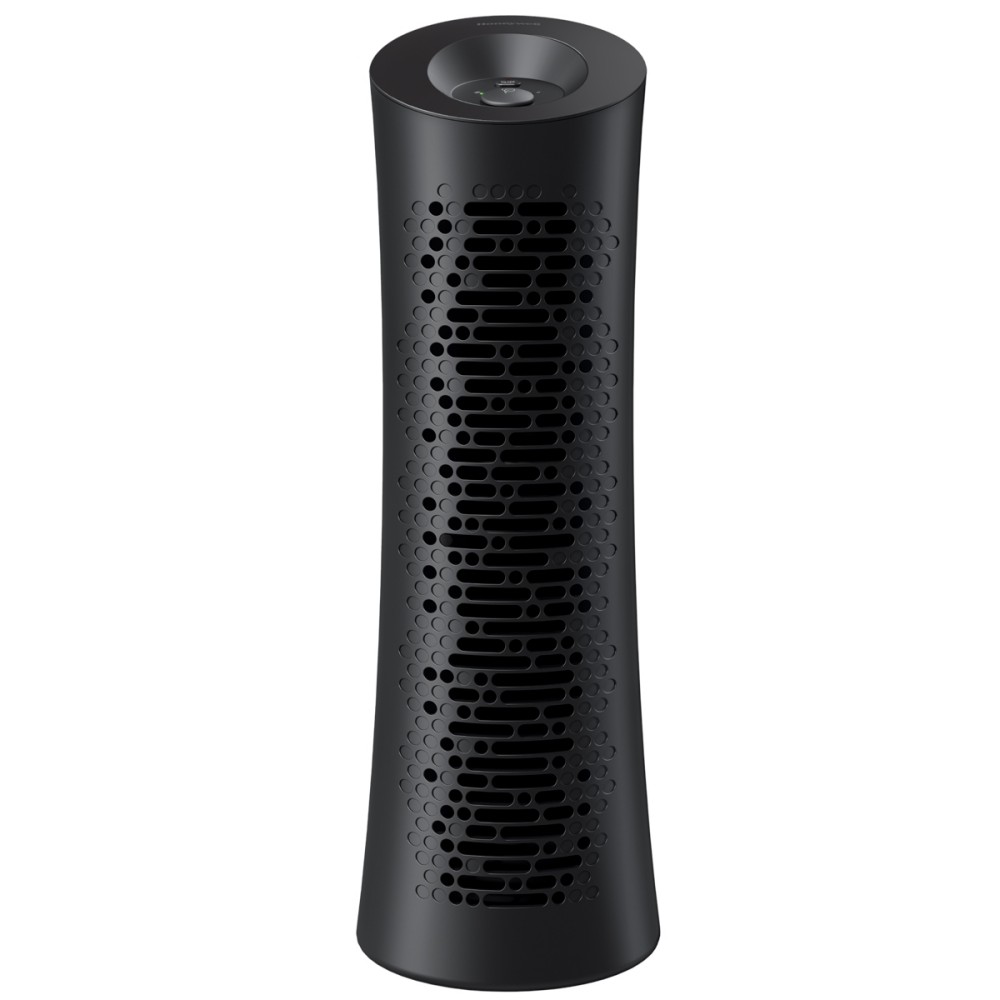
Explore this need in the finder →The Honeywell HPA030 is a slim, manually controlled HEPA tower whose detailed room rating is more useful than its large headline area. Honeywell states 200 square feet at 4.8 air changes per hour (ACH), based on smoke-CADR testing at the highest setting. Its product title also shows 990 square feet, but the exact product copy does not label that number with a cleaning-rate basis. Do not treat it as a 4.8-ACH room size or fill an unknown slower-rate figure by inference.
Use the 200-square-foot comparison point
The 200-square-foot figure makes the HPA030 a better fit than the smaller HPA020 tabletop purifier when the room-area choice requires at least 140 square feet at 4.8 ACH. It falls short of a 219-square-foot threshold. In the larger-area title, Honeywell does not expressly state 1 ACH on the product page, so that 990-square-foot claim should remain unclassified for a strict ACH comparison. Open doorways, room shape, ceiling height and the speed used will change practical results; the manufacturer itself cautions that circulation depends on room configuration and does not guarantee all room air passes through the filter.
The licensed Honeywell Store lists pollutant-specific CADR figures of 110 CFM for smoke, 124 for dust and 117 for pollen. The site’s single CADR comparison is the smoke figure, not whichever pollutant number is highest. An essential 110-CFM smoke threshold is met; 111 CFM is not. These manufacturer-reported test values help distinguish models, but they are not an independent test result for this review and do not imply removal of every indoor contaminant.
Two HEPA cartridges change the upkeep
Inside the HPA030 are two Type G certified HEPA filters and one Type A odor-reducing pre-filter. The pre-filter helps capture larger particles and reduce ordinary odors; the HEPA cartridges address particles in the air that passes through the unit. Honeywell’s manual recommends checking conditions and gives a guideline of roughly three months for the pre-filter and 12 months for the HEPA filters. The filter monitor counts hours of use and signals filter checks; it is not an air-quality sensor. The two HEPA replacements are separate consumables, so verify that the correct quantity is included in a replacement pack rather than assuming one cartridge serves the whole tower.
Installation is straightforward but involves opening the rear grille. With the purifier off and unplugged, remove the grille, take off protective wraps, seat both G filters with their pull tabs accessible, attach the A pre-filter to the grille, then snap the grille back into place. The manual says none of the filters are washable. Dust-heavy rooms, smoke events and pets can change how long media remains useful, so the reminder is a prompt to inspect and replace, not proof that a filter has the same life in every home.
Manual speed selection is the whole control story
The HPA030 has three selectable speeds—High, Medium and Low—and a filter-check/reset reminder. The manual describes cycling through speed settings at the unit, not sensor-triggered adjustment. There is no documented app control, particle-sensor Auto mode, numerical PM2.5 display, VOC-level display or timed shutoff. This can be an advantage for a shopper who values direct, uncomplicated operation, but it cannot meet a hard requirement for remote schedules, automatic particle response or visible air-quality readings. A filter-reset light should not be mistaken for an air-quality indicator.
Honeywell describes the tower as quiet, but the exact pages and manual do not provide a numerical dB(A) range. Nor do they provide an exact wattage or annual-energy figure in the sources reviewed. If acoustic or energy limits are essential, keep those properties unknown rather than converting promotional wording into a measurement. The exact product pages also report body dimensions differently: Plugged In lists 9.8 by 26 inches without labeled axes, while the Store lists 10.8 by 12.1 by 26 inches as length, width and height. Height agrees at 26 inches, but width and depth do not; check the actual cabinet and clearance before relying on a tight footprint limit.
Fit, placement and status
The upright tower is intended for a firm, level floor location with its front facing away from nearby furniture and all grilles clear. It is a dedicated purifier rather than a heater, cooler, fan, humidifier or purifier-fan combination. Honeywell’s particle-capture statement applies to air passing through the filters; odor reduction is a secondary pre-filter function and is not a substitute for ventilation or a gas detector. The pre-filter does not make this a carbon-monoxide control device.
The exact black HPA030B is identified by the licensed Honeywell Store as model code HPA030B, UPC 092926030018, and the store page showed an active in-stock offer when checked. Availability can change, so check the exact suffix before ordering. Choose it over HPA020 when a 140-to-under-219-square-foot 4.8-ACH comparison tier, tower form or larger smoke CADR matters more than tabletop portability. Choose HPA020 only for its smaller 90-square-foot 4.8-ACH niche or an existing unit you are identifying. If the room needs at least 219 square feet at 4.8 ACH, neither exact model clears that bar.
Primary references: Honeywell Plugged In HPA030 product page, Honeywell Store exact HPA030B listing and its linked HPA030 manual. Source dates and archived files are recorded in the research dossier.
Key details at a glance
| Room area at 4.8 ACH (stated or calculated) | 200 sq ft |
|---|---|
| Clean air delivery rate (CADR) | 110 CFM |
| App control | No |
| Body height | 26 in |
| Published product weight | 11.6 lb |
| On-unit numeric PM2.5 display | No |
| Turbo fan setting | No |
| Separate TVOC sensor | No |
| Manufacturer filter-check/replacement guidance | Honeywell recommends checking conditions, with the A pre-filter around every 3 months and the two G HEPA filters around every 12 months. Heavy dust, smoke or pet loading can shorten useful life; the hour-based reminder is not a particle sensor. |
| Purifier also has a documented circulation-fan function | No |
| Built-in heating mode | No |
| Fan-driven cooling mode | No |
| Cooling mode is air conditioning | No |
| Built-in humidification mode | No |
| Separate adjustable fan in exact offer | No |
| Unqualified manufacturer room-size claim (no ACH basis) | 990 sq ft |
Use the exact model’s instructions for operating limits, supplied equipment and version differences.
Sources for this assessment

Check the room rating against your actual space.
Compare room-area figures at 4.8 air changes per hour, then check their stated or calculated basis, placement and filter care.