
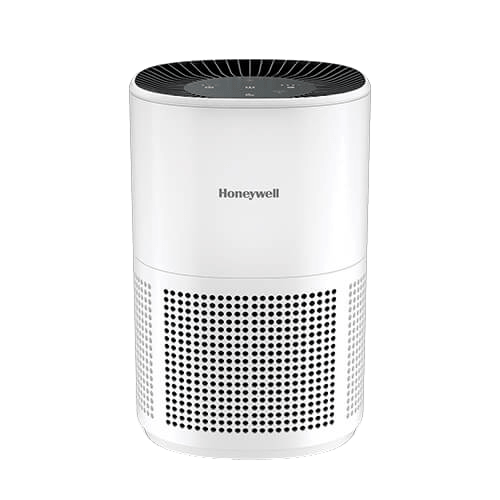
Your needs, this model
Does it fit your priorities?
Will the HPA4100 meet a compact-room minimum using its official 169-square-foot entry?
Its ENERGY STAR room-size field is 169 sq ft, which clears the finder’s 140-sq-ft compact tier but not the 219-sq-ft small-room threshold.
Explore this need in the finder →Do I need manual settings and no particle-sensor Auto mode?
The linked HPA4000-series manual’s HPA4100 control/operation sections list direct speeds and explicitly reserve Auto for HPA4200/4300; the ENERGY STAR HPA4100B automatic_mode field conflicts and remains flagged in the dossier.
Explore this need in the finder →Can it fit a very small shelf opening by body width alone?
The page lists an 8.27-inch body width. Keep the manual’s separate six-inch airflow clearance beyond that footprint.
Explore this need in the finder →The Honeywell Allergen Plus HPA4100 is the smallest of three current HPA4000-series models: a compact tabletop purifier for a bounded bedroom, nursery, dorm room or home office. Its most important distinction is not a hidden smart feature: the series manual gives the HPA4100 direct cleaning-level controls but reserves AQSense particle-sensor Auto and the color air-quality indicator for the HPA4200 and HPA4300. If you want to choose a speed yourself and do not need sensor response, that simpler control set may be enough. If room area is the deciding issue, read its 169-square-foot room-size entry carefully.
Match the room figure, not the marketing tier
The official ENERGY STAR product record for HPA4100B lists 169 square feet, 109 CFM smoke CADR, 117 CFM dust CADR and 117 CFM pollen CADR. Honeywell says its purifier performance is tested and verified at the recommended 4.8 air changes per hour; we therefore use the record’s room-size number as a repeated-cleaning comparison point, not as a promise for a connected hallway or a high-ceiling room. This page’s manufacturer title says “Small Rooms,” but this site’s room choices start its small-room threshold at 219 square feet. HPA4100 clears the 140-square-foot compact tier only. It does not meet the finder’s 219-square-foot small threshold.
The three pollutant-specific CADR values are not one interchangeable score, and they are official dataset values rather than measurements made for this review. They help distinguish this model’s airflow scale from its larger siblings: the HPA4200’s corresponding room-size entry is 223 square feet and the HPA4300’s is 355. The numerical gap is useful when a room needs more capacity; the broader manufacturer room labels do not erase the actual area boundary. A room that opens onto other spaces can exceed the tested volume even if its floor area is below 169 square feet.
What the controls do—and do not do
HPA4100 provides several directly selected cleaning levels, Sleep Mode, a 2-, 4- or 8-hour auto-off timer, a filter reminder and a child lock. Sleep selects the lowest speed and dims noncritical control-panel lights. The child lock requires a button combination rather than a single touch, which matters if curious hands are part of the household. There is no app control or AQSense Auto routine documented for this model. It also does not show a numeric PM2.5 value or color air-quality indicator on the unit.
That absence is a tradeoff, not an automatic defect. Manual settings keep the operating choice in your hands, but they do not react when particles rise while you are away. If you want automatic fan adjustment, the HPA4200 or HPA4300 adds AQSense. Its built-in sensor responds to detected particles, not gases or every kind of odor, and a three-color indicator is not the same as a numeric PM2.5 measurement. Carbon in a filter and a sensor that measures air are different functions.
Plan for the filter and the space around it
The initial HPA4100 box includes one HRFY1 cartridge. Honeywell’s filter finder assigns one HRFY1 to this model; the manual describes a single integrated main unit with HEPA and carbon layers plus vacuumable pre-filter layers. The main filter is not washable. Vacuum the pre-filter layers every three months or sooner if needed, and plan around the manual’s 9-to-12-month replacement guideline. Dust, pet fur and smoke can use up filter capacity sooner; the reminder is based on operating hours, so it is a prompt rather than a measurement of remaining particle-removal performance.
Before the first run, remove the filter’s protective wrapping and reinstall it. Set the purifier upright on a firm, level surface, keep the intake and outlet open, and leave more than six inches from nearby walls or furniture. Its body measures 8.27 inches long by 8.27 inches wide by 12.6 inches high, but those dimensions do not include the operating clearance. Do not squeeze it into a shelf just because the body itself fits. The product materials call Sleep quiet but do not provide a numeric maximum decibel rating or an operating-watt figure that would support a strict noise or power cap.
Which HPA4000 model should you shortlist?
Choose HPA4100 when the actual room fits its 169-square-foot comparison area, the smaller body helps placement and manual speed selection is acceptable. Move to HPA4200 when you want particle-responsive Auto and a color indicator; its 223-square-foot rating still falls short of this site’s 358-square-foot medium-room threshold. HPA4300 increases the room-size entry to 355 square feet and adds a larger HRFY3 cartridge, but even its “large rooms” product title does not satisfy a 358-square-foot minimum. For that threshold, compare a model with a documented figure at or above 358 rather than rounding this one up.
HPA4100 is listed in black and white as HPA4100B and HPA4100W on the U.S. product page. The exact page names HPA4100B in its title; do not assume the finish changes filtration or that an offer includes anything beyond the initial HRFY1 unless the seller’s box contents say so. Filter replacement should be budgeted as part of ownership. If you need quantified odor treatment, a gas-specific monitor or a larger room rating, this compact HEPA-and-carbon unit does not establish those requirements.
Sources: Honeywell HPA4100 product page, HPA4000-series owner’s manual, Honeywell replacement-filter finder, and ENERGY STAR room-air-cleaner dataset.
Key details at a glance
| Room area at 4.8 ACH (stated or calculated) | 169 sq ft |
|---|---|
| Clean air delivery rate (CADR) | 109 CFM |
| App control | No |
| Body width | 8.27 in |
| Body depth | 8.27 in |
| Body height | 12.6 in |
| On-unit numeric PM2.5 display | No |
| On-unit lock for accidental control changes | Yes |
| Turbo fan setting | No |
| Manufacturer filter-check/replacement guidance | One initial HRFY1 filter is listed with the exact model. The manual recommends replacement every 9–12 months as a guideline and says heavy particle loads can shorten useful life; the filter reset is usage-hour based. The main cartridge is not washable. |
| Purifier also has a documented circulation-fan function | No |
| Built-in heating mode | No |
| Built-in humidification mode | No |
Use the exact model’s instructions for operating limits, supplied equipment and version differences.
Sources for this assessment
- Honeywell U.S. air purifier product directory, first page
- Honeywell exact U.S. Honeywell Allergen Plus HPA4100 product page
- Honeywell Allergen Plus HEPA Air Purifier HPA4000 Series owner’s manual, A013744R0
- Honeywell Allergen Plus 4-in-1 series filter finder
- ENERGY STAR room air cleaners qualified product dataset
- ENERGY STAR exact HPA family row HPA4100
- CPSC narrow Honeywell HPA4100 product-name query
- Exact Honeywell Plugged In HPA4100W product image
- Honeywell owner manual archive
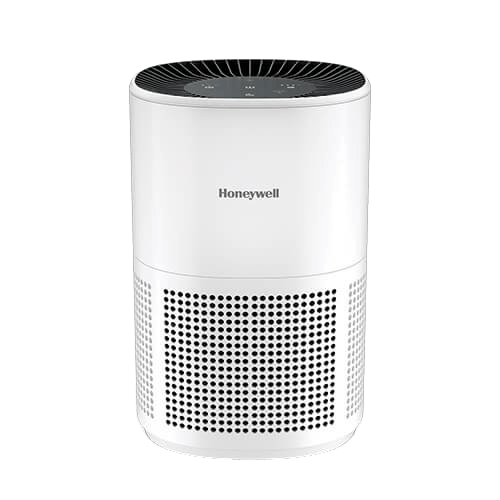
Check the room rating against your actual space.
Compare room-area figures at 4.8 air changes per hour, then check their stated or calculated basis, placement and filter care.