
Your needs, this model
Does it fit your priorities?
Can the HPA4200 cover a room needing at least 219 sq ft at the repeated-cleaning benchmark?
Its ENERGY STAR room-size field is 223 sq ft, so it clears 219 but not 358 sq ft.
Explore this need in the finder →Does the HPA4200 use particle-sensor Auto rather than a gas-sensor Auto mode?
The series manual identifies detected particles as the basis for AQSense fan adjustment on HPA4200 and HPA4300.
Explore this need in the finder →Can I place it in a shelf bay limited to 8.5 inches of body depth?
The product page labels its body dimensions 8.27 inches long by 8.70 inches wide; the length/depth figure is 8.27 inches. Add the manual’s separate six-inch airflow clearance.
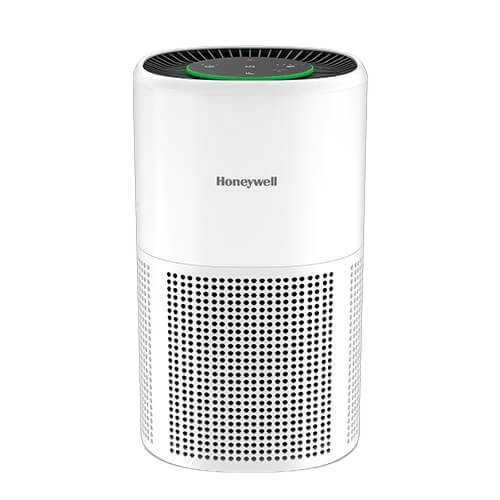
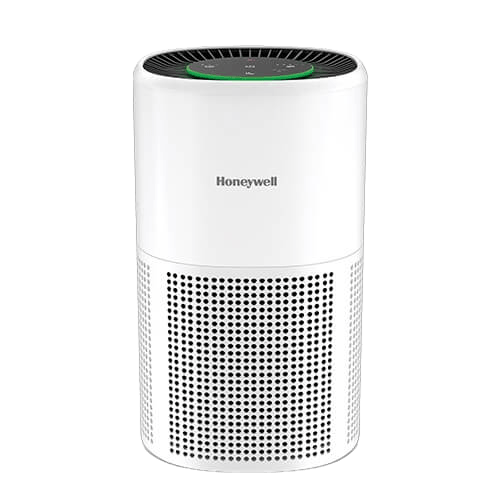
Explore this need in the finder →The Honeywell Allergen Plus HPA4200 is the middle model in the HPA4000 family, but its strongest reason to choose it over the HPA4100 is a control difference rather than a dramatic size jump. It adds AQSense particle-sensor Auto and a color air-quality indicator while retaining direct fan settings, Sleep Mode, a child lock and a timer. Its official ENERGY STAR room-size entry is 223 square feet: enough for the finder’s 219-square-foot minimum, but not its 358-square-foot medium threshold. It can be a compact-body option when you want the fan to respond automatically to detected particles.
223 square feet is the useful boundary
ENERGY STAR lists HPA4200B at 223 square feet, with 144 CFM smoke CADR, 153 CFM dust CADR and 153 CFM pollen CADR. The unit’s performance should be compared on the same repeated-cleaning basis: Honeywell says its purifiers are tested and verified by AHAM at a recommended 4.8 air changes per hour. The official room-size entry is not a guarantee for a connected living/dining area, high ceiling or blocked outlet. Use the room the purifier will actually serve, especially if doors remain open.
The model clears the finder’s 219-square-foot “small” threshold by four square feet, a narrow margin that makes precise room boundaries important. Honeywell’s exact title calls it a medium-room product, but the finder’s medium threshold is 358 square feet; that is a separate, stricter comparison system. HPA4200 is not a match where at least 358 square feet is essential. The HPA4300 reaches 355 square feet, still just below that boundary. If the room needs the 358 figure, look at a model with a verified value at or above it instead of promoting the HPA4200 based on its title.
Auto watches particles, not every kind of air problem
HPA4200 adds a built-in particle sensor and AQSense Auto. The manual says automatic fan adjustment is based on detected particles and describes a green/yellow/red indicator. At startup the sensor takes a few minutes to calibrate, so the colors may pulse before settling. There is no numeric PM2.5 display on the unit, and this source set does not establish a VOC or odor-gas sensor. The carbon layer may help reduce common household odors and chemical fumes, but that is not the same as sensing those gases or confirming their removal.
You can still choose the numbered cleaning settings directly, or select Auto when particle-responsive changes are useful. Sleep drops to the lowest speed and dims noncritical panel lights; the 2-, 4- or 8-hour timer turns the unit off after the selected interval; a child lock prevents button changes while engaged. The purifier has no documented app control, so it is a direct-control appliance with sensor feedback, not a connected monitor. Those functions coexist in one operating plan, but neither the color indicator nor the app-free setup supplies continuous quantified indoor-air reporting.
Filter ownership: one HRFY2, plus a small sensor chore
The HPA4200 includes one HRFY2 main cartridge, and Honeywell’s filter finder assigns that filter to both listed HPA4200B and HPA4200W offers. The all-in-one filter combines HEPA and activated carbon with pre-filter layers. Its main media is not washable; the outer and inner pre-filter layers are vacuumed every three months or as needed. Honeywell gives a 9-to-12-month replacement guideline, with heavier loads potentially shortening the interval. The reminder tracks hours, so inspect the filter routine rather than treating the light as a live efficiency reading.
Auto adds a maintenance step beyond the HPA4100: clean the particle sensor every three months with a dry cotton swab, not a liquid cleaner. A dirty sensor can undermine the automatic response you bought the HPA4200 for. On first use, remove the plastic wrap around the filter. Place the upright unit on a level surface with intake and outlet clear and more than six inches from furniture or walls. The body is 8.27 inches long, 8.70 inches wide and 14.84 inches high. Allow extra space around the case; a tight shelf can defeat airflow even when the dimensions fit.
When to choose it over the siblings
Pick HPA4200 if a room near or below 223 square feet is the real target, a color-only particle cue and automatic fan changes are useful, and a compact tower-like footprint fits. The HPA4100 is shorter and rated for 169 square feet, but the manual does not assign it AQSense Auto. The HPA4300 is taller and wider, rated for 355 square feet, and uses the separate HRFY3 rather than HRFY2. Their filters are not interchangeable just because the housings look related.
HPA4200’s CADR varies by the particle category: the recorded smoke value is lower than its dust and pollen values. Do not convert the three readings into a generic performance claim. The ENERGY STAR entry reports annual use of 137 kWh and an integrated energy factor; these program figures help compare registered models but are not your household bill. No exact maximum-noise or operating-watt figure is in the evidence here, so it should not pass a strict numeric noise or wattage limit. If numeric local PM readings, app scheduling or gas-responsive Auto is essential, select another precisely documented configuration.
Sources: Honeywell HPA4200 product page, HPA4000-series owner’s manual, Honeywell replacement-filter finder, and ENERGY STAR room-air-cleaner dataset.
Key details at a glance
| Room area at 4.8 ACH (stated or calculated) | 223 sq ft |
|---|---|
| Clean air delivery rate (CADR) | 144 CFM |
| App control | No |
| Body width | 8.7 in |
| Body depth | 8.27 in |
| Body height | 14.84 in |
| On-unit numeric PM2.5 display | No |
| On-unit lock for accidental control changes | Yes |
| Turbo fan setting | No |
| Manufacturer filter-check/replacement guidance | One initial HRFY2 filter is listed with the exact model. The manual recommends replacement every 9–12 months as a guideline and says heavy particle loads can shorten useful life; the filter reset is usage-hour based. The main cartridge is not washable. |
| Purifier also has a documented circulation-fan function | No |
| Built-in heating mode | No |
| Built-in humidification mode | No |
Use the exact model’s instructions for operating limits, supplied equipment and version differences.
Sources for this assessment
- Honeywell U.S. air purifier product directory, first page
- Honeywell exact U.S. Honeywell Allergen Plus HPA4200 product page
- Honeywell Allergen Plus HEPA Air Purifier HPA4000 Series owner’s manual, A013744R0
- Honeywell Allergen Plus 4-in-1 series filter finder
- ENERGY STAR room air cleaners qualified product dataset
- ENERGY STAR exact HPA family row HPA4200
- CPSC narrow Honeywell HPA4200 product-name query
- Exact Honeywell Plugged In HPA4200W product image
- Honeywell owner manual archive
Check the room rating against your actual space.
Compare room-area figures at 4.8 air changes per hour, then check their stated or calculated basis, placement and filter care.