
Your needs, this model
Does it fit your priorities?
Does the HPA4300 meet the finder’s 219-square-foot repeated-cleaning tier?
The ENERGY STAR room-size field is 355 sq ft, above the 219-square-foot tier but below the 358-square-foot medium threshold.
Explore this need in the finder →Is its Auto response based on particles rather than a VOC/odor sensor?
The linked HPA4000-series manual identifies detected room particles as the HPA4200/4300 Auto trigger.
Explore this need in the finder →Will the HPA4300 fit below a 10-inch body-width limit?
The product page lists 10.24 inches as its width; it exceeds a strict 10-inch cap before allowing operating space.
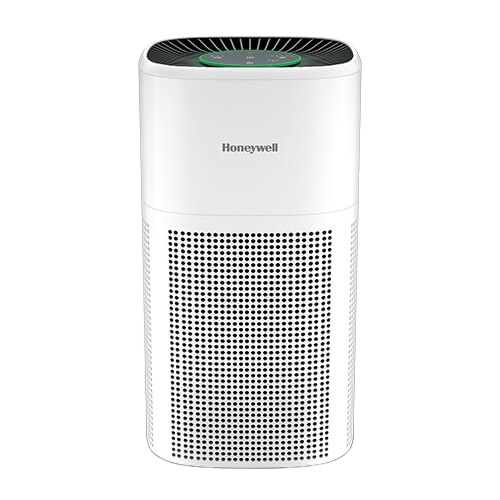
Explore this need in the finder →The Honeywell Allergen Plus HPA4300 is the largest HPA4000-series purifier in this group. It has AQSense particle-sensor Auto, four cleaning levels, Sleep Mode, a child lock and a larger HRFY3 cartridge. Its published ENERGY STAR room-size value is 355 square feet, making it the strongest of these three on the same room-area comparison. There is an important catch for shoppers using a 358-square-foot minimum: 355 is still below that threshold, even though Honeywell’s product title calls it a large-room model. Check the exact number against your actual room before treating the size label as a fit.
Room scale and output, with the threshold kept honest
The ENERGY STAR record lists HPA4300B at 355 square feet, with pollutant-specific clean-air delivery values of 229 CFM for smoke, 238 CFM for dust and 245 CFM for pollen. Honeywell’s purifier category says performance is tested and verified by AHAM at the recommended 4.8 air changes per hour. Those are useful comparison values, not an assurance that an open-plan space or a room with a high ceiling will receive the same repeated cleaning. Keep doors and windows closed for the stated room-size basis and avoid obstructing the intake or outlet.
Among the HPA4000 siblings, HPA4100 is listed at 169 square feet and HPA4200 at 223; HPA4300 steps up to 355. The increasing output comes with a larger body and a different replacement cartridge. Yet this site’s room choices label 358 square feet as the medium minimum, so even the HPA4300 fails that specific hard requirement. Do not round it, combine the capacities of two machines, or use the manufacturer’s category title to bypass the threshold. If 358 or more is essential, compare against an exact model whose rate-matched evidence reaches that number.
Particle Auto, four speeds and a color indicator
AQSense senses particles and changes the fan setting automatically; it is not a gas/VOC sensor. The manual describes a three-color indicator for low, moderate and elevated detected particle levels. On startup, allow a few minutes for calibration, when the display may cycle before it settles. The display is not a numeric PM2.5 readout, and its color should not be treated as a medical measurement or proof that an odor or gas has been removed.
The unit also lets you select cleaning levels directly. Sleep puts it on the lowest speed and dims noncritical panel lights; the 2-, 4- or 8-hour timer can stop a scheduled run; the child lock prevents accidental button changes. It has no app control documented in the product materials. If you want a connected schedule or a local numeric reading, compare a product that lists those functions explicitly. If you prefer a simple sensor-based response without phone setup, HPA4300’s mix of direct controls and Auto is easier to evaluate than a general “smart” label.
Filter changes and placement are part of the purchase
One initial HRFY3 is listed in the HPA4300 box, and Honeywell’s filter finder identifies HRFY3 as the correct cartridge. This is a size-specific all-in-one main filter: do not substitute the HPA4100’s HRFY1 or HPA4200’s HRFY2 based on appearance. The cartridge has HEPA and activated-carbon layers alongside vacuumable pre-filter layers. The main filter is not washable; vacuum the pre-filters every three months or as needed. Honeywell recommends replacing the single main filter about every 9 to 12 months, with heavier particle loads able to shorten useful life. The filter reminder is tied to hours, so the calendar estimate remains a planning guide.
Because this model has Auto, the particle sensor needs its own cleaning every three months with a dry cotton swab. Skip liquids. Remove the protective filter packaging before the first run and set the purifier upright on a firm, level surface. Honeywell calls for more than six inches from walls or furniture and clear air passages. The product page labels its case 10.43 inches long by 10.24 inches wide by 18.9 inches high; the room must accommodate that footprint, height and clearance rather than merely accept the case dimensions. That is a meaningful tradeoff against the smaller HPA4200, which has the same sensor features but a 223-square-foot area entry.
What the size upgrade does not establish
The carbon layer is intended to help reduce household odors and chemical fumes, but the sources do not provide a quantified gas-removal profile or confirm a VOC sensor. Use source control and appropriate ventilation for persistent fumes rather than relying on particle Auto. ENERGY STAR lists 185 kWh annual energy use and an integrated energy factor for the qualified record; these are standardized program values, not a promised bill. This source set does not give the exact model’s maximum decibel level or operating wattage, so do not use “Sleep” or “large” as a substitute for a numeric noise or power requirement.
HPA4300 is a sensible shortlist candidate for a closed room up to its documented 355-square-foot comparison value when particle-responsive Auto, color feedback and the bigger filter path matter. The HPA4200 is more compact for rooms up to 223 square feet; the HPA4100 trades away AQSense for manual operation in a smaller 169-square-foot area. HPA4300’s black and white SKUs are HPA4300B and HPA4300W on the U.S. page. Confirm the exact suffix and included filter on the offer, and plan for the model-specific HRFY3 replacement before deciding that the larger housing is the better long-term fit.
Sources: Honeywell HPA4300 product page, HPA4000-series owner’s manual, Honeywell replacement-filter finder, and ENERGY STAR room-air-cleaner dataset.
Key details at a glance
| Room area at 4.8 ACH (stated or calculated) | 355 sq ft |
|---|---|
| Clean air delivery rate (CADR) | 229 CFM |
| App control | No |
| Body width | 10.24 in |
| Body depth | 10.43 in |
| Body height | 18.9 in |
| On-unit numeric PM2.5 display | No |
| On-unit lock for accidental control changes | Yes |
| Turbo fan setting | No |
| Manufacturer filter-check/replacement guidance | One initial HRFY3 filter is listed with the exact model. The manual recommends replacement every 9–12 months as a guideline and says heavy particle loads can shorten useful life; the filter reset is usage-hour based. The main cartridge is not washable. |
| Purifier also has a documented circulation-fan function | No |
| Built-in heating mode | No |
| Built-in humidification mode | No |
Use the exact model’s instructions for operating limits, supplied equipment and version differences.
Sources for this assessment
- Honeywell U.S. air purifier product directory, first page
- Honeywell exact U.S. Honeywell Allergen Plus HPA4300 product page
- Honeywell Allergen Plus HEPA Air Purifier HPA4000 Series owner’s manual, A013744R0
- Honeywell Allergen Plus 4-in-1 series filter finder
- ENERGY STAR room air cleaners qualified product dataset
- ENERGY STAR exact HPA family row HPA4300
- CPSC narrow Honeywell HPA4300 product-name query
- Exact Honeywell Plugged In HPA4300W product image
- Honeywell owner manual archive
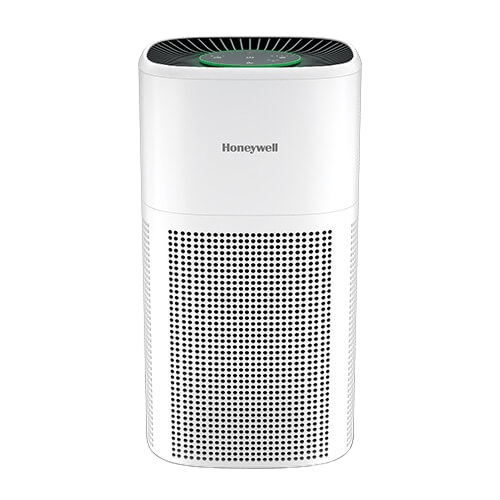
Check the room rating against your actual space.
Compare room-area figures at 4.8 air changes per hour, then check their stated or calculated basis, placement and filter care.