
Your needs, this model
Does it fit your priorities?
Can this console cover at least a compact room at its stated 4.8-ACH basis?
Does the HPA5100 clear the 140-sq-ft compact threshold but stop short of the 219-sq-ft small threshold?
Explore this need in the finder →Do you prefer direct fan selection instead of sensor-led Auto?
The HPA5100 manual groups this model with no VOC-sensing air-quality Auto mode. It does have an Auto-Off timer, which schedules a shutoff rather than changing speed from an air-quality sensor.
Explore this need in the finder →Does its 114-CFM smoke-CADR figure meet your minimum?
Honeywell Store lists smoke CADR 114 CFM for HPA5100B. The supported boundary is 114, not 115 CFM.
Explore this need in the finder →The Honeywell InSight HPA5100 is the restrained member of this console family: a replaceable HEPA-and-carbon system with direct controls, but without the VOC-sensor Auto feature found on HPA5200 and HPA5300. Its useful room figure is 190 square feet at the manufacturer’s 4.8-air-changes-per-hour benchmark. The product title also carries a 938-square-foot headline, but the page does not give that figure the same repeated-cleaning basis. Treat it as a separate, unqualified area claim—not proof that this model supports a 938-square-foot room at 4.8 ACH.
Use the 190-square-foot figure for repeated cleaning
Honeywell describes the HPA5100 as a medium-to-large-room purifier and lists 190 square feet at 4.8 air changes per hour. That clears a 140-square-foot compact-room threshold but not the 219-square-foot small-room benchmark used by this guide. The gap matters if you expect the unit to clean a bedroom or home office repeatedly rather than simply move some air through a much larger space. Doors, ceiling height, furniture and open connections to other rooms all affect practical circulation; the stated rating is not a guarantee that every pocket of the room passes through the filter.
The large 938-square-foot number appears in the product title, while the product details give the 190-square-foot 4.8-ACH figure. Because the title does not itself state a rate, keep those claims separate. If you need a specific repeated air-change rate, size against the 190-square-foot number. The HPA5200 is the meaningful sibling step if the target exceeds that area; HPA5300 moves farther, but also needs three HEPA cartridges instead of one.
Physical settings, no sensor-led Auto
The InSight display makes the selected setting visible, and the panel can be dimmed. Honeywell’s store copy calls out three power settings, while the shared-series manual’s diagram groups HPA5100 with a panel labeled Quiet Clean, General Clean, Pollen and Turbo. Treat the exact count and names cautiously; the useful distinction is that HPA5100 uses local controls rather than sensor-led Auto. The panel also has an Auto-Off timer button for a 2-, 4- or 8-hour shutoff; that timer is not an air-quality Auto mode. The manual separately identifies the VOC sensor and automatic-cleaning arrangement on HPA5200 and HPA5300. HPA5100’s display communicates the selected setting rather than a measured particle concentration: there is no on-unit numeric PM2.5 readout or color air-quality indicator documented for this model.
This simpler setup is useful when you prefer to choose the fan behavior yourself and do not need sensor feedback. It is not an app-connected purifier, and the quietest “Microscopic Particles” setting is not the same as a named Night or Sleep mode. Honeywell gives no numeric decibel maximum or rated operating wattage in the sources used here. If either is essential, leave those limits unanswered rather than treating “quiet” wording as a measured value.
Plan for one R filter, a carbon pre-filter and optional odor stages
The HPA5100 ships with one R HEPA filter and one A odor-reducing pre-filter. Honeywell’s guidance is to change the R filter about once a year and the A pre-filter about every three months; the actual interval can shorten in dusty or smoky conditions. The manual says the HEPA, pre-filter and optional enhanced odor/VOC filters are not washable and should not be vacuumed. This is a replacement-media system, not a permanent washable filter design.
Optional S filters add a targeted stage for smoke, kitchen, home-renovation or pet odors. They are separate accessories, not a bundle of four filters in the box, and Honeywell recommends changing them every three months. Carbon can help reduce odors, but the purifier does not establish which compound is present or guarantee removal of every gas. In particular, it does not reduce carbon monoxide; keep fuel-burning appliances properly ventilated.
Who should choose this version?
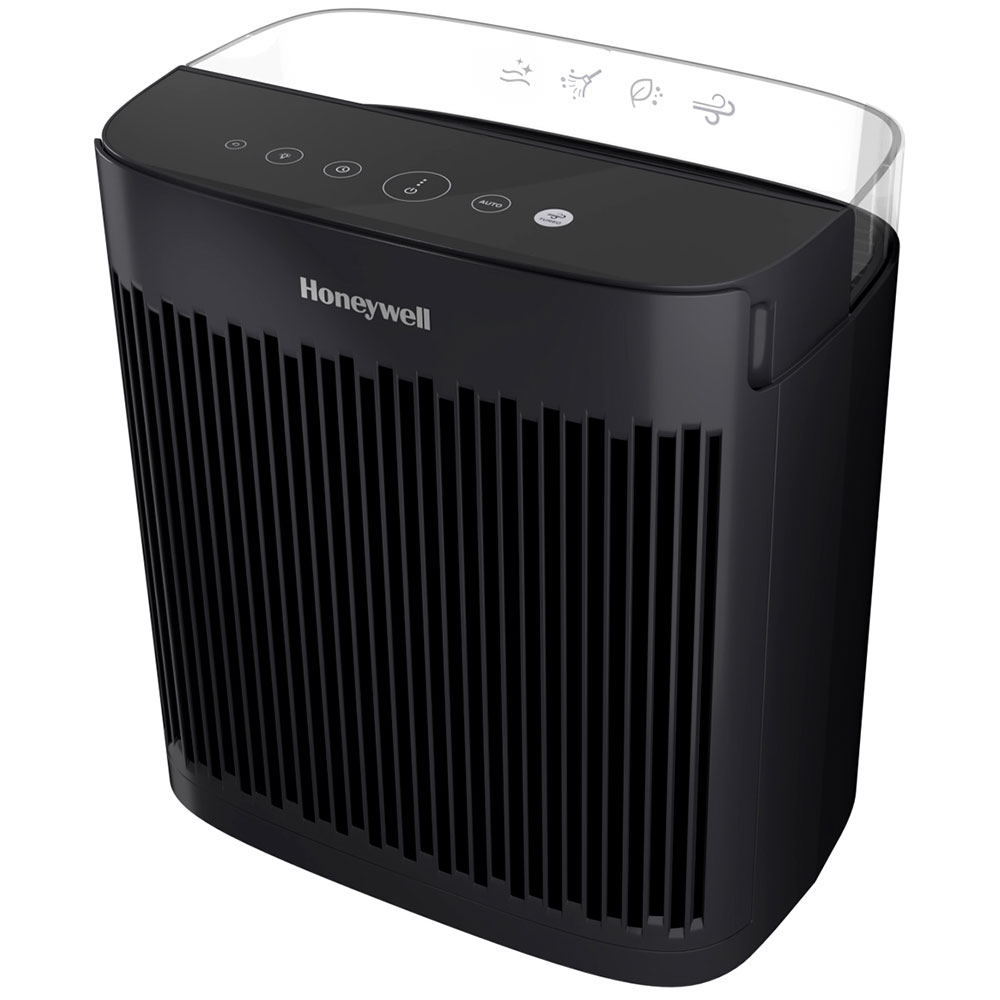
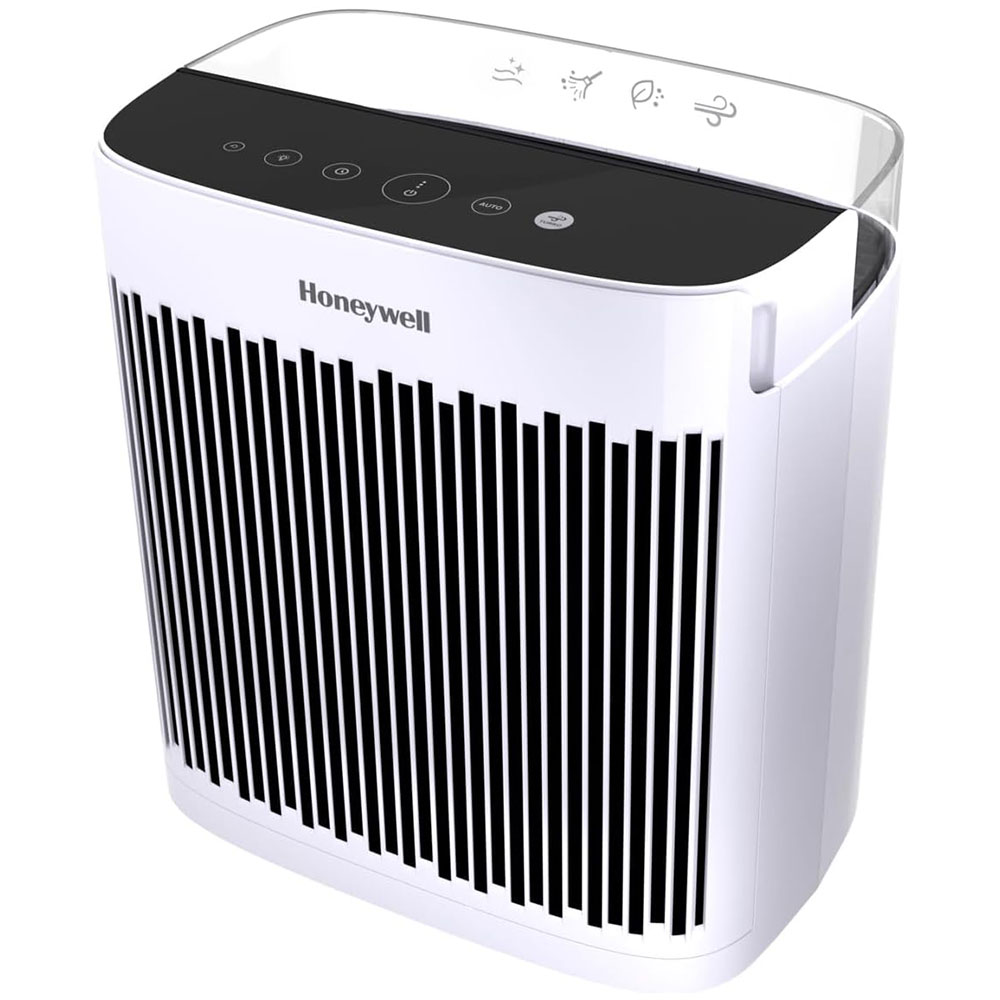
Choose HPA5100 when the actual room is within its 190-square-foot repeated-cleaning rating, manual speed choice is acceptable, and a standard replaceable filter routine is preferable to automatic sensor changes. Its one-R-filter setup is the least complicated upkeep in this three-size family. The black HPA5100B is pictured here; Honeywell also lists a white HPA5100W finish under the same HPA5100 family. Confirm the offered finish and filter pack before ordering.
Move to HPA5200 if you want a larger published 4.8-ACH area and VOC-responsive Auto with a color indicator; HPA5300 adds still more rated area but uses three R filters. Neither larger model gives a numeric PM2.5 value on the unit. HPA5100 is not the choice for a 219-square-foot minimum, particle-sensor Auto, numeric air-quality display, a dedicated Night mode or a confirmed 938-square-foot 4.8-ACH fit. The manufacturer lists body measurements in different orders across its product materials, so this assessment does not use a hard width/depth/height limit; allow a clear, level placement and open intake and outlet.
Sources: Honeywell HPA5100 product page, Honeywell Store HPA5100B listing, InSight series owner’s manual, and Honeywell filter finder.
Key details at a glance
| Room area at 4.8 ACH (stated or calculated) | 190 sq ft |
|---|---|
| Clean air delivery rate (CADR) | 114 CFM |
| App control | No |
| Published product weight | 13.45 lb |
| On-unit numeric PM2.5 display | No |
| Included Pet Allergy Filter with ARC Formula | No |
| On-unit lock for accidental control changes | No |
| Turbo fan setting | Yes |
| Separate TVOC sensor | No |
| Manufacturer filter-check/replacement guidance | Honeywell recommends replacing R HEPA filters about every 12 months and the A/A+ and optional S filters about every three months. These are guidelines; high contaminant loads can shorten useful life. The manual says the filters are not washable. |
| Purifier also has a documented circulation-fan function | No |
| Built-in heating mode | No |
| Fan-driven cooling mode | No |
| Cooling mode is air conditioning | No |
| Built-in humidification mode | No |
| Separate adjustable fan in exact offer | No |
| Unqualified manufacturer room-size claim (no ACH basis) | 938 sq ft |
Use the exact model’s instructions for operating limits, supplied equipment and version differences.
Sources for this assessment
- Honeywell U.S. air-purifier category row
- Honeywell Plugged In exact U.S. product page
- Official Honeywell Store exact U.S. product listing
- Honeywell InSight HPA5000 series owner manual
- Exact Honeywell Store product image/render
- CPSC narrow exact model-name recall query
- Honeywell Allergen Plus Series HEPA filter finder
- Official Honeywell Store exact white HPA5100W U.S. finish listing
- Exact white HPA5100W manufacturer product render


Check the room rating against your actual space.
Compare room-area figures at 4.8 air changes per hour, then check their stated or calculated basis, placement and filter care.