
Your needs, this model
Does it fit your priorities?
Does the 170-square-foot HFD230 rating meet a compact 4.8-ACH need without relying on the broad medium/large title?
The exact product page states 170 square feet at up to 4.8 ACH. That clears the compact tier but falls below the 219-square-foot small tier.
Explore this need in the finder →Do you want local fan settings rather than a sensor-driven Auto mode?
The HFD230 manual and product page document physical fan levels, dimming and oscillation, not sensor-based Auto or app control.
Explore this need in the finder →Will the general-odor K pre-filter work, without requiring a pet-specific filter profile?
The optional K pad is described for common household odor/VOC reduction; it is replaced periodically and no dedicated pet-odor media profile is documented.
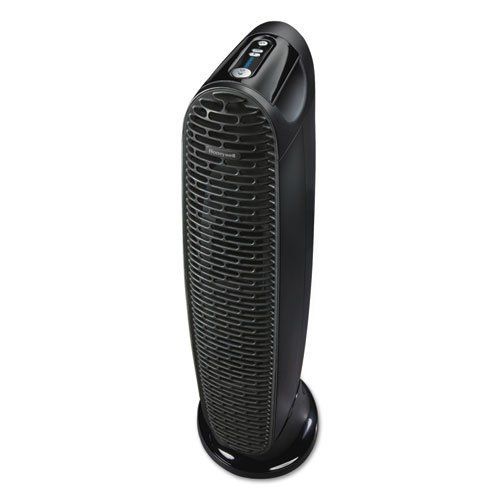
Explore this need in the finder →The Honeywell QuietClean HFD230 is a tall, manually controlled ifD purifier for a smaller room: Honeywell lists 170 square feet at 4.8 air changes per hour, with two washable particle filters and optional oscillation. Its appeal is a reusable filter routine, not app control, automatic sensing, or a large-room rating.
Start with the repeated-cleaning room figure
The exact Honeywell Plugged In page calls the HFD230 a medium-to-large-room model, but the more useful comparison is its stated 170-square-foot room at up to 4.8 air changes per hour. Honeywell says that figure uses smoke-CADR testing at the highest setting and warns that room layout and circulation affect what actually passes through the unit. A 170-square-foot rating clears this guide’s compact tier; it does not clear a 219-square-foot minimum at the same repeated-cleaning rate. Treat the headline label as a shopping description, not an alternate 4.8-ACH result.
The official Honeywell Store page for its HFD230BV1 listing gives smoke, dust and pollen CADR values of 110, 100 and 132, respectively. These are manufacturer-published ratings, not measurements made for this review. The HFD230 is therefore most defensible as a one-room option where the rated room boundary fits. It should not be stretched into a large open plan simply because the product title uses a broad room-size phrase.
Reusable ifD filters, with a real maintenance routine
The HFD230 is not a conventional replaceable-HEPA setup. Honeywell describes two permanent, washable ifD particle filters, a washable foam pre-filter, and an electronic ionizer stage. Its product page says the ifD media can capture listed particles from air passing through the filter, but the official pages disagree about the particle-size threshold: Plugged In says 2 microns and larger, while the Store listing says 0.3 microns and larger. Neither wording should be turned into an unqualified True HEPA claim. If a mechanical HEPA filter or a particular independently verified capture specification is essential, choose a model with matching documentation instead.
The optional K pre-filter is for general household odor and VOC reduction. It takes the same pre-filter position as the washable pad, so the choice is between washing the reusable pre-filter and periodically replacing the K—not stacking both. Honeywell’s manual says the K cannot be washed and should be changed about every three months. It is not described as a specialized pet or smoke cartridge. The permanent ifD filters and washable pre-filter also need periodic attention, approximately every three months in the manual guidance; after washing, let them dry completely before reinstalling. A timer-based filter reminder is helpful, but it is not an air-quality sensor and high particle loads can make a calendar reminder late.
Manual settings, dimming, and oscillation
This is a local-control appliance rather than a connected purifier. The manual describes three cleaning levels selected at the unit, a push-button panel, a dimmer and optional oscillation. The unit begins at medium briefly and then changes to low. The display can be dimmed, but the manual says its LEDs cannot be shut off completely. No phone app, particle-responsive Auto mode, or numerical PM2.5 display is documented for this configuration. The filter-check light tracks cleaning time; it should not be read as a report about indoor particle concentration.
The tall shape is easy to place beside a wall compared with a wide console, but it still needs an unobstructed intake and outlet. Honeywell Store labels its body dimensions as 10.04 × 9.65 × 28.74 inches (L × W × H) and lists 12.42 pounds. The Plugged In product page prints rounded dimensions in a different, unlabeled order, so use the Store’s labeled axes cautiously and check your available space against the actual unit. The published dimensions are body measurements, not a guaranteed clearance envelope. Neither page provides a numeric sound range or rated wattage that I could verify; a strict noise or energy limit should remain an open requirement rather than a pass.
One safety detail changes the shortlist
The HFD230 manual identifies an electronic ionizer and says ozone is produced as a byproduct; it also states that the product meets cited U.S. and California limits. That is the manufacturer’s statement, not an independent emissions test, and I did not find a documented user control to switch the ionizer off. If your household requires a switchable ionizer—or prefers a purifier without this stage—do not assume the HFD230 meets that constraint. The same strictness applies to sound level, Auto sensing, and a mechanical HEPA requirement: an undocumented feature is not a match.
Who should consider the HFD230
It is a reasonable candidate for someone who wants a single-room tower near the compact-room end of the category, is comfortable choosing fan settings locally, and prefers washing permanent filters over routinely replacing a main filter. The optional K pad adds a limited general-odor routine but also creates a recurring replacement task. If your room needs at least 219 square feet at 4.8 ACH, compare a larger exact model such as the Air Genius 3 HFD300 or Air Genius 5 HFD320, each documented at 250 square feet at that rate; these are still ifD designs, not a switch to mechanical HEPA.
There is also a model-label wrinkle worth checking before purchase. Honeywell Plugged In identifies the product-page SKU as HFD230B, while the official Store lists a black HFD230BV1 offer with an MPN ending HFD230BV2R1 and currently marks that offer out of stock. Both point to the HFD230 model family, but their suffixes are not explicitly crosswalked in the records I reviewed. Match the label on the unit, the supplied manual, and replacement-filter compatibility rather than assuming every nearby code is interchangeable. Availability can change, and a listed model is not a promise of stock.
Key details at a glance
| Room area at 4.8 ACH (stated or calculated) | 170 sq ft |
|---|---|
| Clean air delivery rate (CADR) | 110 CFM |
| App control | No |
| Body width | 10.04 in |
| Body depth | 9.65 in |
| Body height | 28.74 in |
| Published product weight | 12.42 lb |
| On-unit numeric PM2.5 display | No |
| On-unit lock for accidental control changes | No |
| Turbo fan setting | No |
| Separate TVOC sensor | No |
| Manufacturer filter-check/replacement guidance | The manufacturer recommends checking/cleaning washable media about every three months; the optional K pre-filter is not washable and is replaced about every three months. Heavy particle loads may require earlier inspection. |
| Purifier also has a documented circulation-fan function | No |
| Built-in heating mode | No |
| Fan-driven cooling mode | No |
| Cooling mode is air conditioning | No |
| Built-in humidification mode | No |
| Separate adjustable fan in exact offer | No |
| Unqualified manufacturer room-size claim (no ACH basis) | 170 sq ft |
Use the exact model’s instructions for operating limits, supplied equipment and version differences.
Sources for this assessment
- QuietClean Oscillating Tower w/ Permanent Washable Filter - Medium Rooms, Black, HFD230
- QuietClean Oscillating Tower Air Purifier Owner's Manual, HFD230 Series, revision 4 (2021)
- QuietClean Towers & Fresher Air Tabletop Air Purifiers support page
- Honeywell QuietClean Oscillating Tower Air Purifier - Black, HFD230BV1
- QuietClean Oscillating Tower Air Purifier HFD230 Model Series Owner's Manual (2014 revision)
- Honeywell Store product image for the black HFD230BV1 offer

Check the room rating against your actual space.
Compare room-area figures at 4.8 air changes per hour, then check their stated or calculated basis, placement and filter care.