
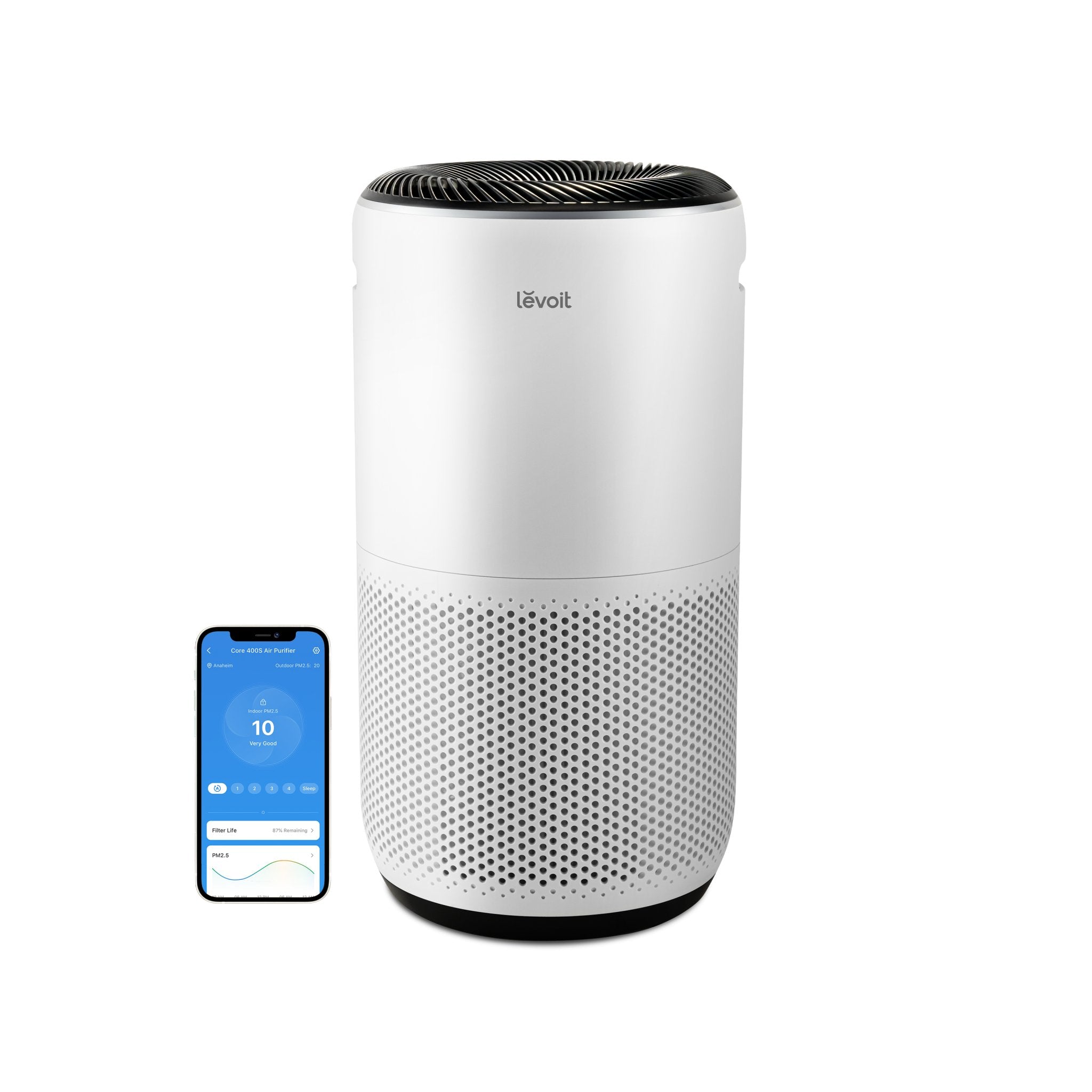
Your needs, this model
Does it fit your priorities?
Can the 400S-P’s published 4.8-ACH room rating support a space up to 358 ft²?
Yes, its current US listing pairs 358 ft² with 4.8 air changes per hour. The larger 1718-ft² number describes one change per hour, a different and slower nominal rate. Actual room shape, ceiling height, adjoining spaces and usable fan speed still matter.
Explore this need in the finder →Can I see a numeric PM2.5 reading without opening the phone app?
Yes. The manual labels a PM2.5/timer display on the purifier, while the VeSync app adds remote readings and history. That is a particle measurement, not a direct gas or odor measurement.
Explore this need in the finder →Will this model keep a turbo speed for a short higher-output run?
Yes. The manual identifies low, medium, high and turbo speeds and describes turbo as the loudest setting. It is a user-selected speed; a high CADR number does not mean the purifier remains quiet at maximum output.
Explore this need in the finder →The Core 400S-P occupies a useful middle position in this three-model group. Levoit lists 231 CFM and rates it for 358 square feet at 4.8 air changes per hour, alongside a much larger 1,718-square-foot figure at one air change per hour. For choosing a purifier around a room where repeated turnover is the aim, the 358-square-foot line is the clearer comparison. The larger headline is not an equivalent promise of fast cleaning, and neither figure accounts for adjoining rooms, ceiling height, blocked airflow or how quietly you choose to run the fan.
The display is a real step up from the smaller Core
The 400S-P adds something the 300S-P does not document on its own controls: a numeric PM2.5/timer display on the purifier. The manual identifies the screen and the AirSight Plus laser sensor. Auto Mode can change speed based on the particle reading, while the color ring supplies a quick visual cue. VeSync extends that routine to remote settings, real-time readings, recent air-quality history, schedules, filter status and compatible voice assistants. It is a useful combination if you want to check what the sensor is doing without opening the phone each time, but it is still a particulate sensor—not a reading for every gas, odor or chemical in the room.
The panel offers four speeds, including turbo. That gives you a more deliberate high-output option than the 300S-P’s three listed manual speeds. It also creates a practical tradeoff: the manual says turbo is the loudest setting. A high CADR is most relevant when the machine can run at a useful rate; if a bedroom needs silence all night, compare the speed you will actually use, not only the maximum rating. Sleep Mode and the app's controls offer quieter routines, but they do not change the room-area calculation.
Plan around the taller body and the filter work
The published dimensions are 10.8 inches square and 20.5 inches high; the listed product weight is 11 pounds. It takes more visual and floor space than the Core 300S-P, yet is still narrower and shorter than the 600S-P. The manual calls for at least 15 inches of clearance on every side and a stable, flat location. That rules out many shelf niches and tight cabinets even when the purifier physically fits. The top discharge also needs open space rather than a shelf directly above it.
The included original filter is a three-stage assembly with a cleanable pre-filter, main filter and activated carbon layer. The manual recommends vacuuming or brushing the pre-filter every two to four weeks and checking the filter at its indicator; its typical replacement interval is around 12 months. Dust load, usage hours and local pollution change that interval. A filter-life percentage or a timer is useful for planning, but it is not a measurement of every contaminant or a promise that the filter will last the full year. The laser-sensor openings also need periodic care; the manual says to vacuum them about every three months, more often in dusty use.
Useful differences, and one small specification mismatch
Compared with the 300S-P, the 400S-P has a larger 4.8-ACH rating, a numeric on-unit PM2.5 display and a turbo setting. It is not simply a larger shell with the same interface. Compared with the 600S-P, it has the smaller body and lower published CFM and room rating. The 400S-P manual file lists four US model codes on its title file and describes the shared Core 400S controls; I have used details that are also supported by the current 400S-P page rather than assigning a finish or bundle from those codes.
There is a modest source disagreement on minimum noise: the current product page says 22–52 dB, while the linked manual says 24–52 dB. The upper figure is consistent, but the lower one is not; I do not use the minimum as an essential match. The page and manual agree on the listed 38-watt rating, 11-pound weight and body dimensions. If low-end sound is the deciding issue, check the exact product documentation for the unit you are considering and listen in your intended room if possible; I have not measured it.
Who should move up—or down?
The 400S-P is the most balanced fit among these three when a room needs more than the 300S-P’s 219-square-foot 4.8-ACH rating, but the larger 600S-P is physically too broad or more capacity than necessary. It is also the better of these three if you require a local numeric particle reading. For a smaller enclosed room, compare the 300S-P and preserve its more compact body; for a room approaching 600 square feet, compare the 600S-P while allowing its wider placement envelope. Our three-size comparison puts those thresholds beside the practical space and upkeep tradeoffs.
Key details at a glance
| Room area at 4.8 ACH (stated or calculated) | 358 sq ft |
|---|---|
| Published room area at 1 air change per hour | 1718 sq ft |
| Clean air delivery rate (CADR) | 231 CFM |
| Published rated input power | 38 W |
| App control | Yes |
| Body width | 10.8 in |
| Body depth | 10.8 in |
| Body height | 20.5 in |
| Published product weight | 11 lb |
| On-unit numeric PM2.5 display | Yes |
| Turbo fan setting | Yes |
| Manufacturer filter-check/replacement guidance | The manual recommends checking the pre-filter every 2–4 weeks and replacing the main filter about every 12 months; actual replacement depends on use and air quality. |
| Placement and care | Unwrap the supplied filter before use; keep at least 15 in (38 cm) clear on every side; clean the pre-filter every 2–4 weeks; vacuum the laser-sensor openings about every 3 months. |
Use the exact model’s instructions for operating limits, supplied equipment and version differences.
Sources for this assessment
Check the room rating against your actual space.
Compare room-area figures at 4.8 air changes per hour, then check their stated or calculated basis, placement and filter care.