
On this page
Your needs, this model
Does it fit your priorities?
Do you need the larger listed smoke-CADR class and numeric particle feedback?
AC5659/40 is listed at 293 CFM smoke CADR and its manual describes a numeric PM2.5 display. Its 454-ft² headline still lacks an ACH basis.
Explore this need in the finder →Is a distinct carbon replacement stage important for general odors?
The exact support page lists FY5182/40 active carbon and manufacturer describes TVOC/odor reduction. This does not promise a health outcome or a specific pet-odor profile.
Explore this need in the finder →Does the numeric gas-level display mean Auto responds to VOCs?
The manual documents a gas-level display but does not establish that Auto reacts to gas; the matcher counts only particle response for Auto.
Explore this need in the finder →Can its gas sensing replace a CO or radon safety monitor?
No. The exact manual says not to use the purifier as a carbon-monoxide or radon safety device.
Explore this need in the finder →The largest of the four Philips purifier listings is not a simple compact upgrade
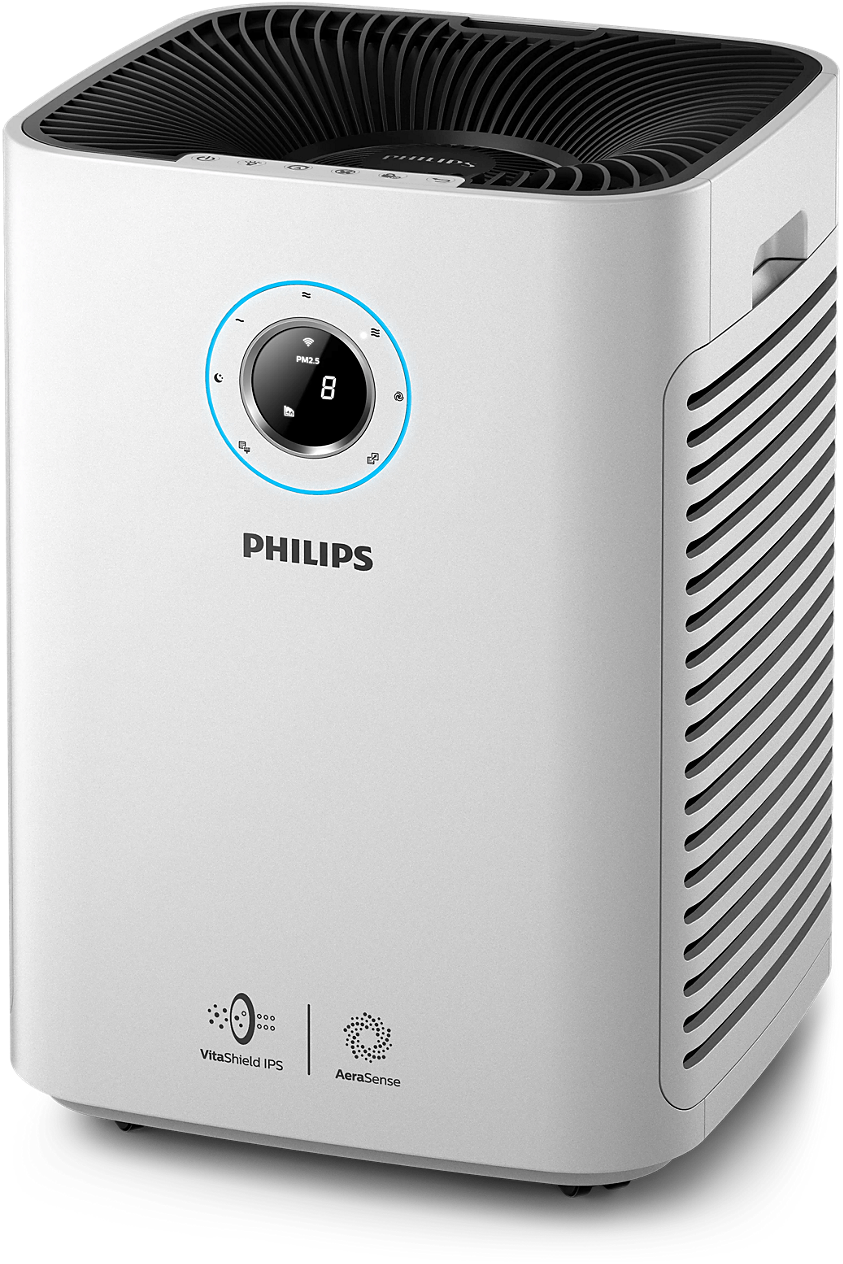
Philips’s U.S. Series 5000i AC5659/40 is the higher-output comparison in the current four-card U.S. purifier listing. Its product page promotes a room area up to 454 square feet and cites a 293 CFM smoke CADR in a technical footnote. Those are distinct kinds of evidence: the CADR is the more useful delivery comparison, while the 454-square-foot figure is an unqualified manufacturer room claim. Philips does not state an ACH basis beside that room area, so do not interpret it as a verified 4.8-ACH rating or use it to pass a rate-specific room requirement.
This model is most interesting when the room is larger than the compact 800/800i models are meant to serve, and when you value both particle and gas-level feedback. It is not just a larger fan with one disposable cylinder. The manual depicts a two-sided intake and calls for repeating the filter installation on the other side, which means a full replacement involves two HEPA filters and two active-carbon filters, as well as the washable pre-filter panels. That can make sourcing and upkeep more involved than on a one-cartridge purifier.
What the 5000i measures—and what its display cannot prove
The AC5659 manual names a particle sensor, Indoor Allergen Index and a separate gas sensor. The unit can display a numeric PM2.5 index, the allergen index or a gas level from L1 to L4; the manual says the gas reading includes VOCs and odors. That is a more substantial on-unit feedback set than a simple color ring. It is still an appliance sensor display, not a calibrated indoor-air lab test, and it does not establish that a particular contaminant has been eliminated from an entire room.
The manual explicitly says that the purifier does not remove carbon monoxide or radon and is not a safety device for combustion or chemical accidents. Treat the gas readout as a way to observe the purifier’s own sensor response, not as an alarm or substitute for ventilation. The product page also describes active carbon for odors and gases; Philips’s support page lists the HEPA filter FY5185/40 and active-carbon filter FY5182/40 for this model. The exact manual names FY5185 and FY5182 and specifies their installation order. Its carbon stage is a documented general-odor choice, not evidence of a specialized smoke, pet or chemical-remediation cartridge.
Mode choices, app setup and care
Local controls and the display remain usable without a phone. The manual identifies General, Allergen and Bacteria & Virus modes, Auto operation, three numbered manual speeds, Sleep and Turbo. It also documents a child lock and controls for dimming or turning off the indicator lights. Those options make sense in a shared bedroom or family room where a locked panel and a darkened display matter. The names of the modes describe the manufacturer’s settings; they are not medical treatment claims.
The 2017 U.S. manual names the Air Matters app and says setup uses 2.4-GHz Wi-Fi; it does not support 5-GHz-only networks or web-authentication networks. Philips’s U.S. support page now lists a model-specific quick-start guide and the current product page says the unit is app connected, but software support can change. If remote control matters, verify current app and phone compatibility before buying an older or stored unit.
The manual says the pre-filter is washable, while the HEPA and carbon elements are not. It documents separate replacement alerts for those two filters and a cleaning alert for the pre-filter. Philips lists the replacement elements separately, and the HEPA accessory is described as lasting up to 12 months; actual life depends on the environment, and the carbon element’s exact replacement timing should be checked in the current model instructions. Do not assume that buying one HEPA and one carbon filter is enough for the two-sided system.
Compare by clean-air need, not by the biggest number
For a more modest room, Philips’s 1000i AC1715/41 has a 149 CFM listing and a 231-square-foot claim. The 800i AC0850/41 lists 93 CFM and 144 square feet, with app control and active carbon but no documented gas-sensor display in its reviewed materials. The 5000i asks for more filter attention in exchange for a higher published smoke CADR, multiple live sensor displays and its separate filter stages. Those differences—not the series number alone—should guide the choice.
There is no verified live-stock guarantee for AC5659/40; the manufacturer page and exact support materials establish its identity and specifications, not whether a particular seller’s unit is new, complete or locally warranted. Check the label, included filters and replacement compatibility on any offer. The image used here comes from Philips’s exact AC5659/40 product page and is credited as manufacturer product-page imagery; no hands-on unit or photo-versus-render claim is implied.
Key details at a glance
| Clean air delivery rate (CADR) | 293 CFM |
|---|---|
| App control | Yes |
| On-unit numeric PM2.5 display | Yes |
| Included Pet Allergy Filter with ARC Formula | No |
| Turbo fan setting | Yes |
| Automatic pre-filter scraper and dust tray | No |
More specifications and setup details
| Separate TVOC sensor | Yes |
|---|---|
| Manufacturer filter-check/replacement guidance | Philips replacement listings give up to 12 months; actual replacement timing depends on environment and the unit alert. Confirm both filter types and quantity for the exact offer. |
| Unqualified manufacturer room-size claim (no ACH basis) | 454 sq ft |
Use the exact model’s instructions for operating limits, supplied equipment and version differences.
Sources for this assessment
Check the room rating against your actual space.
Compare room-area figures at 4.8 air changes per hour, then check their stated or calculated basis, placement and filter care.