
Your needs, this model
Does it fit your priorities?
Is the documented 384-square-foot room at 4.8 ACH enough, or does the room need the large-room tier?
The exact Winix page states AHAM Verifide 384 sq ft at 4.8 ACH. That clears medium but not the 606-sq-ft large tier; the one-hour headline is slower.
Explore this need in the finder →Does the C710 meet a 384-sq-ft 4.8-ACH minimum, and is 385 beyond its printed rating?
384 sq ft is the model page’s explicit 4.8-ACH figure; a stricter 385-sq-ft minimum exceeds it.
Explore this need in the finder →If numeric PM2.5 feedback matters, does the room still fit the C710’s medium 4.8-ACH size?
The on-unit display toggles to a numeric PM2.5 value, but C710 remains a 384-sq-ft 4.8-ACH model; a 606-sq-ft large-room requirement is not met.
Explore this need in the finder →Is connected app control essential, or must the purifier be app-free?
The C710 has Winix Smart App/Wi-Fi plus local controls, so it qualifies for an app requirement but not a strictly manual-only requirement.
Explore this need in the finder →Do you need sensor-driven automatic fan adjustment without insisting on a named pollutant target?
Auto is confirmed. Although it has PM2.5 feedback, the consulted sources do not explicitly identify the Auto sensor target, so a particle- or gas-specific requirement remains unknown.
Explore this need in the finder →Is dedicated Sleep enough, or must a published maximum sound level also stay below 30 dB?
Sleep and the ambient-light transition in Auto are documented, but 22 dB is a minimum, not a maximum; a strict 30-dB cap is unverified.
Explore this need in the finder →Does the lock suit the household if its exact width also has to fit an 11-inch cap?
The Child Lock is documented, but the official page and exact manual disagree on width, so an 11-inch maximum cannot be confirmed.
Explore this need in the finder →Is named Turbo enough, or does a generic published CADR minimum also need to be verified?
Turbo is confirmed; EPA supplies pollutant-specific CADRs, but the shared matcher’s single generic CADR field is intentionally left unknown.
Explore this need in the finder →Is general household-odor carbon enough, or is a specialty replacement cartridge essential?
Filter Z is documented for general cooking, pet and smoke odors; no distinct pet/smoke-cooking/premium compatible profile is established.
Explore this need in the finder →Is the ordinary medium-room plan sufficient, or must an on/off ionizer control be confirmed?
C710 is an exact medium-room candidate, but the sources call its toggle PlasmaWave and do not identify it as an ionizer control.
Explore this need in the finder →Will the manufacturer’s dimensions fit a strict furniture-width limit?
The page and manual disagree on width, depth and height. A maximum-width requirement cannot be safely matched until Winix resolves the body dimensions.
Explore this need in the finder →Is Sleep mode enough for a quiet-room need, or is a strict published maximum-noise cap essential?
Sleep is documented and the product page lists a 22-dB minimum; maximum noise across modes remains unpublished.
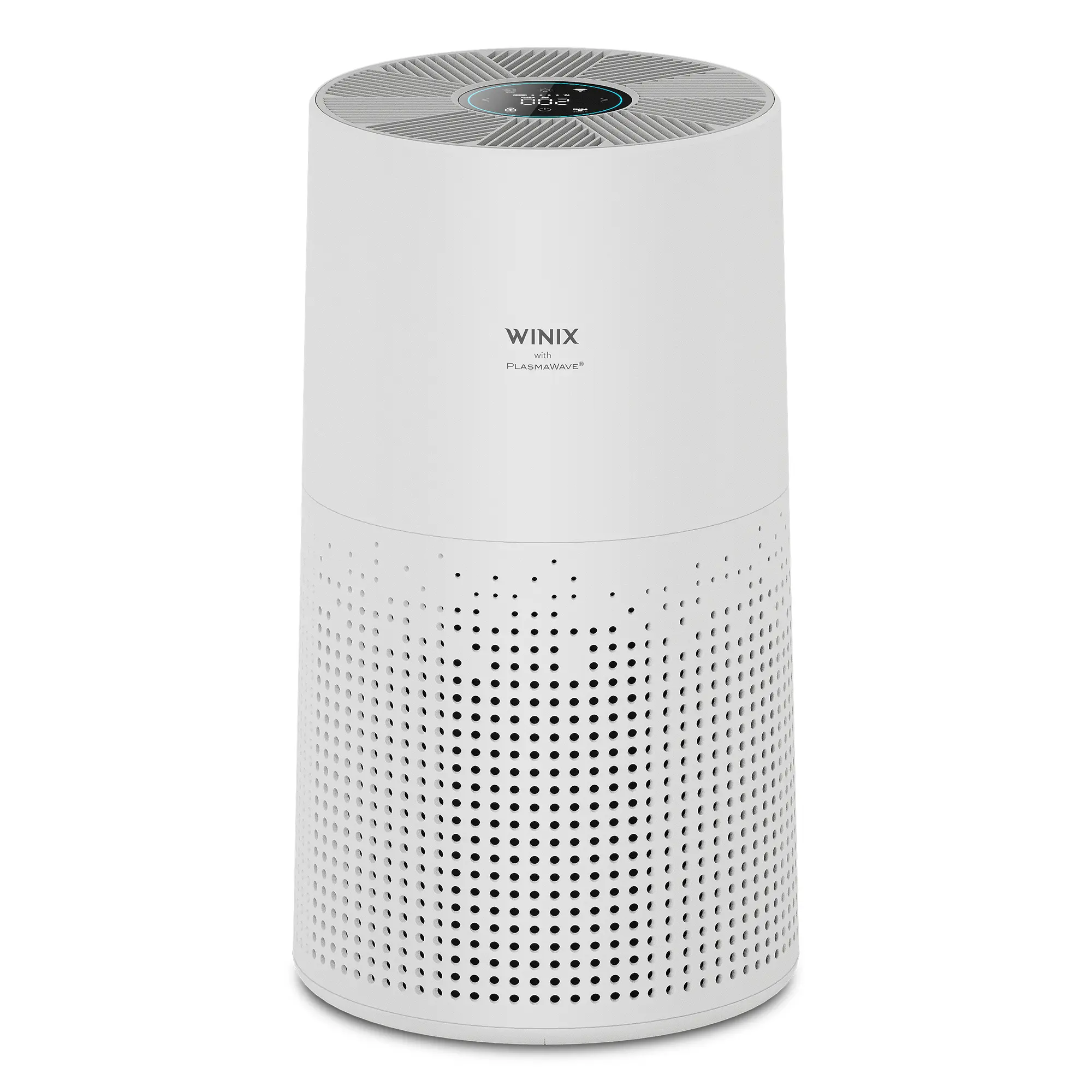
Explore this need in the finder →The Winix C710 is a connected, cylindrical room purifier whose U.S. product page gives it an AHAM Verifide room figure of 384 square feet at 4.8 air changes per hour (ACH). That is the number to compare when a room needs repeated cleaning; it is not interchangeable with the much larger 1,844-square-foot, one-hour headline. Winix also lists 922 square feet in 30 minutes, 614 in 20 and 461 in 15. Open plans, high ceilings and noise-sensitive operation can reduce practical fit.
Room rating, not the biggest headline
At 384 square feet on the stated 4.8-ACH basis, the C710 clears the library's medium-room threshold of 358 square feet but not its 606-square-foot large-room threshold. The direct product page names this as AHAM Verifide at 4.8 ACH; the EPA ENERGY STAR record independently lists a 384-square-foot room estimate and pollutant-specific CADRs of 248 CFM smoke, 252 dust, 262 pollen and 250 PM2.5. The EPA record also explains its room-size calculation using its own stated convention, so do not silently combine the database estimate, Winix's printed 4.8-ACH label and the one-hour headline into a single interchangeable rating. For the finder, the conservative repeated-cleaning comparison stays at 384 square feet. The more generous 1,844-square-foot number is a slower manufacturer claim, not a promise of five fast air changes each hour across that whole area.
Those are pollutant-specific CADRs, not one generic all-purpose rating. The C710's on-unit PM2.5 number is a sensor display, not a delivery-rate measurement.
Where it differs from the C610
The C710 is not a renamed C610. ENERGY STAR's model information calls it a C610 derivative with identical performance and identifies the design distinction as changed inlet and exhaust geometry plus an updated control panel. Winix's manual-page instructions support that control change: the C710 display can toggle between a numeric PM2.5 reading and an overall air-quality percentage, while a separate four-color LED provides a quick status cue. The C610's reviewed manual documents the four-color feedback but no on-unit numeric PM2.5 reading. If seeing a number at the machine matters, the C710 has the more useful documented display. If it does not, the published purifier performance is described as the same; the official record does not establish that one model cleans faster or has a larger correctly rated room than the other.
Both use the Winix Filter Z 1712-0121-00, so replacement compatibility is convenient but does not make the machines, control panels or model identifiers interchangeable. The new-unit C710 package is documented with two 360-degree all-in-one filters; the manual notes a certified refurbished unit includes one. Its approximate 12-month replacement interval is per cartridge and varies with conditions. “Up to two years” for a standard two-filter box is therefore a package arithmetic, not a two-year life for a single filter.
Controls and routine
Auto adjusts fan operation from Winix's air-quality sensors, and the manual says the ambient-light sensor can move the unit into Sleep while Auto is active. The display can be dimmed through 100%, 70%, 30% and off. Manual, Low, Medium, High, Turbo and Sleep appear as selectable modes in the manual, while the Winix technical table counts five fan speeds; Turbo and Sleep are clear, but the source's count convention is not. The minimum sound specification is 22 dB, not a published maximum across fan settings. Do not use that minimum as proof that a strict maximum-noise request is met. The EPA record identifies an automatic air-quality sensor but does not name its target pollutant; the presence of a PM2.5 screen does not by itself prove exactly what drives Auto. Gas or odor sensing remains unconfirmed.
Wi-Fi and Winix Smart App control are listed alongside the physical panel, so the C710 may suit someone who wants remote monitoring but it is not a manual-only model. Winix places the timer feature in the app. The manual also documents Wi-Fi on/off and pairing buttons, a three-second child lock, an Auto-mode light sensor, and a three-second hold to toggle PlasmaWave. PlasmaWave is a named switchable feature; the sources do not identify that button as an “ionizer control,” so a strict requirement for an ionizer switch should not be satisfied by assumption.
On setup, remove the protective film from the filter before use, then restore the filter cover and keep the unit upright on a hard, level indoor surface. Leave the documented 12–18 inches around it and keep intake and outlet vents unobstructed. The manual says vacuum or soft-brush only the pre-filter about every 14 days; it is not washable. Vacuuming the interior every one to two months and cleaning the sensor lens with a damp swab are also specified. It gives 120 V/60 Hz and 45 W. Its body-dimension line conflicts with the current product-page table, so width, depth and height remain unknown for tight-furniture matching; the manual and page both list 8.8 lb.
Limits and who should shortlist it
The Winix page markets a True HEPA filter and reports its own 99.999% capture figure at 0.1 microns. ENERGY STAR classifies the primary filter as “HEPA-Type” and explains that this label alone does not demonstrate that a filter meets its HEPA definition. Those descriptions are not the same claim; keep both visible rather than converting the marketing statement into an independent certification. The unit also includes carbon for general household odors, but no separate pet, smoke/cooking or premium cartridge profile is established on the exact Filter Z listing. It is a sensible candidate for a medium room when you value numeric local PM2.5 feedback, an app plus local buttons, a lock and a replaceable cylindrical cartridge. Look elsewhere if the room needs the large-room 4.8-ACH tier, your setup is strictly manual-only, a gas-specific sensor or specialty odor cartridge is essential, or your furniture requires a settled body-width number. It is a particle purifier, not a substitute for smoke source control, ventilation, a carbon-monoxide alarm or professional advice.
Key details at a glance
| Room area at 4.8 ACH (stated or calculated) | 384 sq ft |
|---|---|
| Published room area at 1 air change per hour | 1844 sq ft |
| Room area at 2 ACH (stated or calculated) | 922 sq ft |
| Published rated input power | 45 W |
| App control | Yes |
| Published product weight | 8.8 lb |
| On-unit numeric PM2.5 display | Yes |
| Included Pet Allergy Filter with ARC Formula | No |
| On-unit lock for accidental control changes | Yes |
| Turbo fan setting | Yes |
| Automatic pre-filter scraper and dust tray | No |
| Manufacturer filter-check/replacement guidance | Manual estimates approximately 12 months per cartridge, depending on environment. The two-filter standard package is advertised for up to two years; that is not two years from one filter. |
| Important specification note | Winix page lists 384 sq ft AHAM Verifide at 4.8 ACH, minimum noise 22 dB, 4-stage arrangement, 12M filter expectancy per cartridge, a numeric/percentage display, 5 fan speeds, app timer, dual smart sensors, Wi-Fi/Alexa/Google and Thai manufacture. EPA supplies separate CFM values and labels the filter HEPA-Type. Product-page and manual dimensions conflict; no maximum sound is published, and the manual mode count differs from the five-speed table. |
| Placement and care | Before first run remove the protective filter vinyl; keep the purifier upright on a hard, level surface with 12–18 inches from walls/electronics and open vents. Vacuum/soft-brush the nonwashable pre-filter about every 14 days; vacuum the inside every 1–2 months. Replace the complete Filter Z around every 12 months per cartridge, depending on conditions; see reset instruction conflict. |
| Purifier also has a documented circulation-fan function | No |
| Built-in heating mode | No |
| Fan-driven cooling mode | No |
| Cooling mode is air conditioning | No |
| App can activate and set heating | No |
| Built-in humidification mode | No |
| DermaSense Skin Mode documented | No |
| Water refresher listed with offer | No |
Use the exact model’s instructions for operating limits, supplied equipment and version differences.
Sources for this assessment

Check the room rating against your actual space.
Compare room-area figures at 4.8 air changes per hour, then check their stated or calculated basis, placement and filter care.