
Your needs, this model
Does it fit your priorities?
Will the Airmega 100 meet a 140-square-foot room requirement at the faster 4.8-change-per-hour basis?
Coway's exact page graphic states 167 square feet in 12.5 minutes, equivalent to one change every 12.5 minutes or 4.8 per hour. It clears 140 square feet but not a 219-square-foot threshold; the table's 810-square-foot figure is only at one change per hour.
Explore this need in the finder →Can it be selected when I need a manufacturer-listed 2-ACH area of at least 400 square feet?
Yes. Coway's specification table gives 405 square feet at two air changes per hour. This is a separate, slower basis from the page's 167-square-foot/12.5-minute artwork.
Explore this need in the finder →Can I use sensor-led Auto and direct buttons without setting up an app?
Yes. The page and manual document a PM2.5 sensor, Auto and numbered speeds on the appliance, plus a four-color grille indicator. The exact manual does not document app or Wi-Fi operation, and its indicator is not a numeric reading.
Explore this need in the finder →Does its AQI/light control include a selectable night-light setting?
Yes. The manual says its AQI/light control cycles through the color AQI light, a night light, and all lights off. That does not turn the color indicator into a numeric PM2.5 display.
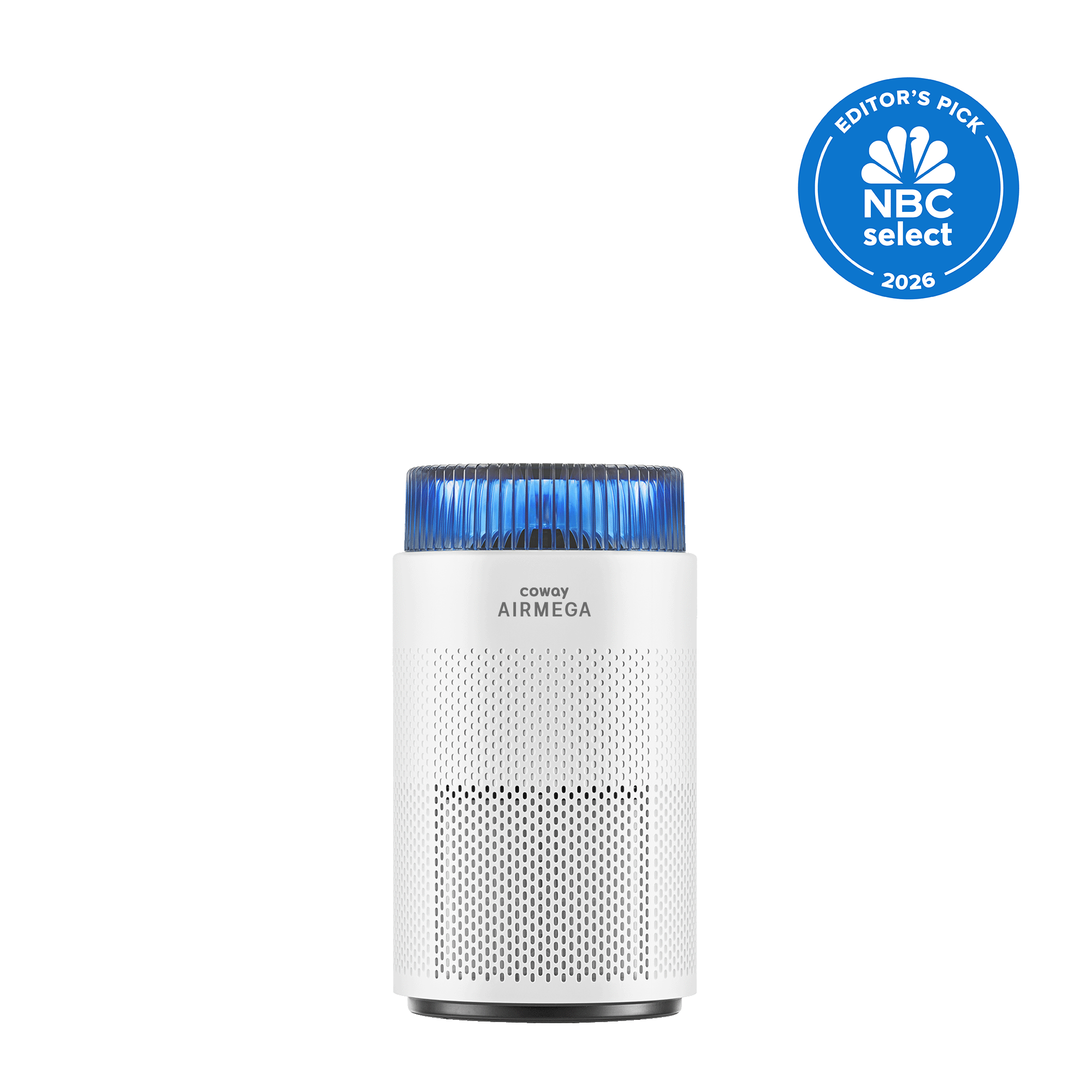
Explore this need in the finder →The Coway Airmega 100 is a compact cylindrical room purifier built around local touch controls, a PM2.5 sensor and a three-in-one replacement filter. It suits a small bedroom or study where you want sensor-led Auto mode and a night light without app setup, and where the real room-size basis is clear. Do not choose it by the prominent 810-square-foot headline alone: that is the one-air-change figure, not its faster cleaning area.
Start with the rate behind the room number
Coway's specification table gives 810 square feet at one air change per hour and 405 square feet at two air changes per hour. A separate graphic on that same exact product page shows 167 square feet in 12.5 minutes. One change in 12.5 minutes is 4.8 changes per hour, so that artwork supports a derived 167-square-foot, 4.8-ACH comparison. It does not label the figure as “4.8 ACH,” and the specification table itself omits that row; keep the basis visible rather than presenting 810 square feet as equivalent. In the usual 4.8-ACH finder, the Airmega 100 clears a 140-square-foot compact threshold but not a 219-square-foot small-room threshold. Its explicit two-change figure is useful for a different requirement. The manufacturer publishes smoke, dust and pollen CADR separately—108, 124 and 112 CFM—so there is no single generic CADR value to plug into a strict universal-CADR limit.
These are Coway ratings, not measurements from this review, and do not guarantee the same air change in an open-plan space or at every fan setting. For a room larger than 167 square feet at this basis, the Airmega 150 has a larger published 214-square-foot 4.8-ACH rating; compare its filter routine and body shape before deciding.
What the controls do in one usable plan
The top panel switches between Auto and three numbered fan speeds. Its PM2.5 sensor changes airflow automatically in Smart Mode; the illuminated grille gives four color levels—blue, green, orange and purple—not a numeric reading. The model manual documents local controls but no app-pairing or Wi-Fi procedure. Select Auto for everyday particle response, use a manual speed when preferred, then choose Sleep at bedtime. Sleep reduces fan speed, noise and power draw. The page lists 20–48 dB(A), not independent bedroom measurements.
The AQI/light button cycles through the color indicator, a night light, and lights off. A built-in timer offers one, two, four or eight hours, and a panel lock helps prevent accidental button presses. These functions are more useful than the very small chassis suggests, but they do not create a numeric monitor, gas sensor, app control or a dedicated pet-cleaning program. If you need a screen value or remote scheduling, choose a model whose exact manual documents those features.
Keep the filter routine simple, not invisible
Airmega 100 uses one 3-in-1 cartridge containing a vacuumable pre-filter, HEPA stage and deodorization stage. Coway lists a one-year filter life and a replacement indicator; after changing the cartridge, the manual says to hold the reset control for three seconds. The pre-filter catches visible hair and larger debris, so gently brush or vacuum its surface when dust builds up. The manual says not to wash or reuse the filter. It also recommends cleaning the particle sensor's inlet and outlet every two months, more often in dusty surroundings. That recurring care is modest, but the filter is a combined unit rather than three independently scheduled replacements.
For unpacking, turn the appliance over, remove the rear cover and take the filter out; remove its plastic wrap, then reinstall it and the cover before plugging in. The grounded U.S. specification is 120 V/60 Hz. The body is 8.7 inches wide and deep, 15.6 inches tall and 6.6 pounds, but a cylinder still needs open intake and outlet space. The manual also advises keeping it away from humid areas, windows and direct sun. Leave room around it instead of treating the body width as the whole furniture opening.
Choose the offer, not just the model name
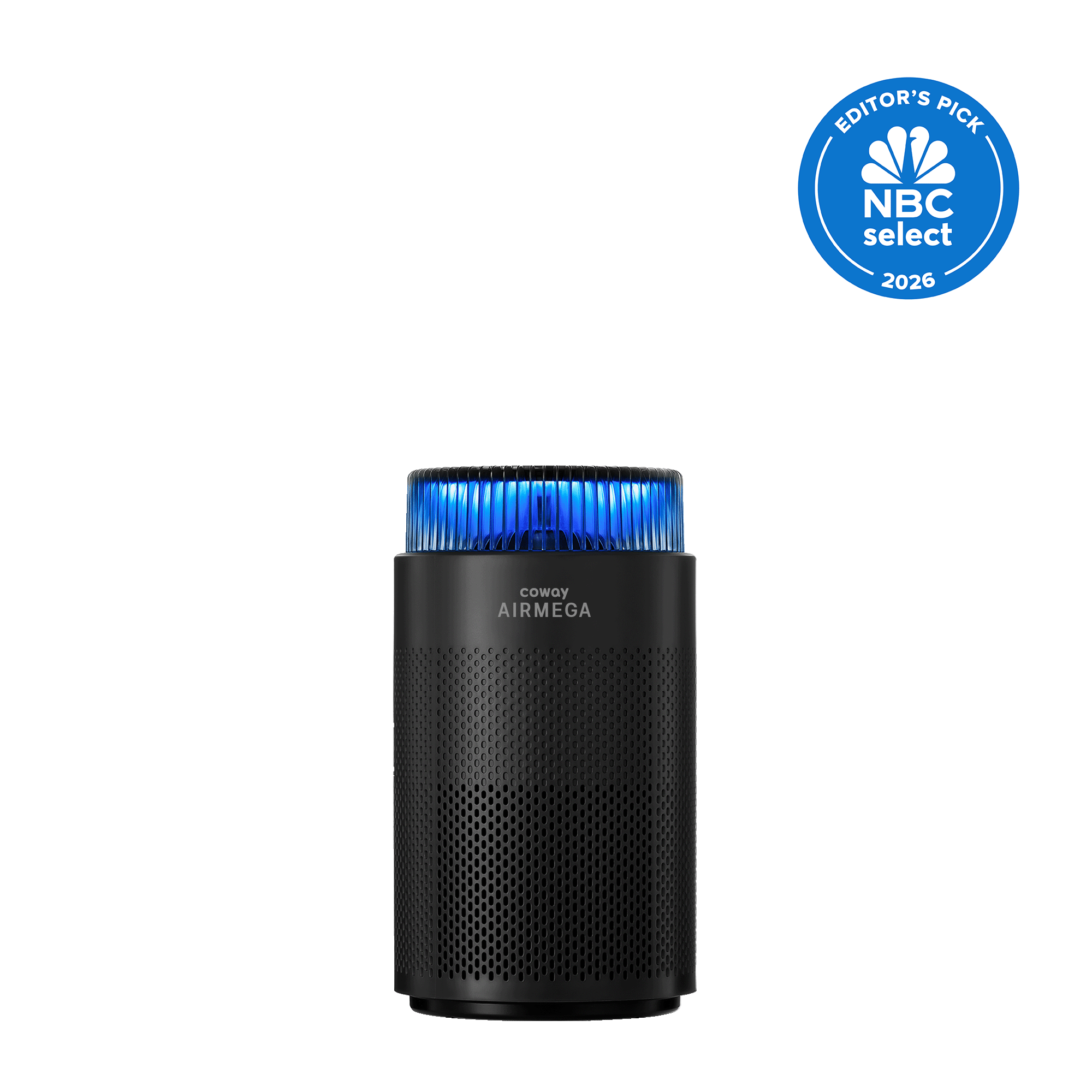
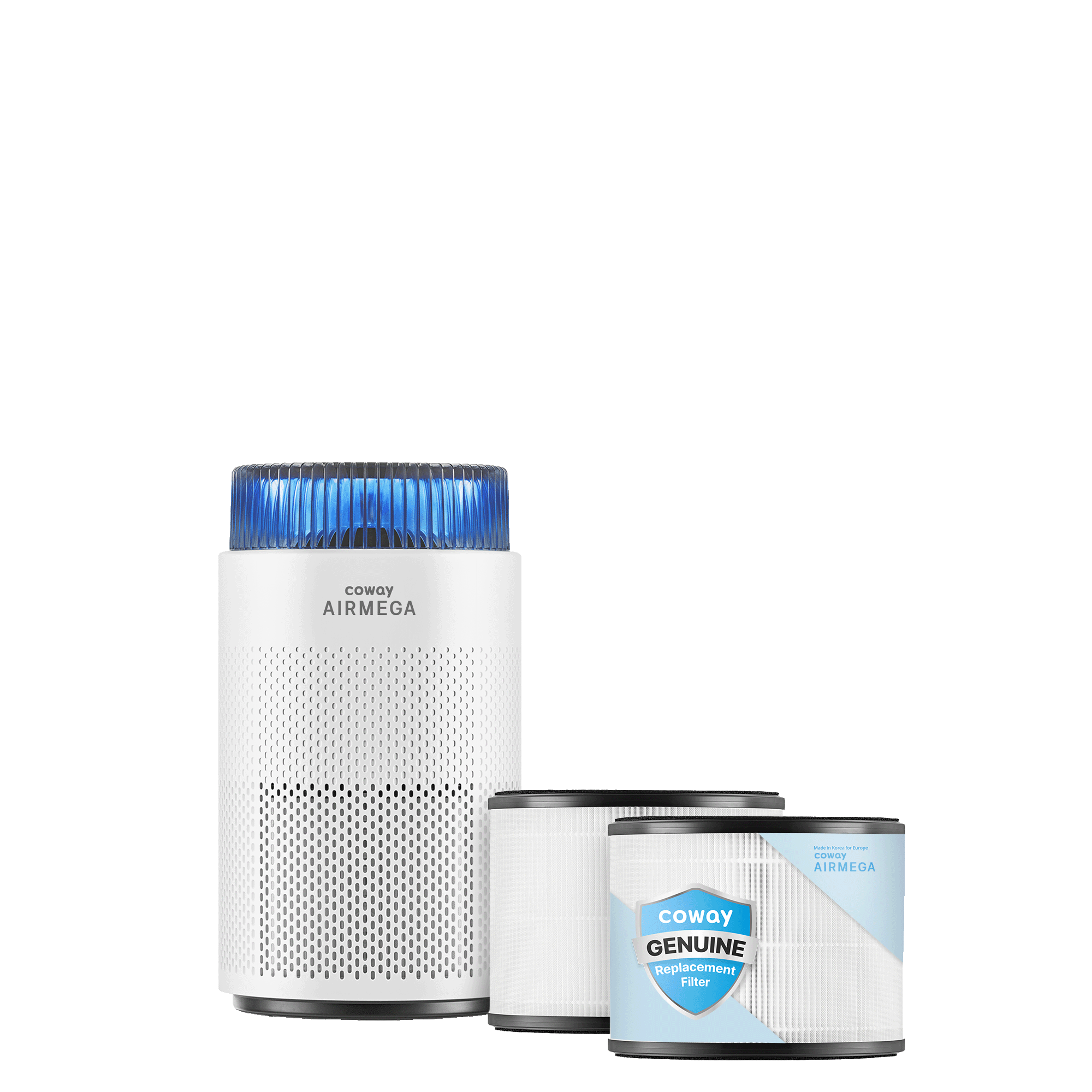
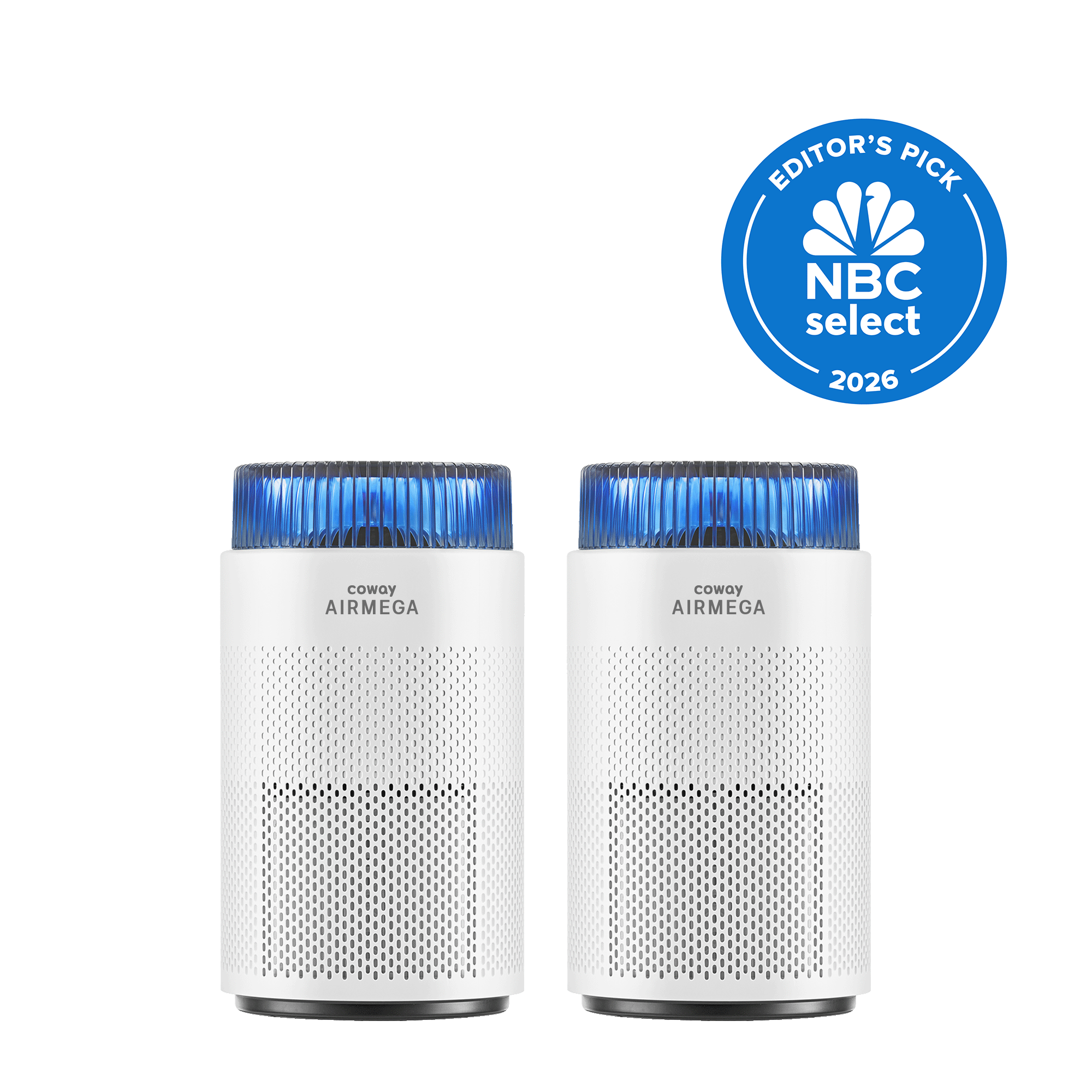
The manual covers Airmega 100, AP-0823E, and the W and B finish suffixes. Coway's exact U.S. product record offers white (SKU 826439000783) and black (SKU 826439000943). Two collection cards are packages of the same purifier, not different machines: the filter bundle is one white unit with one filter installed plus one spare, while the two-pack is two white Airmega 100 units. These are packages, not upgraded purifiers. Their images show the extra cartridge and two-unit quantity.
Choose Airmega 100 when a compact direct-control cylinder, its 167-square-foot 4.8-equivalent area, color feedback and night-light option suit the room. Step up to the Airmega 150 if you need the higher 214-square-foot published 4.8-ACH area, a separate washable pre-filter, or the shallower front-intake body. The 100's 405-square-foot two-ACH number can also help compare lower-rate plans, but it must not be substituted for a faster room-size requirement. If a verified 4.8-ACH area, numeric PM2.5 display, gas sensing or app control is essential, use those exact requirements to screen alternatives rather than relying on the larger one-change headline.
Compare the Airmega 100 and Airmega 150 by rate, footprint and filter care, or read the Airmega 150 assessment.
Primary references: Coway Airmega 100 page and its model-specific manual.
Key details at a glance
| Room area at 4.8 ACH (stated or calculated) | 167 sq ft |
|---|---|
| Published room area at 1 air change per hour | 810 sq ft |
| Room area at 2 ACH (stated or calculated) | 405 sq ft |
| Published rated input power | 25 W |
| App control | No |
| Body width | 8.7 in |
| Body depth | 8.7 in |
| Body height | 15.6 in |
| Published product weight | 6.6 lb |
| On-unit numeric PM2.5 display | No |
| Included Pet Allergy Filter with ARC Formula | No |
| On-unit lock for accidental control changes | Yes |
| Turbo fan setting | No |
| Automatic pre-filter scraper and dust tray | No |
| Separate TVOC sensor | No |
| Manufacturer filter-check/replacement guidance | The manual and product page state a one-year filter life/expectancy and a replacement indicator. It tells the owner to brush or vacuum visible dust from the pre-filter; it does not give a separate calendar interval for that surface cleaning and says not to wash or reuse the filter. Reset the indicator by holding its control for three seconds after replacement. |
| Important specification note | The page's table gives room area at 1 and 2 ACH; its separate product-page image supplies a 167-ft²/12.5-min figure, equivalent to 4.8 changes/hour. CADR is pollutant-specific. Do not use the 810-ft²/one-change figure for the 4.8-ACH matcher. |
| Placement and care | The removable pre-filter is vacuumable, not washable. Replace the combined filter at the listed one-year expectancy and heed its indicator; clean the particle sensor about every two months. Keep the cylindrical air paths open. |
Use the exact model’s instructions for operating limits, supplied equipment and version differences.
Sources for this assessment
- Coway US Airmega 100 exact product page
- Coway official Shopify Airmega 100 product and offer record
- Coway official Airmega manual directory including Airmega 100
- Coway Airmega 100 / AP-0823E US user manual; English section
- Coway US Airmega 100 plus filter bundle exact page
- Coway official Shopify filter-bundle offer record
- Coway US Airmega 100 two-unit bundle exact page
- Coway official Shopify two-unit bundle offer record
- Coway Airmega 100 exact product-page room/rate artwork
- CPSC targeted exact-name recall query for Coway Airmega 100
- CPSC targeted exact-model recall query for AP-0823E

Check the room rating against your actual space.
Compare room-area figures at 4.8 air changes per hour, then check their stated or calculated basis, placement and filter care.