
Your needs, this model
Does it fit your priorities?
Does the Airmega 50 meet the personal-room floor without treating its one-change headline as a faster rating?
Yes for the 47-sq-ft personal tier. Coway lists 250 sq ft at 2 ACH; rescaling to 4.8 ACH gives a conservative 104-sq-ft comparison. Its 500-sq-ft figure is at 1 ACH and it does not reach the 140-sq-ft compact tier.
Explore this need in the finder →Can it be shortlisted if I need a compact-room 140-sq-ft rating at 4.8 ACH?
No. The calculated 4.8-ACH comparison is about 104 sq ft per unit, even though the page lists 250 sq ft at 2 ACH and 500 at 1 ACH.
Explore this need in the finder →Does the machine offer sensor-based automatic adjustment while remaining manual-only rather than app-connected?
Yes. The PM2.5 sensor changes airflow among levels 1–3 in Auto mode, and the controls are physical; app control is not documented for this model.
Explore this need in the finder →Is its air-quality feedback sufficient if color is acceptable but a numeric PM2.5 value is essential?
Color only is supported; a numeric value on the purifier is not documented. If a numeric on-unit PM2.5 reading is essential, it must be excluded.
Explore this need in the finder →Can the numeric CADR question verify a CFM minimum from Coway's exact-page figures?
No. Coway lists smoke, dust and pollen CADR figures but prints no unit alongside them on the exact page, so they do not establish a verified CFM threshold.
Explore this need in the finder →Does the Airmega 50 manual document a separate TVOC sensor for a household that needs gas readings?
No separate TVOC measurement is documented; the manual identifies a PM2.5 particle sensor. An essential TVOC requirement is not met by particle sensing or broad product-page language.
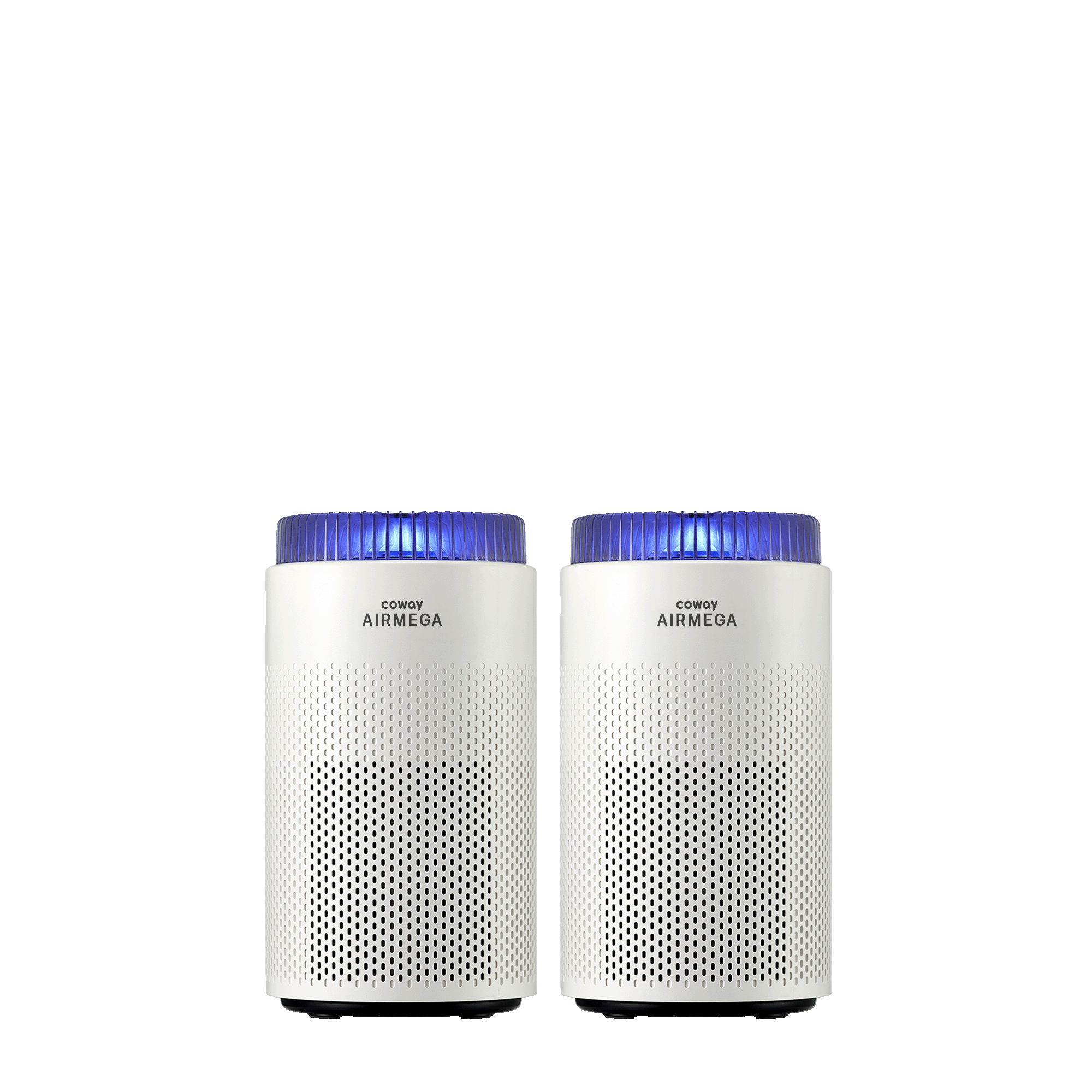
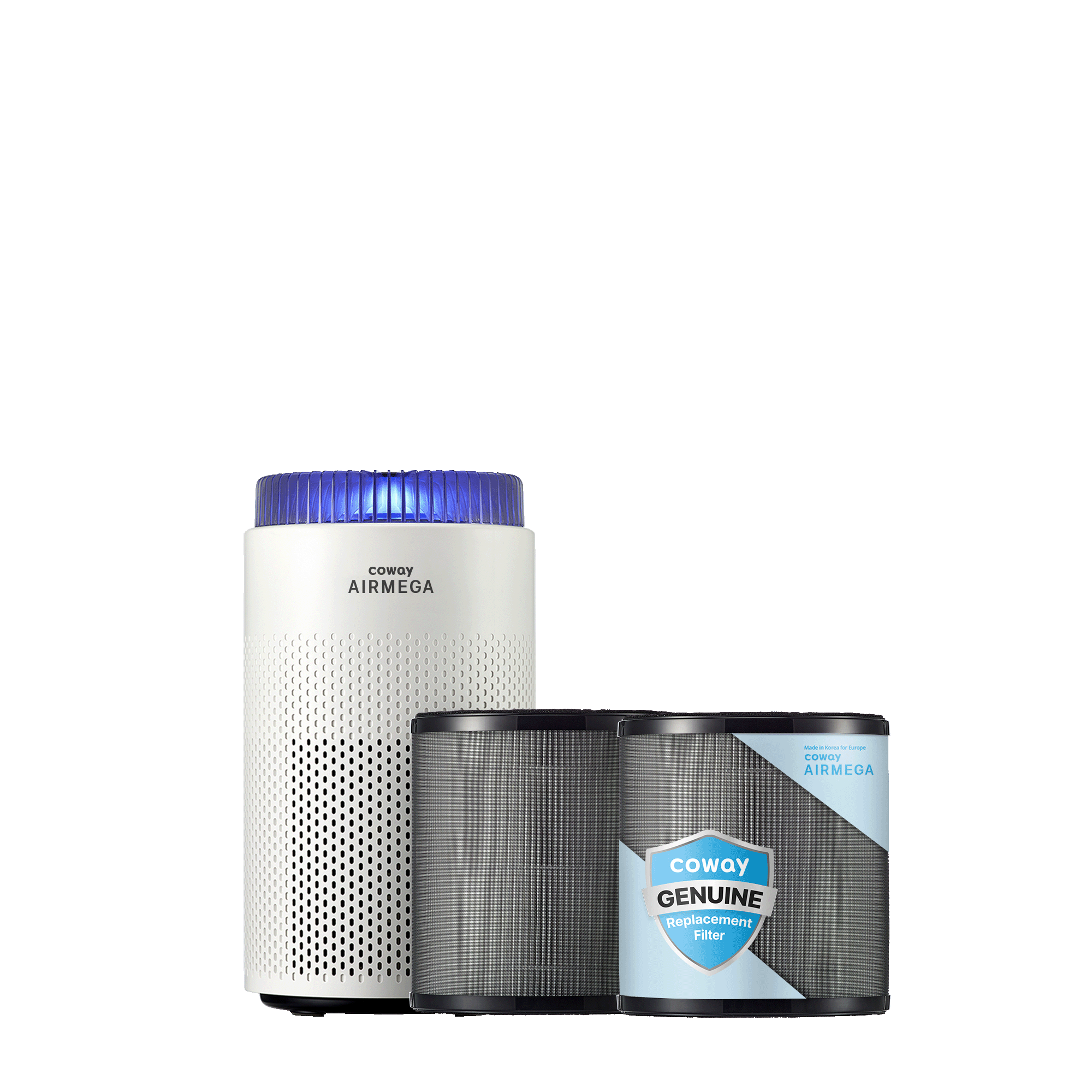
Explore this need in the finder →The Coway Airmega 50 is a very small, direct-control room purifier for a personal space rather than a compact bedroom that needs the next coverage tier. It adds particle-responsive Auto, a color-only AQI light and a night-light setting to a tiny cylinder, but its rate-based room figures are modest: Coway lists 250 square feet at two air changes per hour. The observed U.S. packages are either two White machines or one White machine with a spare filter. Room ratings below apply to each Airmega 50, not to combined coverage in one room.
Use the faster room rating, not the headline
Coway's specification table gives 500 square feet at one air change per hour and 250 square feet at two. A 4.8-ACH comparison derived from the latter is about 104 square feet: 250 × 2 ÷ 4.8, rounded down. That is well above the site's 47-square-foot personal-room baseline, but below the 140-square-foot compact tier. The 500-square-foot one-change figure is a slower basis and should not be used to size a room where repeated cleaning is the goal. These are manufacturer ratings, not room measurements from this review; doorways, ceiling height, placement and the fan level you actually run all matter.
Coway publishes CADR figures of 66.7 for smoke, 74 for dust and 95.3 for pollen, but the exact page prints no unit beside those numbers. They are pollutant-specific rather than one generic CADR score, and their units cannot be treated as confirmed for a strict CFM minimum. A room threshold above the personal tier points instead toward the Airmega 100, which Coway rates at 405 square feet at two ACH and whose product-page graphic supports a larger 167-square-foot 4.8-ACH equivalent.
Automatic response, but no numeric monitor
The Airmega 50 has a PM2.5 particle sensor and local Auto mode. The manual says Auto can adjust between airflow levels 1, 2 and 3; those same speeds are also selected directly. A colored AQI light offers a broad status cue, not a number you can read from the appliance. The manual calls its highest category purple, while the product page calls it red, so rely on the existence of the color-only indicator rather than a specific fourth color. It does not provide a documented numeric on-unit PM2.5 value.
A separate button cycles through the AQI light, a night light and all lights off. Sleep lowers airflow, noise and power draw; the timer offers one, two, four or eight hours, the lock is held for three seconds, and sensor sensitivity has three settings. This is a practical local-control routine, but the manual gives no phone-pairing steps and Coway's listed compatible models omit the Airmega 50. If app scheduling or numeric particle readings are essential, choose a model whose manual documents them.
One replaceable assembly and straightforward care
The included filter is a 3-in-1 assembly with a pre-filter, particulate-filter stage and deodorization stage. Coway says it is vacuumable and gives an eight-month life expectancy; the manual independently lists eight months and warns not to wash or reuse the filter. Treat that interval as a reference rather than a guarantee: dust load and hours of operation can change when replacement is due. The pre-filter surface can be brushed or gently vacuumed dry, but the manual does not describe it as washable. A replacement indicator appears on the control panel, and the manual says to reset it after the new filter is installed.
For replacement, unplug the purifier, turn it upside down, open the rear cover and seat the new cartridge after removing its plastic wrapping. Clean the sensor openings about every two months, more often in dusty surroundings; accumulated dust can make it report more pollution than is present. The exterior should be wiped with a dry cloth. This is simpler than managing separate stages, but the eight-month expectancy is not a once-a-year interval.
Check the true package and the available space
The manual names Airmega 50(W). Coway's observed White offers are SKU 826439001803 for two machines and SKU 826439001810 for one machine plus one extra Airmega 50 filter; the second package advertises 16 months of filter supply based on two eight-month filters. Neither package changes the purifier. Both pages display sold-out/unavailable and in-stock text, although Shopify marks each variant available; verify the exact offer directly rather than trusting those conflicting stock messages.
Each unit is 6.7 inches wide and deep and 12.6 inches tall; page and manual agree after accounting for their different dimension order, and both list 14 watts. Weight is unknown for strict fit because the sources say 3.5 and 3.4 pounds. The 360-degree intake and top outlet need open airflow. The manual specifies indoor household use at 120 V/60 Hz. Product-page copy mentions VOCs, but the manual documents only PM2.5 sensing, not a separate gas/TVOC measurement.
Who is likely to prefer it?
Choose the Airmega 50 for a personal room within roughly 104 square feet at the calculated 4.8-ACH basis, when local Auto, a color cue, night light and a one-piece filter suit you. Two units can cover two separate small rooms; they do not double one room's rating. Compare the Airmega 100 for a larger room, its 405-square-foot 2-ACH rating or its one-year listed filter expectancy. Avoid this model if a 140-square-foot 4.8-ACH minimum, app, numeric display, verified weight or confirmed gas sensing is essential.
Compare the Airmega 50 and Airmega 100 by room rate, controls and filter routine, or read the Airmega 100 assessment.
Primary references: Coway's two-unit offer, filter-bundle offer and Airmega 50 user manual.
Key details at a glance
| Room area at 4.8 ACH (stated or calculated) | 104 sq ft |
|---|---|
| Published room area at 1 air change per hour | 500 sq ft |
| Room area at 2 ACH (stated or calculated) | 250 sq ft |
| Published rated input power | 14 W |
| App control | No |
| Body width | 6.7 in |
| Body depth | 6.7 in |
| Body height | 12.6 in |
| On-unit numeric PM2.5 display | No |
| Included Pet Allergy Filter with ARC Formula | No |
| On-unit lock for accidental control changes | Yes |
| Turbo fan setting | No |
| Manufacturer filter-check/replacement guidance | Coway's product page and manual give an eight-month filter expectancy. This is guidance, not a remaining-capacity measurement; actual life varies with use and room conditions. The manual says not to wash or reuse the filter. |
Use the exact model’s instructions for operating limits, supplied equipment and version differences.
Sources for this assessment
- Coway U.S. Airmega 50 Bundle Pack exact product page, White two-unit offer
- Coway official Shopify Airmega 50 Bundle Pack product/offer record
- Coway Airmega 50 U.S. user manual, English pages
- Targeted U.S. CPSC recall query for Coway Airmega 50
- Coway U.S. Airmega app-compatible model list
- Exact Coway Airmega 50 White two-unit bundle manufacturer render
- Coway U.S. Airmega 50 plus filter bundle exact product page
- Coway official Shopify Airmega 50 plus filter bundle offer record
- Exact Coway Airmega 50 single-unit plus filter-bundle manufacturer render


Check the room rating against your actual space.
Compare room-area figures at 4.8 air changes per hour, then check their stated or calculated basis, placement and filter care.