
Your needs, this model
Does it fit your priorities?
Does the EverestAir-P meet a 358-ft² minimum at the product page's stated 4.8 ACH rate?
Its current US page lists 549 ft² at 4.8 ACH, above 358 ft². The manual instead labels 549 ft² at 5 ACH, so use the page basis and keep the rate difference visible.
Explore this need in the finder →Can I see numeric PM1.0, PM2.5 and PM10 readings on the unit without the app?
Yes. The manual's Air Info control cycles between those three particle ranges and an approximate clean-air percentage. None is a gas or odor reading.
Explore this need in the finder →Can its outlet angle be changed when I need to direct air around furniture?
Yes. The manual lists physical angle choices at 45°, 60°, 75° and 90°; the app can set intermediate angles. Keep the front intake clear regardless of outlet direction.
Explore this need in the finder →Will built-in wheels help reposition it on a level floor?
Yes. The product page and manual show wheels beneath the cabinet. It still weighs 20.7 lb, so the wheels do not make it a light purifier to carry up stairs.
Explore this need in the finder →Does the EverestAir-P document a separate TVOC sensor?
No. The page and manual identify three particle-size channels. Carbon filtration claims do not establish gas sensing, and the manual says the particle sensor cannot detect gases.
Explore this need in the finder →Can the body fit a 20-inch width limit while leaving front airflow space?
Its published body width is 18.9 inches, within a 20-inch body limit. The manual still calls for at least 15 inches of front clearance, so the furniture opening must be larger than the cabinet.
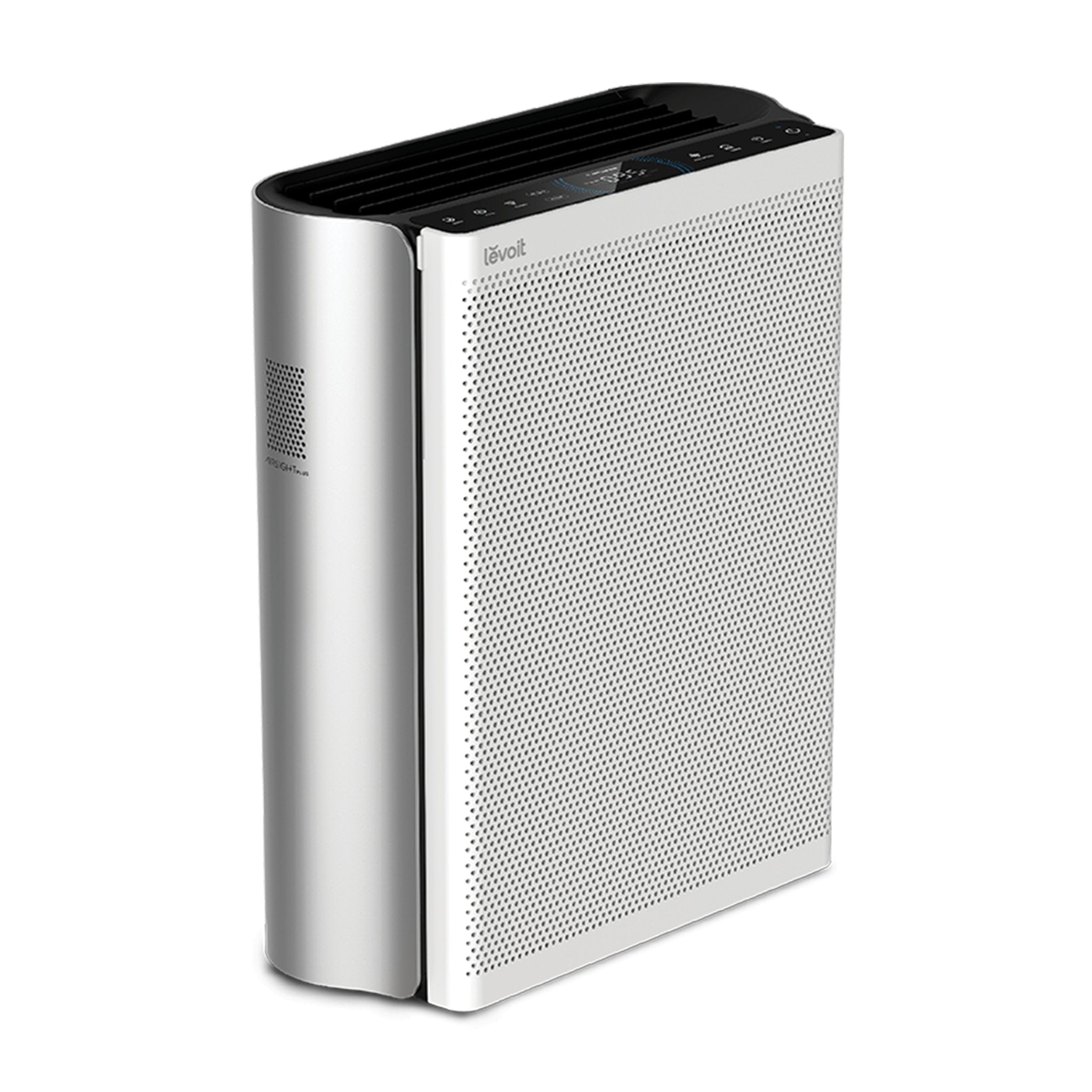
Explore this need in the finder →The EverestAir-P is Levoit’s large, rectangular smart purifier with a useful difference from a plain high-output box: its top outlet can be turned to four physical angles, it rolls on built-in wheels, and its display can show three particle ranges. Those features make placement more adaptable, but they do not replace careful room sizing or filter maintenance.
Use the faster room rating, and keep its rate basis in view
Levoit’s current US product page lists 549 square feet at 4.8 air changes per hour and 2,635 square feet at one air change per hour. The first is the more practical starting point for a shortlist that requires repeated cleaning. The directly linked manual gives 549 square feet at five air changes per hour and 1,373 square feet at two; the manual and page therefore present different room-area/rate pairs. I would use the current page’s stated 4.8-ACH figure for the site’s comparison, while keeping that discrepancy visible rather than converting or combining the manual’s figures. A 606-square-foot minimum is above its published 4.8-ACH area, even if a large living-room illustration appears to suggest otherwise.
The listed CADR is 354 CFM. The smaller Core 600S-P is rated at 606 square feet at 4.8 ACH and 391 CFM, so it remains the stronger pick when the essential requirement is the highest documented repeated-air-change room rating. EverestAir-P instead suits someone who values the outlet direction and wheeled cabinet. Open plans, unusually high ceilings, doors left open and a fan setting you will not use can all make a headline room figure a poor prediction of everyday results.
Its shape needs planning, though the wheels help
The manufacturer lists a body measuring 18.9 by 8.5 by 23.2 inches and a weight of 20.7 pounds in the manual. The shallow depth can help it sit beside furniture, but the long front face takes more width than a Core 600S-P’s roughly 12.3-inch circular body. Wheels under the base make it easier to reposition along a level floor; they do not make a 20.7-pound appliance easy to lift or move between floors.
Air enters through the front and exits through a controllable top vent. The manual calls for at least 15 inches of open space at the front. It does not give the Core 600S-P’s all-side clearance rule, so don’t copy that instruction onto this model—but don’t wedge the intake behind a chair, curtain or cabinet either. The outlet angle can rotate among 45, 60, 75 and 90 degrees using the physical button, with intermediate angles available through the app. Aim the stream around furniture only after preserving the required front clearance.
Particle feedback is detailed, not a gas diagnosis
AirSight Plus 2.0 uses a three-channel laser dust sensor. The Air Info control cycles the built-in display through PM1.0, PM2.5, PM10 and a clean-air percentage. The manual describes that percentage as approximate and algorithmic. Neither the particulate readings nor the colored indicator identify a particular source, diagnose a health risk or measure a gas. Levoit’s filter material may adsorb some fumes and VOCs, but that does not mean the EverestAir-P has a TVOC sensor.
Auto Mode adjusts fan speed in response to particles; it does not use Turbo. The unit also has low, medium and high manual speeds, a separate Turbo mode, and a Sleep mode quieter than low. A light sensor can dim the display and, when active, restrain Auto from using high or Turbo in a dark room. This may be useful overnight, but a person who needs maximum airflow while the room is dark should review that behavior. VeSync adds remote control, schedules, a longer timer, ECO Auto and display lock. Initial setup requires Bluetooth, a secure 2.4-GHz Wi-Fi network and an account; basic buttons still work without app setup.
Budget attention for both filter and sensor
The supplied three-stage arrangement has a washable pre-filter and one combined main/activated-carbon replacement; there is no documented choice of separate odor-profile cartridges. The manual and dedicated replacement page suggest checking or replacing the main filter around 12–15 months, with actual life depending on use and pollution. Clean the pre-filter every two to four weeks, either with a soft brush or vacuum or by washing it with mild detergent; let it dry completely before reinstalling. The manual also calls for vacuuming the particle-sensor openings about every three months. Do not wash the main filter.
Noise is another comparison to treat cautiously: the current product page says 24–56 dB, while the manual says 24–55 dB. The shared 24-dB lower figure is not the whole operating range, and neither source supplies an A-weighted qualifier. I would not use the maximum as a strict fit promise.
Who should shortlist it?
Choose the EverestAir-P when a medium or near-large enclosed room fits the 549-square-foot page rating, you want local particle numbers, and adjustable outlet direction or wheels solve a real placement problem. Skip it for a confirmed 606-square-foot 4.8-ACH requirement, a tight width limit, a TVOC measurement requirement, or a filter routine that depends on an odor-specific replacement profile. If you do not need moving wheels or a directional outlet, the Core 600S-P gives a higher published room rating in a narrower body; it has its own power-specification conflict, so a hard watt ceiling should not be treated as settled there.
This is a source-based assessment of manufacturer specifications and care instructions, not a laboratory test or a claim of personal ownership. Read the EverestAir-P versus Core 600S-P comparison for the trade between room rating, shape and directional airflow, and see the filter-care guide before planning its recurring chores.
Manufacturer references: EverestAir-P product page, 28-page US manual, and compatible replacement filter.
Key details at a glance
| Room area at 4.8 ACH (stated or calculated) | 549 sq ft |
|---|---|
| Published room area at 1 air change per hour | 2635 sq ft |
| Clean air delivery rate (CADR) | 354 CFM |
| Published rated input power | 70 W |
| App control | Yes |
| Body width | 18.9 in |
| Body depth | 8.5 in |
| Body height | 23.2 in |
| Published product weight | 20.7 lb |
| On-unit numeric PM2.5 display | Yes |
| Included Pet Allergy Filter with ARC Formula | No |
| On-unit lock for accidental control changes | No |
| Turbo fan setting | Yes |
| Automatic pre-filter scraper and dust tray | No |
| Separate TVOC sensor | No |
| Placement and care | Remove plastic from the preinstalled filter before use; keep the front intake clear, maintain at least 15 inches of front clearance, and avoid essential-oil diffusers or excessive humidity. Wash and fully dry the pre-filter every 2–4 weeks, check the combined main filter when the reminder illuminates, and vacuum the dust-sensor openings every three months. |
Use the exact model’s instructions for operating limits, supplied equipment and version differences.
Sources for this assessment
- Levoit EverestAir-P exact current US product page
- Official Shopify offer record for EverestAir-P
- Levoit EverestAir-P US user manual, 28 pages
- Levoit EverestAir-P exact compatible replacement filter
- Targeted official CPSC exact product-name query
- Targeted official CPSC exact page-model query
- Targeted official CPSC exact offer-SKU query
Check the room rating against your actual space.
Compare room-area figures at 4.8 air changes per hour, then check their stated or calculated basis, placement and filter care.