
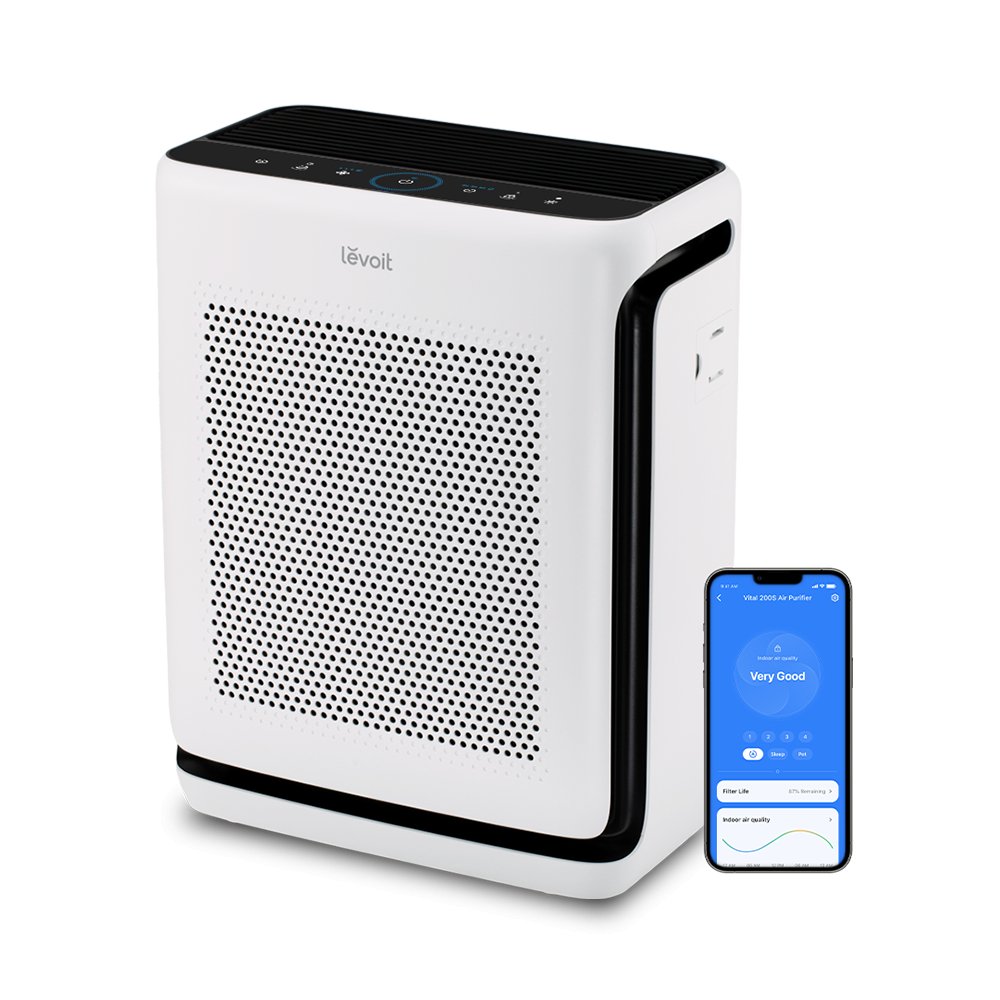
Your needs, this model
Does it fit your priorities?
Does the Vital 200S-P meet a room requirement of at least 358 sq ft at 4.8 air changes per hour?
Levoit publishes 388 sq ft at 4.8 ACH. That is 30 sq ft above a 358-sq-ft minimum, but the manual cautions that purification takes longer above 380 sq ft. Use the published figure as a comparison, not a promise for an open plan, high ceiling or speed you will not run.
Explore this need in the finder →Would you use an app-based Pet Mode that cycles between high and medium fan speeds?
The manual describes 15 minutes at high followed by 60 minutes at medium in a repeating Pet Mode cycle. In a dark room the light-detection setting can limit it to medium, so the mode is not a promise of nonstop maximum output.
Explore this need in the finder →Is a color air-quality indicator sufficient, or do you need a numeric PM2.5 value on the purifier itself?
The manual shows a color-coded indicator and app-based air-quality updates; it does not document a numeric PM2.5 display on the unit. If the local number is essential, compare the Core 400S-P or 600S-P instead.
Explore this need in the finder →Can the purifier's 15.6-inch body width fit before you account for the airflow space it needs?
The body is 15.6 inches wide. The manual separately asks for at least 15 inches of clearance at the front; leave the air path unobstructed rather than treating body width as a complete cabinet-opening measurement.
Explore this need in the finder →The Vital 200S-P is a square-bodied smart purifier whose strongest case is a room with pets and a real need for more airflow than Levoit's compact cylinders provide. Levoit lists a 250 CFM clean-air delivery rate (CADR), with a 388-square-foot room rating at 4.8 air changes per hour and a separate 1,862-square-foot figure at one air change per hour. Those figures describe very different turnover rates: use 388 square feet when comparing repeated cleaning, and do not treat the larger one-change number as the same kind of coverage. The manual also says purification takes longer above 380 square feet, a useful caution close to the advertised 4.8-ACH boundary.
Pet details are more than a label
At the front is a wide U-shaped inlet intended to help collect loose airborne fur while reducing clogging. Behind it, the manual identifies a washable pre-filter, a main particle filter and a high-efficiency activated-carbon filter. The first screen is the part you will routinely remove for lint and hair; the finer main filter is not washable. Levoit says the main filter traps at least 99.97% of 0.3-micron airborne particles and that the carbon stage adsorbs some smoke, odors, fumes and compounds. Those are filtration claims, not evidence of a medical benefit or a guarantee that every gas or smell will disappear.
The app-based Pet Mode is the more distinctive operating detail. The manual describes a repeating schedule of 15 minutes at high speed and 60 minutes at medium, rather than a fixed maximum setting. If its light-detection feature senses a dark room, Pet Mode is limited to medium to avoid making as much noise. This gives a pet household a defined higher-output cycle, but it is not an all-night turbo mode and it cannot pick up fur already resting on upholstery or floors.
Choose between an on-unit cue and a number
The Vital has Auto Mode and an infrared dust sensor. The purifier changes fan speed in response to its particle reading, and its air-quality indicator uses colors. VeSync adds live air-quality updates, recent history, remote controls, schedules and filter information. But the US manual documents a color indicator, not a numeric PM2.5 figure on the purifier itself. If checking a local number without opening an app is essential, compare the Core 400S-P or Core 600S-P. A particle sensor is not a gas detector; a carbon filter and a PM2.5 reading do not establish that all gaseous pollutants have been removed.
The panel handles on/off, Auto, Sleep, four speeds including turbo, timer, display and lock. Its timer offers 2, 4 or 8 hours; VeSync adds remote controls, schedules, filter information and a 1–24-hour timer. Voice-assistant setup goes through the app. Sleep Mode runs below low speed and dims the display, though the filter reminder can stay lit. Levoit publishes 23–54 dB; that range does not promise silence in every mode.
Give the body room to breathe
The manual lists a 15.6-inch width, 8.5-inch depth, 19.8-inch height and 13.2-pound weight. Its broad square body takes more floor width than the 10.8-inch Core 400S-P cylinder. Levoit asks for 15 inches clear in front and cautions against blocked airflow. Check the inlet, outlet and actual placement, not just the shell's footprint; a curtain or tight niche can defeat the reason to choose the larger machine.
Unwrap the supplied filter before use. Clean the removable pre-filter every two to four weeks by brushing or vacuuming; it can also be washed with mild detergent and must dry fully before reuse. Replace the main filter about every 12 months, sooner when conditions warrant or airflow and odor suggest it is spent. The indicator is a check prompt, not a lab measurement of remaining life. Clean the dust-sensor lens about every two months. Unplug before opening or servicing the housing.
Three identities, one reviewed purifier family
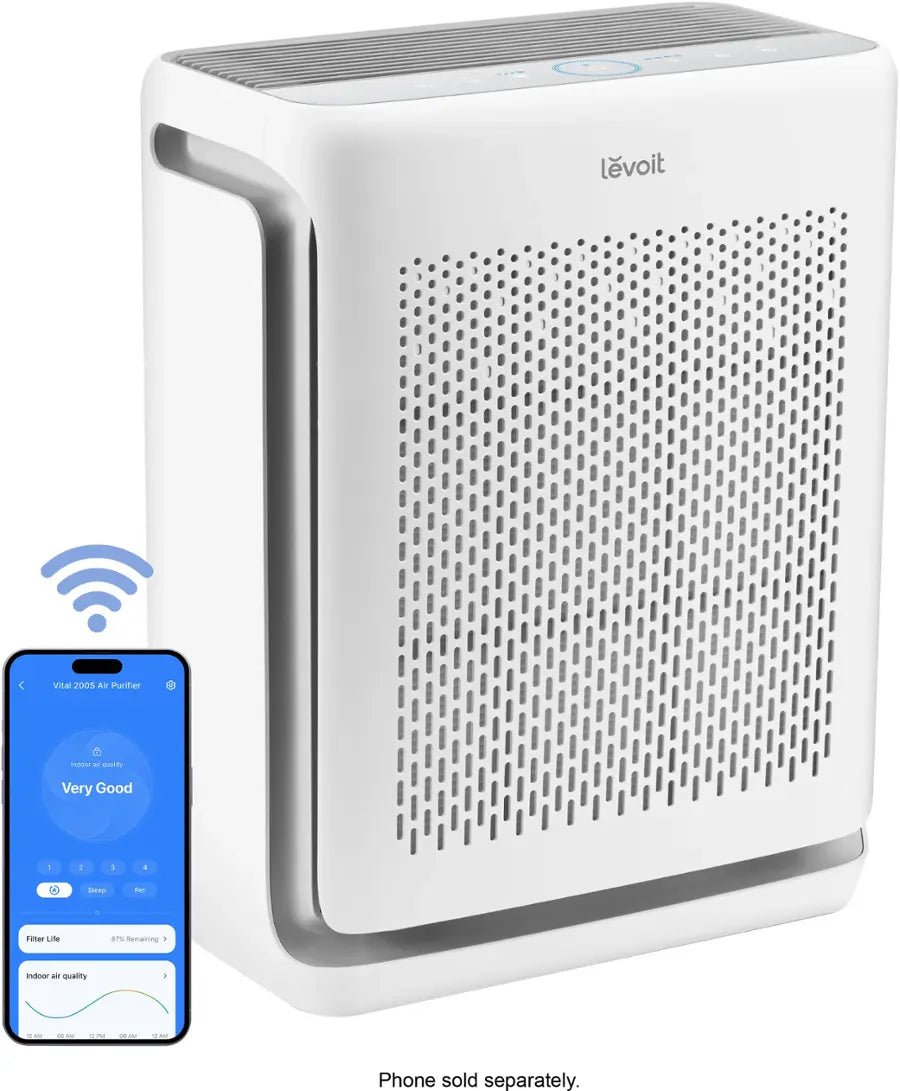
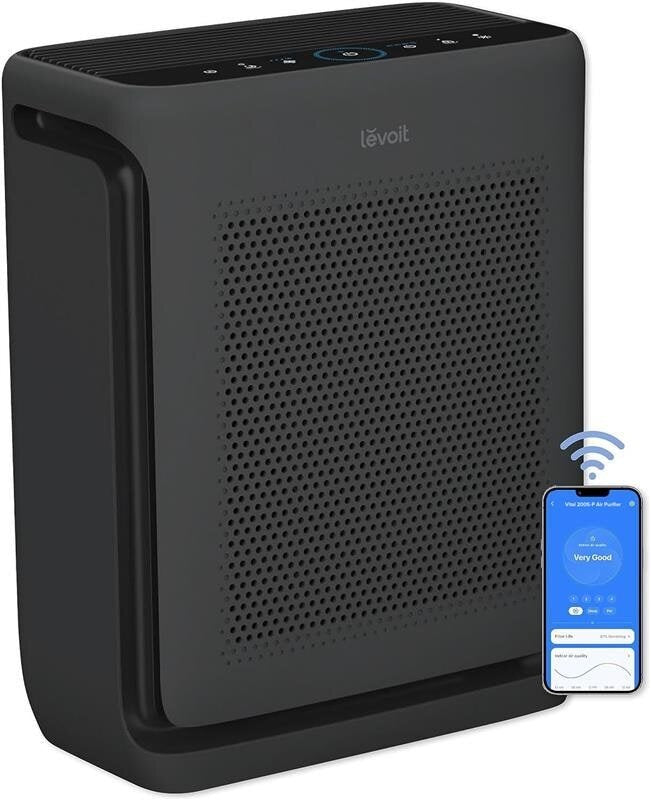
Levoit lists base SKU HEAPAPLVSUS0124A, White/Grey HEAPAPLVSUS0138Y and Black HEAPAPLVSUS0166Y. The base and black pages name LAP-V201S-WUS, and the linked manual covers WUS/KUS versions. The White/Grey page shows the same Vital 200S-P name but a shorter spec panel. These three exact pages show the same body and operation; finish is the only established machine difference. Check the SKU and color when comparing retailer offers.
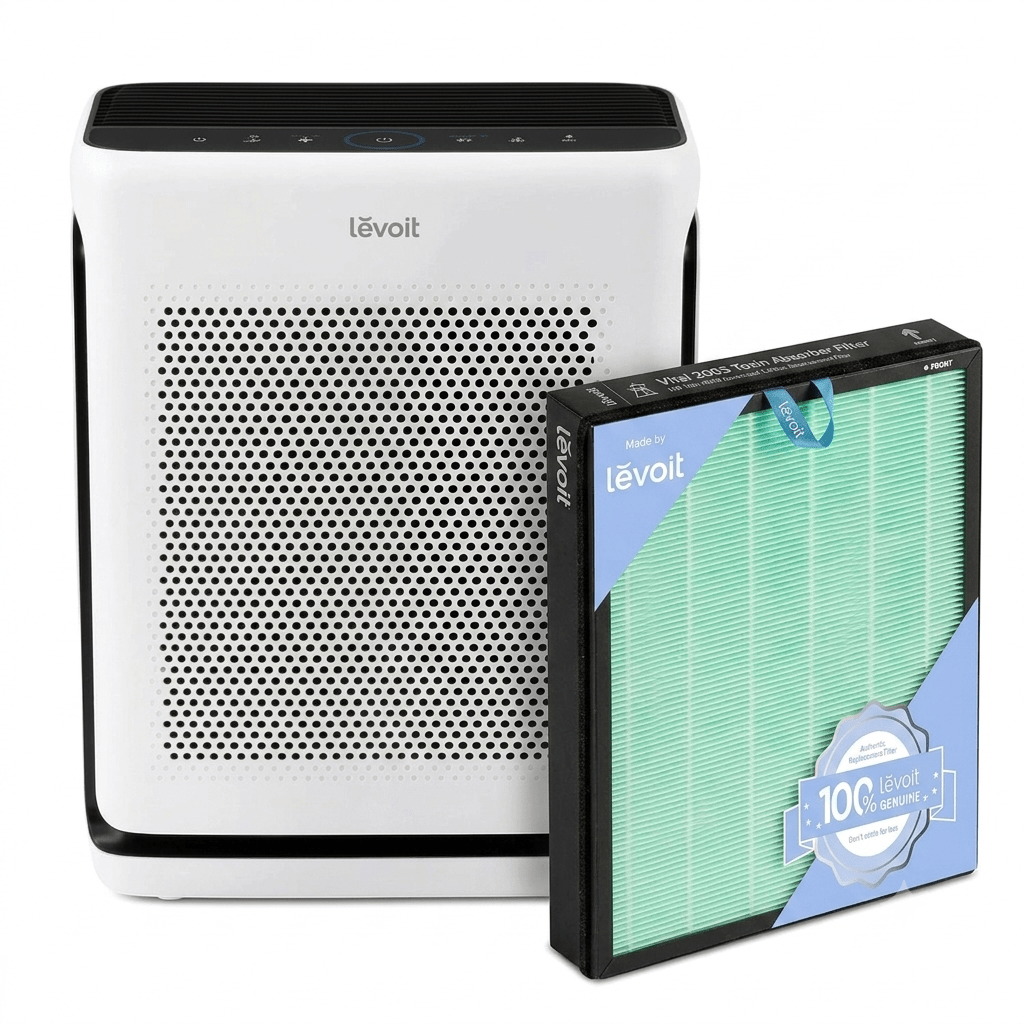
Levoit's Wildfire Protection Bundle pairs the Vital 200S-P with a genuine Vital 200S-P Toxin Filter. That is a spare replacement, not a second purifier or sensor upgrade; only one main filter is installed at a time. The bundle does not change the room rating or particle-sensor limits. Its name is not a guarantee of safety during hazardous wildfire smoke; follow public-health and fire guidance.
Check the power figure before comparing energy use
The product page lists rated power at 50 W, while the linked US manual gives 51 W for its LAP-V201S-WUS/KUS models. I found no revision or test-basis note that reconciles the two, so rated power is deliberately left unknown in the comparison data. If a strict wattage ceiling or energy estimate matters, do not assume either number is the settled value; confirm the label and support documentation for the offered unit.
When to choose it—and when to size differently
Choose the Vital when 388 square feet at 4.8 ACH fits a bounded room, Pet Mode and the wide inlet help your routine, and its body has an open location. The Core 400S-P is narrower and has a numeric display, but is rated at 358 square feet and lacks the Vital's documented pet cycle. For a 606-square-foot 4.8-ACH need, consider the larger Core 600S-P. A Core 300 model may be better for a smaller room. Compare placement and filter care alongside capacity.
Key details at a glance
| Room area at 4.8 ACH (stated or calculated) | 388 sq ft |
|---|---|
| Published room area at 1 air change per hour | 1862 sq ft |
| Clean air delivery rate (CADR) | 250 CFM |
| App control | Yes |
| Body width | 15.6 in |
| Body depth | 8.5 in |
| Body height | 19.8 in |
| Published product weight | 13.2 lb |
| On-unit numeric PM2.5 display | No |
| Turbo fan setting | Yes |
| Manufacturer filter-check/replacement guidance | Clean the washable pre-filter every 2–4 weeks. The manual recommends replacing the main/activated-carbon filter about every 12 months, sooner when use or pollution warrants; a reminder is a prompt to inspect, not a guaranteed filter-life measurement. |
| Important specification note | Rated input power is unresolved: exact base/black US pages state 50 W, while the linked LAP-V201S-WUS/KUS manual states 51 W; a strict wattage limit must not count either figure as settled. |
| Placement and care | Unwrap the filter before use; keep at least 15 in (38 cm) clear at the front and do not block the inlet or outlet. Clean the washable pre-filter every 2–4 weeks; let it dry fully if washed; inspect/replace the main filter about every 12 months, earlier if conditions warrant; clean the infrared dust-sensor lens about every 2 months. |
Use the exact model’s instructions for operating limits, supplied equipment and version differences.
Sources for this assessment
Check the room rating against your actual space.
Compare room-area figures at 4.8 air changes per hour, then check their stated or calculated basis, placement and filter care.