
Your needs, this model
Does it fit your priorities?
Will this single unit serve a room needing at least 358 sq ft at the family’s conservative 4.8-ACH comparison?
Yes; its 366 sq ft comparison floor exceeds 358 sq ft, but it falls short of the 606 sq ft large-room tier.
Explore this need in the finder →Is the desired control path met without mixing versions?
The 250 and 250 Art have physical Auto/manual controls with no documented app; the 250S adds IoCare+ app use while retaining physical controls.
Explore this need in the finder →Can it show a numeric PM2.5 reading on the purifier itself?
No. The purifier’s own AQI cue is color only; the 250S app can show particle numbers, but that does not make the on-unit display numeric.
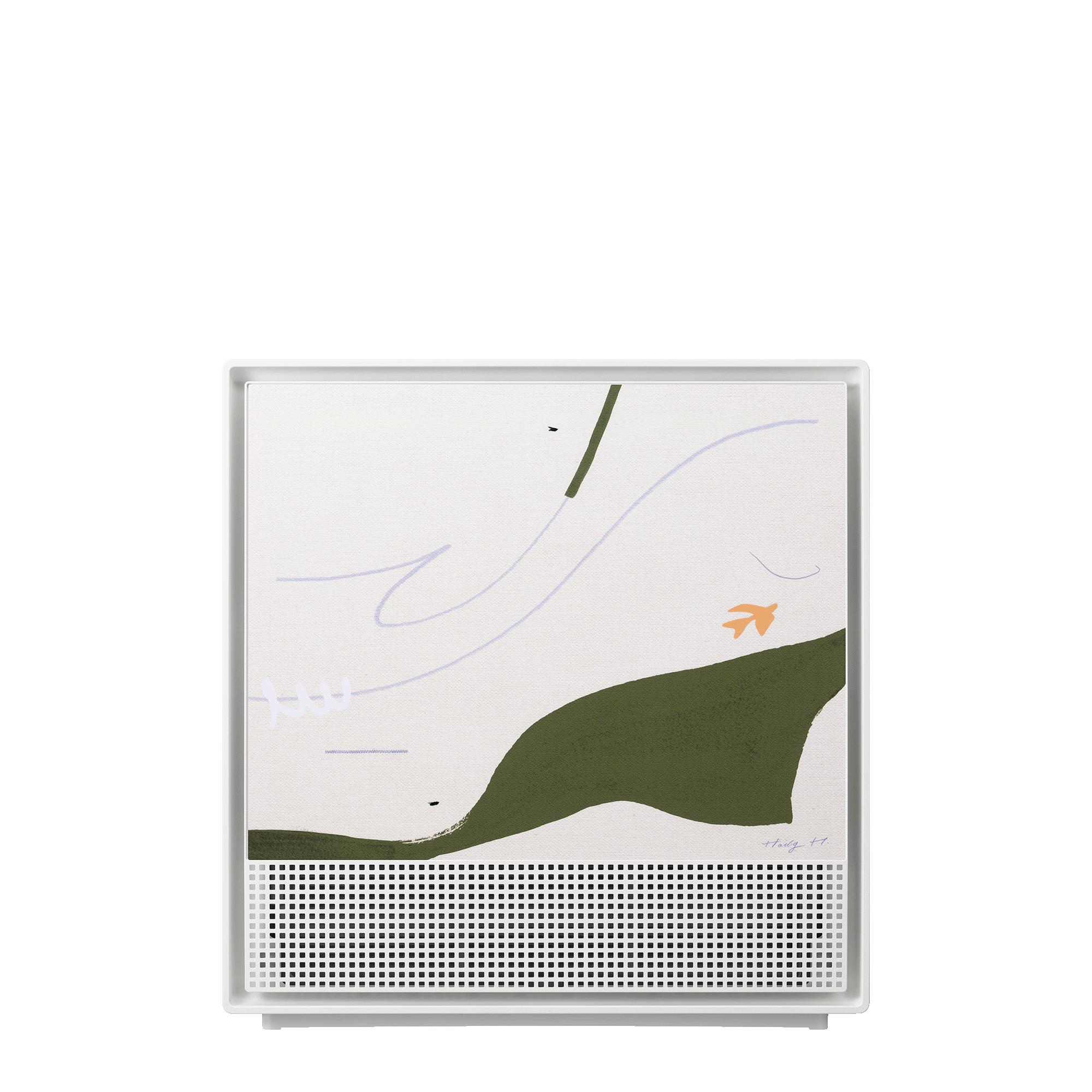
Explore this need in the finder →The Coway Airmega 250 Art uses the 250-family purifier layout with a decorative fabric-like front panel in Vanilla Sky, Pink Pebbles or Green Breeze. That art panel changes the room-facing appearance, not the core control plan. Coway’s U.S. page and manual describe local sensor-led Auto, a color air-quality bar, a washable pre-filter and the same Max2 replacement cartridge used by the 250 and 250S. It is most relevant when a visible decorative front is a priority and a medium-room rating around 366 square feet at the 4.8-ACH comparison is sufficient.
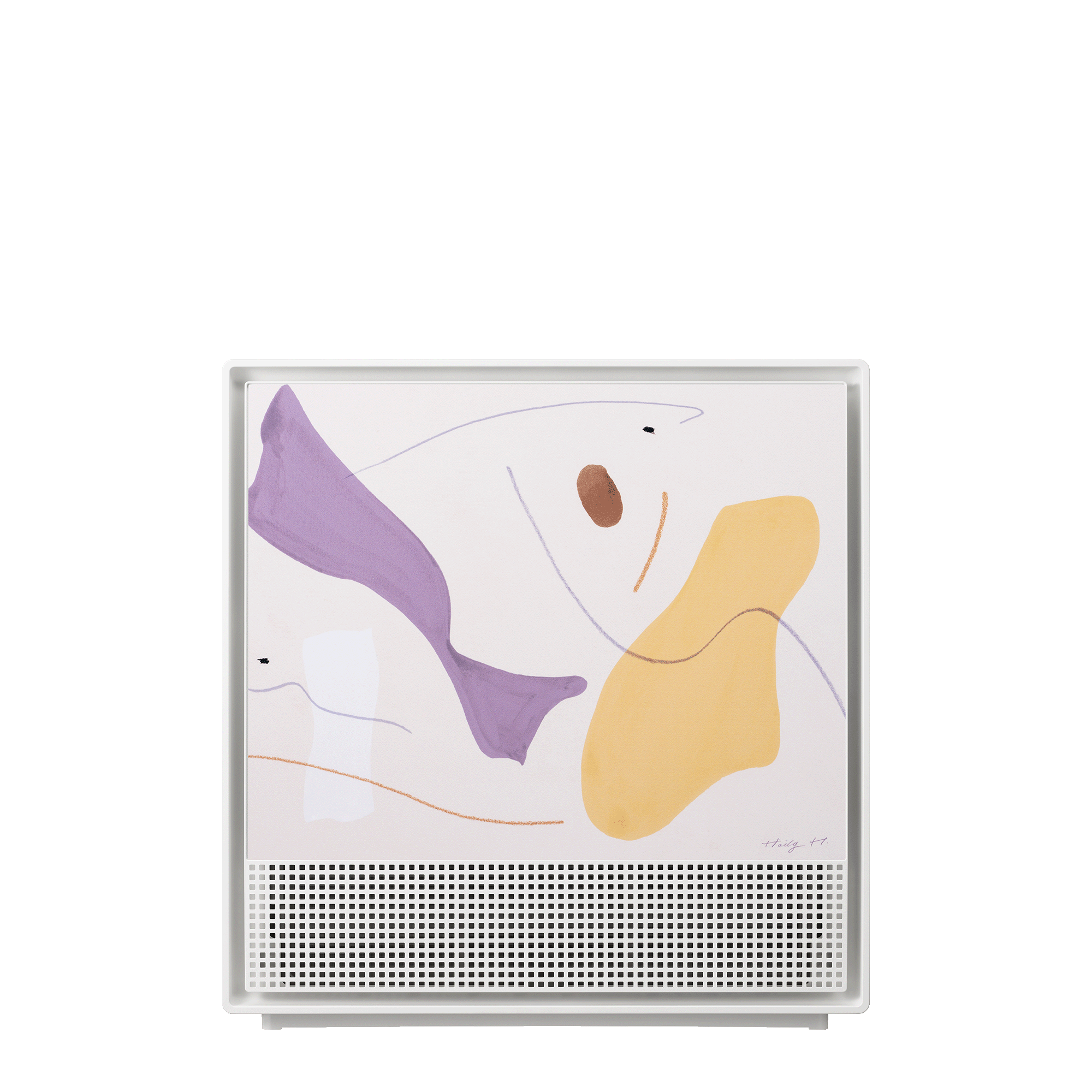
The exact product record also identifies Pink Pebbles (SKU 826439000660) and Green Breeze (SKU 826439000653). Coway marked Green Breeze unavailable in the captured offer record, but no current stock claim is made. The finishes share the same assessed purifier plan.
Rate the room by repeated cleaning
Coway’s current Airmega 250 Art page lists 1,763 square feet at one air change per hour and 881 square feet at two. The linked manual also lists 440 square feet at four changes per hour. Scaling the manual’s lower four-change figure to 4.8 air changes gives a conservative floor of 366 square feet (440 × 4 ÷ 4.8, rounded down). This is a calculation, not a published 4.8-ACH rating. It just clears the site’s 358-square-foot medium tier and does not reach the 606-square-foot large tier. The regular Airmega 250 and 250S list 465 square feet at four changes per hour, making their comparable floor a little higher.
The product page lists CADR numbers—235 smoke, 240 dust and 293 pollen—but provides no unit beside them. The two-page art sheet lists CADR as “TBD,” so generic CFM remains unknown and cannot satisfy a strict CFM threshold. The page describes capture down to 0.3 microns and the user manual describes up to 99.97% down to 0.3 microns. An older Coway art sheet states 0.01 microns and 99.999%; I do not use the more ambitious figure because it conflicts with the model’s page/manual description and a standardized test basis is not established here.
Local Auto, no documented phone setup
Airmega 250 Art senses particle conditions and can adjust airflow in Smart mode. Its indicator uses the familiar blue, green, yellow and red status categories; there is no numeric PM2.5 display on the purifier. The user manual describes Auto, Sleep, Eco and Rapid modes, three manual speeds, sensor-sensitivity settings, a light control, a physical one-, four- or eight-hour timer and a child lock. Rapid mode temporarily uses the highest fan level; it is not a separate fourth speed. No Wi-Fi or app-pairing procedure is documented for the Art configuration, so choose the 250S instead if phone scheduling is essential.
The Art’s control panel is a functional purifier interface, not a touchscreen built into the artwork. This distinction matters if you expect the front panel to show a precise particle number or if your reason for choosing a decorative edition is connected control. The covered front face does not remove the need to keep its sides and top outlet open, and the manual gives no precise clearance that would validate a shelf enclosure.
Shared filter system, disputed power and sound figures
The machine ships with a washable pre-filter and Max2 filter set made from activated carbon and Green True HEPA media. The manual suggests pre-filter cleaning at roughly two-week intervals under an eight-hours-per-day, maximum-speed basis; the Max2 cartridge is listed at about one year. In dusty conditions, more frequent pre-filter care may be appropriate. The replacement-filter page names the 250 Art as compatible with the same Max2 product listed for the 250 and 250S. The Max2 cartridge itself is not washable or reusable.
There is a meaningful record conflict for strict electrical and sound limits. The current Airmega 250 Art page and its product manual state 57 watts; the linked two-page Coway Art sheet gives 64 watts. The page gives 22–51 dB(A), while that sheet lists 22–54. I leave rated power and maximum sound unknown for hard matching rather than picking one source. The model page and manual agree on width 18.5 inches, height 19.7 inches and weight 20.5 pounds, but the manual rounds depth to 8.03 inches and the current page says 8.3. Depth is also unknown for a strict opening limit.
Finish identities and alternatives
The selected collection-row offer is Vanilla Sky, variant 43937046102270 / SKU 826439000646 / barcode 00000113568. Pink Pebbles and Green Breeze are separate finish variants on the same manufacturer product page, not different sensor or app configurations. The product images show each exact artwork, but they are manufacturer renders rather than photographs of an independently tested purifier.
Choose the Art when the designed front will remain visible and its medium-room rate fits. Compare the regular Airmega 250 if you want the slightly higher repeated-rate room basis and a plain enclosure, or the 250S if remote app scheduling matters more than a decorative panel. If the room exceeds this family’s 4.8-ACH comparison range, a larger model is the more useful next step than relying on the slower one-change headline.
Primary references: Coway’s Airmega 250 Art product page, its linked U.S. manual, the Coway art sheet and the shared replacement-filter page.
Key details at a glance
| Room area at 4.8 ACH (stated or calculated) | 366 sq ft |
|---|---|
| Published room area at 1 air change per hour | 1763 sq ft |
| Room area at 2 ACH (stated or calculated) | 881 sq ft |
| App control | No |
| Body width | 18.5 in |
| Body height | 19.7 in |
| Published product weight | 20.5 lb |
| On-unit numeric PM2.5 display | No |
| Included Pet Allergy Filter with ARC Formula | No |
| On-unit lock for accidental control changes | Yes |
| Turbo fan setting | No |
| Manufacturer filter-check/replacement guidance | Coway describes about one year for the Max2 filter under its stated use condition; current product copy gives a 6–12 month range. Actual service life depends on use and room conditions. |
Use the exact model’s instructions for operating limits, supplied equipment and version differences.
Sources for this assessment

Check the room rating against your actual space.
Compare room-area figures at 4.8 air changes per hour, then check their stated or calculated basis, placement and filter care.