
Your needs, this model
Does it fit your priorities?
Will this single unit serve a room needing at least 358 sq ft at the family’s conservative 4.8-ACH comparison?
Yes; its 387 sq ft comparison floor exceeds 358 sq ft, but it falls short of the 606 sq ft large-room tier.
Explore this need in the finder →Is the desired control path met without mixing versions?
The 250 and 250 Art have physical Auto/manual controls with no documented app; the 250S adds IoCare+ app use while retaining physical controls.
Explore this need in the finder →Can it show a numeric PM2.5 reading on the purifier itself?
No. The purifier’s own AQI cue is color only; the 250S app can show particle numbers, but that does not make the on-unit display numeric.
Explore this need in the finder →The Coway Airmega 250 is the non-Wi-Fi member of a mid-size room-purifier family: it offers local automatic control, a color air-quality bar and a washable front pre-filter, but does not require or document phone setup. The useful fit is a medium room where a manufacturer-derived 4.8-ACH comparison near 387 square feet is enough. Its larger 930-square-foot headline uses only two air changes per hour, so it is not the same cleaning rate as that higher-refresh figure.
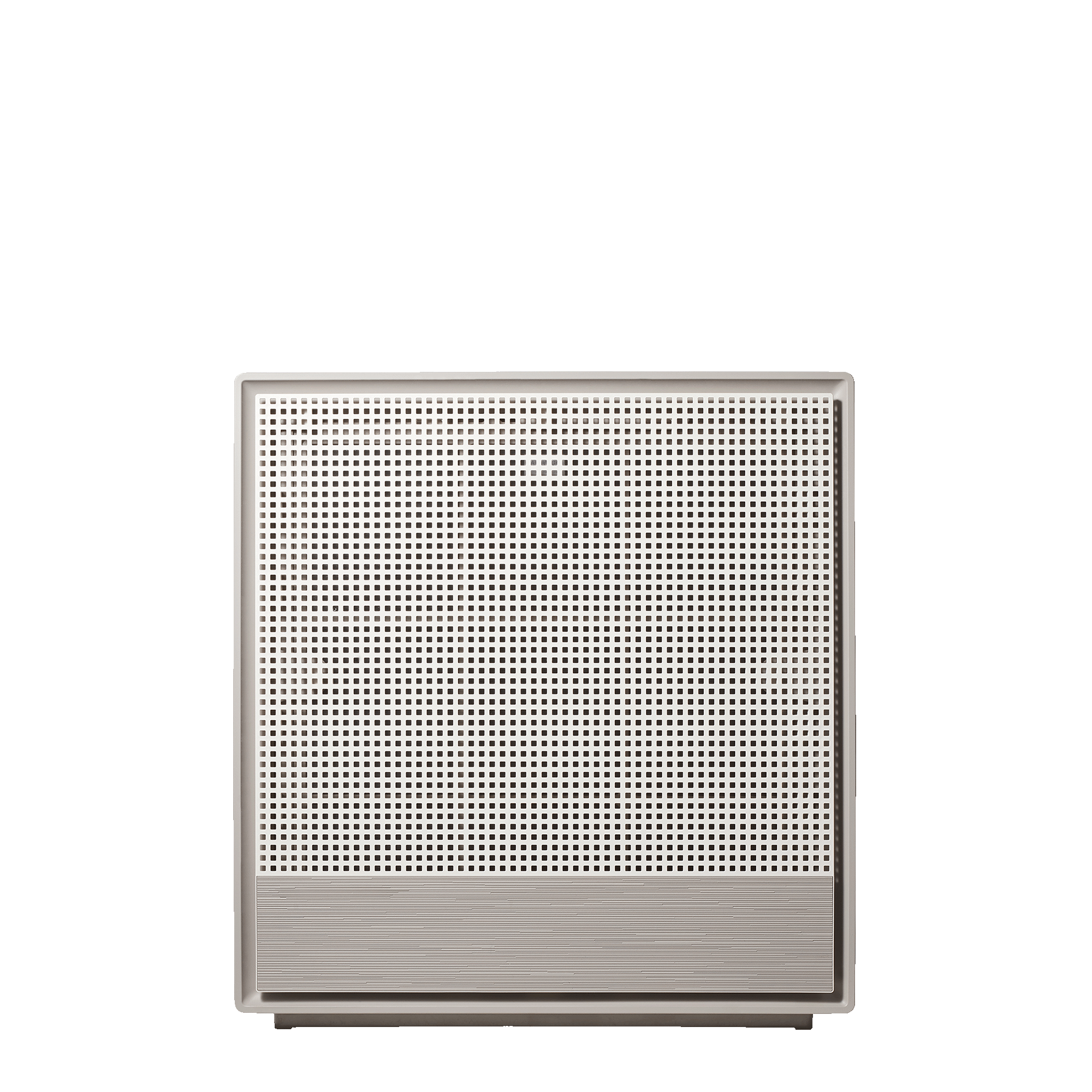
Use the repeated-air-change rating for room fit
Coway lists 1,860 square feet at one air change per hour, 930 square feet at two and 465 square feet at four. The two-change value is the more useful starting point for ordinary home comparison; scaling the four-change figure to 4.8 gives about 387 square feet (465 × 4 ÷ 4.8, rounded down). That is enough for the site’s medium-room tier, not its 606-square-foot large-room tier. It is a calculation from Coway’s published area basis, not a 4.8-ACH figure printed by the company or a room test by this review. High ceilings, connected spaces, blocked sides and a quieter fan setting can change practical fit.
The page also lists smoke, dust and pollen CADR numbers—249, 261 and 230—but prints no unit alongside them. The manual does not supply a CADR table. I therefore leave generic CFM unknown rather than use those values to meet a strict CFM minimum. Coway’s page says the filter captures particles down to 0.01 microns; the manual describes the Max2 filter at up to 99.97% for particles down to 0.3 microns. Because those are not the same claim or method, treat the 0.01 wording as an unresolved manufacturer-page difference, not a reason to buy this over another purifier.
Automatic does not mean connected
The Airmega 250 senses PM2.5 and PM10 particles and offers Smart mode, which adjusts among three fan levels as the local air-quality category changes. The onboard bar shows four color categories; it is not a numeric PM2.5 screen. The light sensor helps Smart mode shift to quieter Sleep behavior when the room is dark and the air quality is good, while Rapid mode runs at the top fan level until the air-quality status improves or the mode times out. You can also pick a level directly, alter sensor sensitivity and set the physical timer to one, four or eight hours. A child-lock control is documented.
This is a good fit if the useful promise is “set Auto on the machine and leave it,” not phone scheduling. Coway identifies this model as non-Wi-Fi, and the shared manual separates its physical timer from the 250S app controls. If a remote schedule, app monitoring or the manufacturer’s stated voice-control feature is essential, compare the Airmega 250S: it keeps essentially the same room rating and filtration arrangement but adds Wi-Fi. If you want no connected-device setup, the regular 250 avoids a feature you may never use.
One reusable screen, one combined replacement filter
The installed Max2 cartridge combines activated carbon and Green True HEPA media; a separate washable mesh pre-filter catches larger debris first. Coway’s manual suggests cleaning the pre-filter about every two weeks under its stated daily-use basis, with more frequent care in dusty conditions. It says the Max2 filter is replaced at about twelve months under eight hours a day at maximum speed; the current product page also gives a broader six-to-twelve-month range. Treat the indicator as a maintenance reminder, not a guarantee that every household gets the same life. The Max2 cartridge is not washable or reusable.
Filter access is a front-cover routine: unplug the unit, lift the pre-filter, clean it by vacuuming or water, let it dry fully in the shade if washed, and reset the indicator after service. Keep the sides and top outlet clear; the manual gives no numeric furniture clearance that would make a tight cubby safe. Coway lists one Max2 replacement filter as compatible with the 250, 250S and 250 Art, so replacing it does not require a model-specific alternative cartridge search. A dedicated pet cycle, odor-profile choice, aroma pad and separate gas/TVOC sensor are not documented.
Check the body opening and the details that stay uncertain
The page and manual agree on 18.5 inches wide, 19.7 inches high, 20.5 pounds and a 64-watt rated input. They differ slightly on depth: the page rounds it to 8.3 inches while the manual gives 8.03. Width and height are useful for a rough opening check; depth remains unknown for a strict maximum. The listed sound range is 22–54 dB(A), but the sound you hear depends on the fan setting and placement.
The exact observed U.S. purifier offer is a single Airmega 250, AP-1720H, variant 39668545454239 / SKU 826439000400. This is a source identity, not a price or availability promise. Choose the 250 when the medium-room rate, local Auto and physical controls match your routine. For the same-size smart option see the Airmega 250S review; if a decorative front is worth accepting a slightly smaller room basis, see the Airmega 250 Art review. For larger rooms, compare the Airmega 350, 400 or 450 using their own rated areas rather than extrapolating beyond the 250’s figure.
Primary references: Coway’s Airmega 250 product page, its linked U.S. Airmega 250 manual, and Coway’s Airmega 250/250S/250 Art replacement-filter page.
Key details at a glance
| Room area at 4.8 ACH (stated or calculated) | 387 sq ft |
|---|---|
| Published room area at 1 air change per hour | 1860 sq ft |
| Room area at 2 ACH (stated or calculated) | 930 sq ft |
| Published rated input power | 64 W |
| App control | No |
| Body width | 18.5 in |
| Body height | 19.7 in |
| Published product weight | 20.5 lb |
| On-unit numeric PM2.5 display | No |
| Included Pet Allergy Filter with ARC Formula | No |
| On-unit lock for accidental control changes | Yes |
| Turbo fan setting | No |
| Manufacturer filter-check/replacement guidance | Coway describes about one year for the Max2 filter under its stated use condition; current product copy gives a 6–12 month range. Actual service life depends on use and room conditions. |
Use the exact model’s instructions for operating limits, supplied equipment and version differences.
Sources for this assessment

Check the room rating against your actual space.
Compare room-area figures at 4.8 air changes per hour, then check their stated or calculated basis, placement and filter care.