
Your needs, this model
Does it fit your priorities?
Does this model meet a minimum 219-square-foot rating at 4.8 air changes per hour?
Levoit publishes 222 sq ft at 4.8 ACH, only three square feet above that threshold. Its linked manual says purification takes longer above 222 sq ft, so it is a close boundary comparison rather than headroom for an open plan or high ceiling.
Explore this need in the finder →Would a repeating Pet Mode cycle be useful for the room's everyday routine?
The linked manual describes 15 minutes at high followed by 60 at medium. Light Detection can limit faster operation in darkness, then return through a medium/high transition when light comes back; it is not a nonstop turbo setting.
Explore this need in the finder →Is a color air-quality indicator enough, or is a numeric PM2.5 display on the purifier essential?
The manual documents a four-color indicator and app-based particle updates, not a numeric PM2.5 value on the unit. Its infrared dust sensor also does not detect gas.
Explore this need in the finder →Can a 12.6-inch body width fit before the separate front-airflow clearance is added?
The manufacturer lists a 12.6-inch body width. The manual separately asks for at least 15 inches clear at the front, so a shelf or furniture opening must allow the whole air path rather than only the shell.
Explore this need in the finder →The Vital 100S-P is a small rectangular purifier for a bounded bedroom or pet room. Its defining features are a wide U-shaped inlet, washable pre-filter, infrared dust sensor and scheduled Pet Mode. Levoit lists 222 square feet at 4.8 air changes per hour (ACH), versus 1,066 square feet at one ACH; use the first figure for repeated room turnover. The linked manual says purification takes longer above 222 square feet, so this is a boundary rating rather than generous headroom for a high ceiling or open living area.
What the pet-oriented inlet changes
The broad U-shaped inlet is intended to draw in airborne fur, while the washable pre-filter catches larger material such as hair, lint and fibers before it reaches the main filter. An owner can remove and vacuum or brush this screen every two to four weeks, or wash it gently and dry it completely. That makes pre-filter maintenance a practical part of pet ownership, but the purifier will not remove hair already on a sofa, replace floor cleaning or guarantee less airborne allergen in every room.
The manual describes a main particle filter and activated-carbon filtration. Levoit states 99.97% filtration efficiency for 0.1–0.3-micron airborne particulates in its manual; the carbon stage is described as adsorbing smoke, odors and fumes. These are manufacturer filter claims, not proof that every pollutant or smell will disappear. The AirSight infrared sensor watches particles, not gases, and the air-quality indicator is color-coded rather than a local numerical PM2.5 display.
Pet Mode is a schedule, not a maximum-speed lock
Pet Mode repeats 15 minutes at high, then 60 minutes at medium. With Light Detection enabled, darkness limits Auto and Pet operation below high or turbo; when light returns, the 100S-P runs 30 minutes at medium and 15 at high before resuming its usual Pet Mode cycle. This is more deliberate than setting a high fan and forgetting it, but it is not a permanent turbo command. For continuous higher output, choose a manual speed and accept the added sound.
Physical controls handle power, Auto, Sleep, fan speed, timer, display lock and Pet Mode. There are four speeds, including turbo. The on-unit timer offers two, four or eight hours; VeSync adds a one-to-24-hour timer, remote settings, schedules, recent particle-quality history and filter information. App setup calls for a secure 2.4-GHz Wi-Fi network and Bluetooth; the manual says a VeSync account is needed for connected services. If the household would rather avoid an account or network setup, local buttons still provide basic operation but not app-only functions. Sleep Mode runs below low and blanks the display after six seconds; the filter reminder can stay visible when attention is due.
Keep the sensor and filter in the plan
The manual gives a nine-to-twelve-month replacement interval for the main/activated-carbon filter, but pollution, airflow and odor can call for an earlier change. The reminder and app filter-life percentage are prompts, not direct measurements of remaining filter material. The main filter is not washable. Levoit recommends cleaning the infrared sensor lens about every two months, more often in dust; buildup can distort the color indication. These periodic chores matter if you expect Auto Mode to react usefully.
Set the purifier on a stable surface with at least 15 inches clear in front. The body is 12.6 inches wide, 6.3 deep and 16 tall, and weighs 8.6 pounds—more furniture-friendly than the wider Vital 200S-P, but the front clearance and clear outlet still matter. The manual permits 14–104°F and up to 85% relative humidity and warns against excess moisture, essential oils and nearby ultrasonic mist. Measure the airflow space rather than only the shell opening.
Two exact color pages, one unresolved suffix bridge
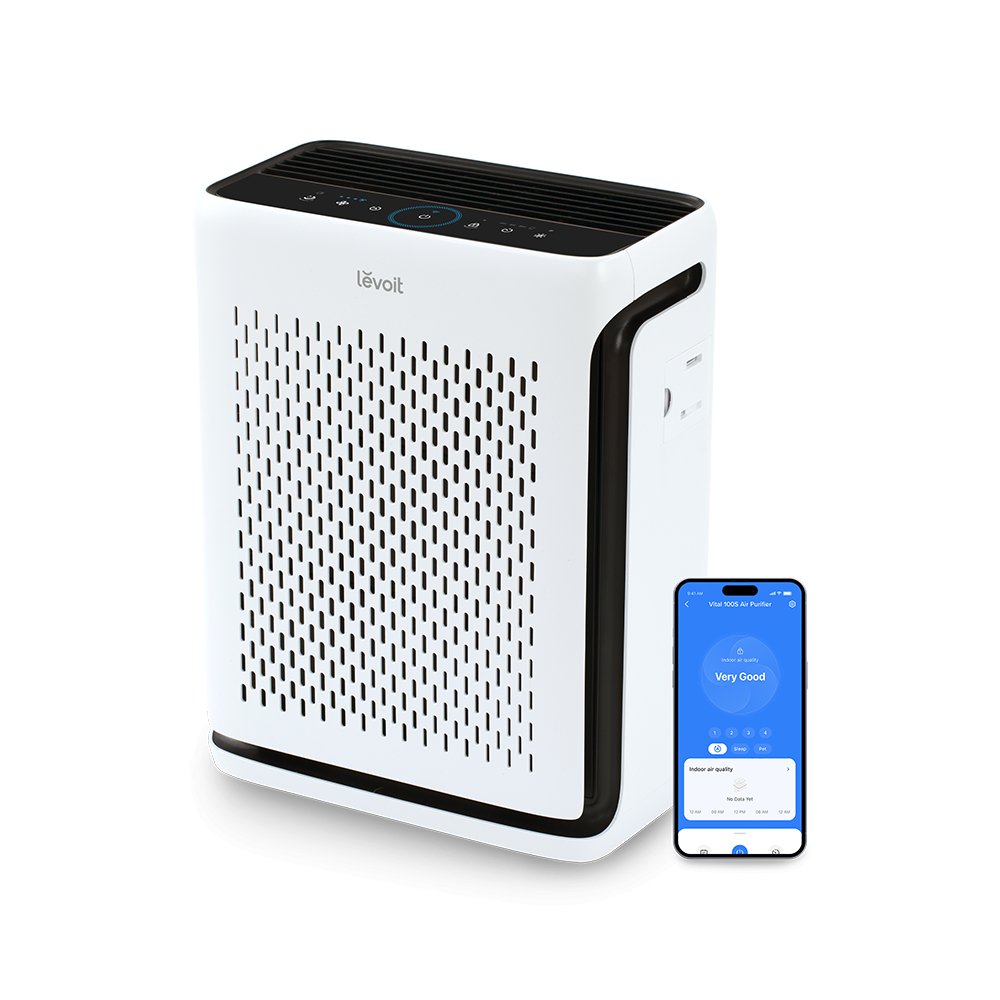
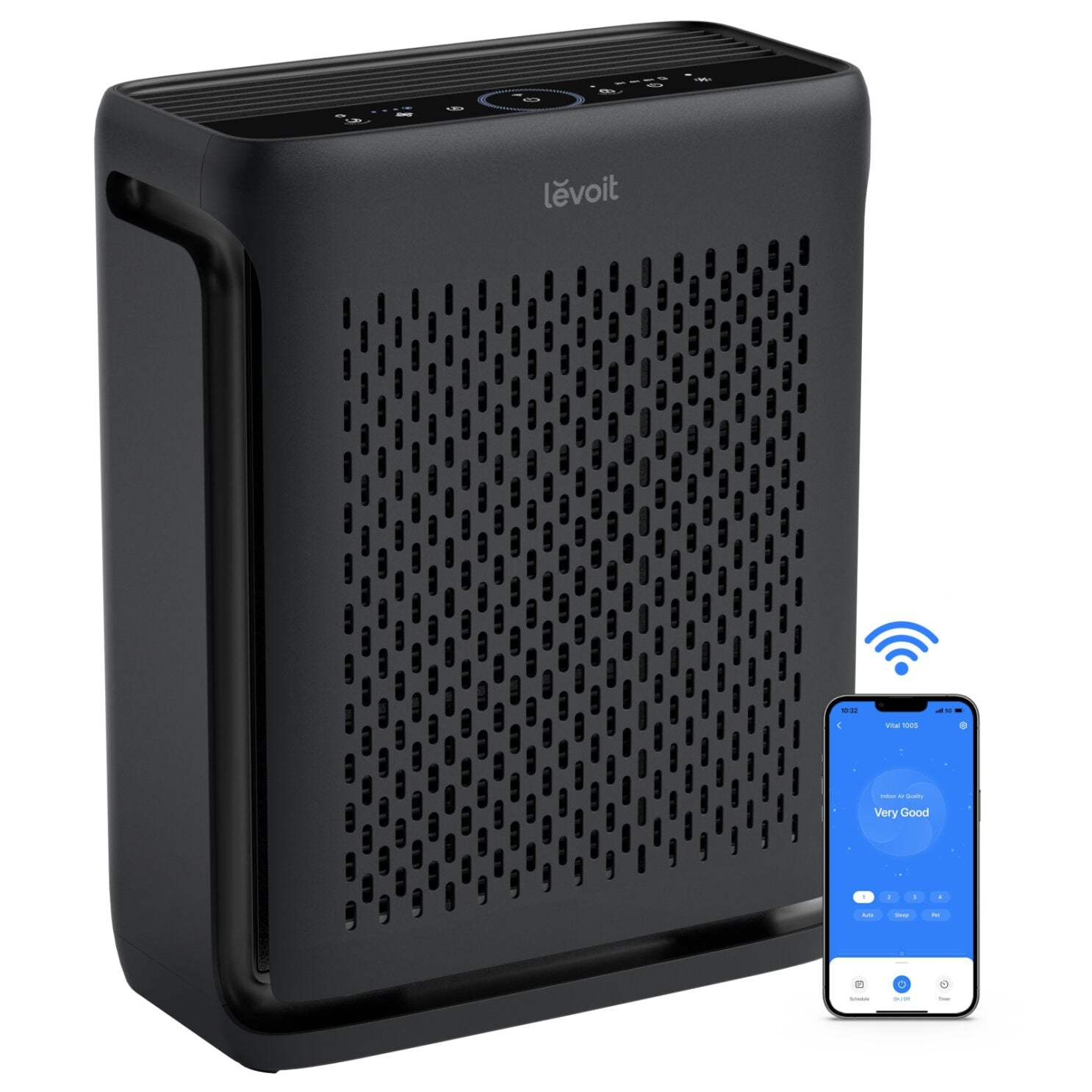
The white US product page identifies SKU HEAPAPLVSUS0125A / GTIN 810043379489. The black page identifies SKU HEAPAPLVSUS0167Y; its inspected product record does not expose a GTIN. Both pages print model LAP-V102S-WUS and repeat the same room ratings, CADR, body size, modes and included filter package. That supports treating Black as a finish configuration rather than a different operating model. Check the offered SKU and color on a retailer listing.
The 28-page US manual linked from both pages names LAP-V102S-AUSR, not the WUS suffix printed on the current product pages. It lists 32 W; the pages list 35 W. No manufacturer note explains the suffix or wattage difference, so rated power stays unknown for strict comparisons. Confirm the offered label before making a precise energy estimate. The overlapping dimensions and operating features do not erase the unresolved model-code bridge.
Choose the scale that fits
Choose the 100S-P when a bounded room falls within its 222-square-foot 4.8-ACH reference, and a pet-focused inlet, washable screen and app Pet Mode fit your routine. The Vital 200S-P is rated at 388 square feet with a wider body. If you need more than 222 square feet of repeated turnover but prefer a narrower cylinder and numeric local display, the Core 400S-P is rated at 358 square feet. The Core 300S-P is a smaller-room alternative at 219 square feet. Size the room, leave airflow clearance and choose a fan speed you can live with; larger one-ACH figures are not equivalent to the repeated-turnover rating.
Key details at a glance
| Room area at 4.8 ACH (stated or calculated) | 222 sq ft |
|---|---|
| Published room area at 1 air change per hour | 1066 sq ft |
| Clean air delivery rate (CADR) | 143 CFM |
| App control | Yes |
| Body width | 12.6 in |
| Body depth | 6.3 in |
| Body height | 16 in |
| Published product weight | 8.6 lb |
| On-unit numeric PM2.5 display | No |
| Turbo fan setting | Yes |
| Manufacturer filter-check/replacement guidance | Clean the washable pre-filter about every 2–4 weeks by vacuuming or brushing; it may also be rinsed with water and mild detergent, then must dry completely. The manual says the main/activated-carbon filter should be replaced approximately every 9–12 months, earlier if pollution, odor or airflow warrants; it is not washable. Clean the dust-sensor lens about every two months, more often in dusty conditions. |
| Important specification note | Exact US base SKU HEAPAPLVSUS0125A / GTIN 810043379489 and black SKU HEAPAPLVSUS0167Y share the Vital 100S-P title and page-listed model LAP-V102S-WUS. The black page did not expose a GTIN. The linked manual prints LAP-V102S-AUSR; retain this unresolved model-code bridge and the 35 W PDP / 32 W manual conflict. |
| Placement and care | Keep at least 15 inches clear at the front, keep the outlet unobstructed and use indoors. Unwrap the filter before operation. Clean the pre-filter every 2–4 weeks, replace the main filter roughly every 9–12 months as conditions warrant, and periodically clean the infrared sensor lens. Do not run it near an ultrasonic humidifier or essential-oil diffuser if that disrupts sensing or damages the filter. |
Use the exact model’s instructions for operating limits, supplied equipment and version differences.
Sources for this assessment
Check the room rating against your actual space.
Compare room-area figures at 4.8 air changes per hour, then check their stated or calculated basis, placement and filter care.