
Your needs, this model
Does it fit your priorities?
Does this model meet a minimum 219-square-foot room rating at 4.8 air changes per hour?
Levoit publishes 229 sq ft at 4.8 ACH and 1,100 sq ft at 1 ACH. Use the smaller repeated-turnover figure for a close room comparison; the larger number is slower and is not equivalent to nearly five changes each hour.
Explore this need in the finder →Would an automatic scraper that clears the washable pre-filter into a dust tray help your maintenance routine?
The Vital Pet Pro's scraper sweeps loose dust and fur into its removable tray and can be scheduled in VeSync. The tray still needs emptying, and Levoit still recommends cleaning the washable screen every 2–4 weeks.
Explore this need in the finder →Is a separate TVOC sensor useful alongside PM2.5 feedback?
The manual names both a PM2.5 sensor and a TVOC sensor. The on-unit indicator is color-coded, while more detailed air-quality updates are in the app; neither identifies every gas or its source.
Explore this need in the finder →Must the purifier itself show a numeric PM2.5 value?
No. The manual documents four color indicator levels on the unit and app-based air-quality updates, not a numerical PM2.5 display on the machine.
Explore this need in the finder →Can a body-width limit be satisfied before leaving room for air clearance?
The published product-page and manual dimensions disagree, so width is unknown for strict matching. A hard width requirement cannot rely on either value; the manual separately asks for open airflow clearance.
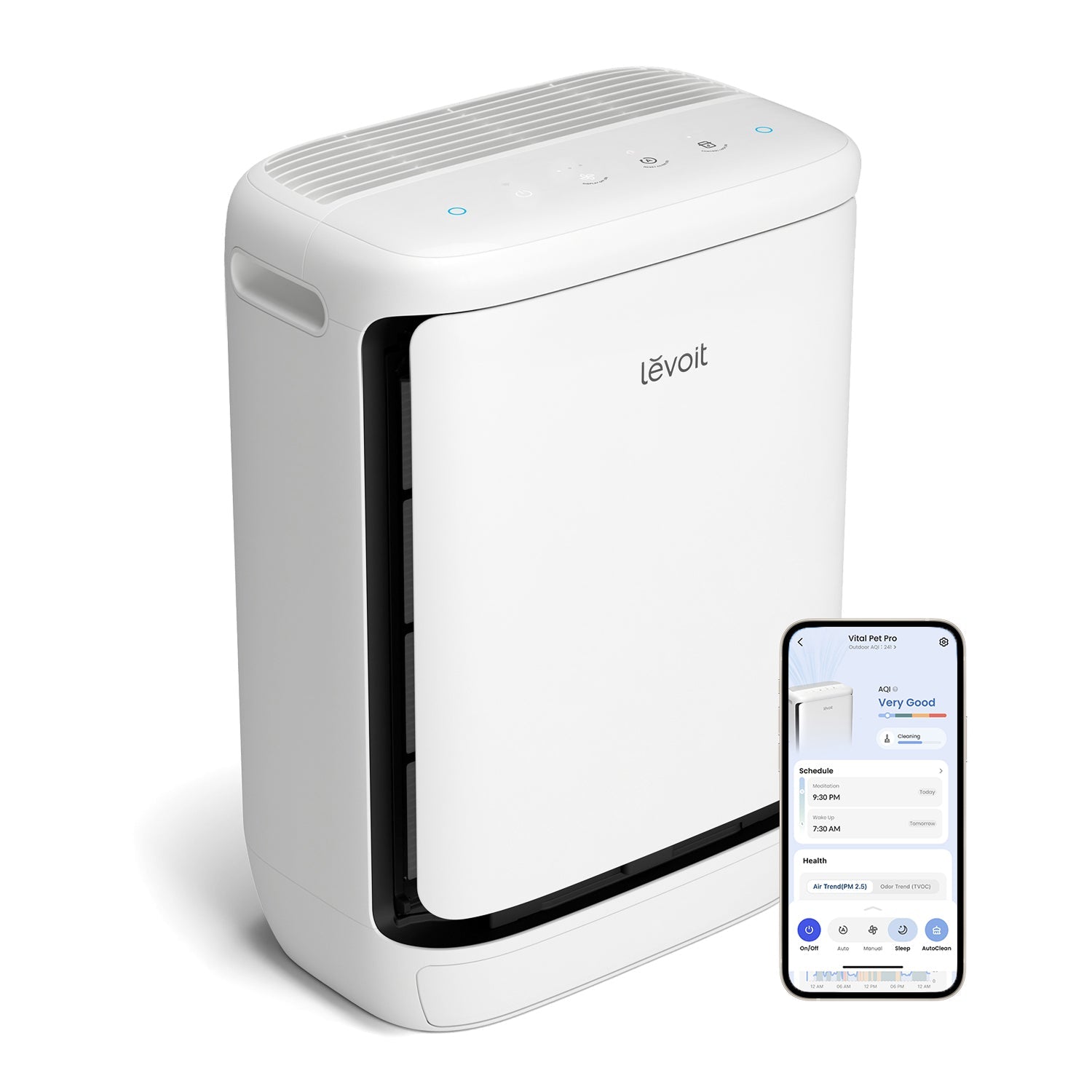
Explore this need in the finder →The Vital Pet Pro is a smart purifier whose distinctive job is to sweep loose fur and dust off its washable pre-filter into a removable tray. That can ease pet-household upkeep, but it is not hands-off: empty the tray, care for the screen, and replace the main filter. Levoit rates it for 229 square feet at 4.8 air changes per hour (ACH); 1,100 square feet is at one ACH, or slower turnover.
What the automatic cleaning actually does
A scraper clears debris from the pre-filter into the dust tray. The manual says it runs daily by default; the VeSync app can set a daily, weekly, or monthly schedule, start a cycle, or switch it off. Emptying the tray is separate. This helps when a washable screen quickly collects fur or lint. It does not vacuum floors, catch hair that never reaches the intake, or clean textiles.
The screen still needs cleaning every two to four weeks. Levoit permits vacuuming or a careful wash with mild detergent; let it dry fully. The manual says to replace the activated-carbon/main filter at about six months, sooner when pollution or reduced airflow/odor control warrants it. The shared Vital Pet/Vital Pet Pro filter page says six to eight months; inspect the filter instead of treating a calendar as a guarantee.
Three jobs in one filter, plus two different sensors
Levoit describes three stages: a washable screen for fur and lint, a main filter that the manual says traps at least 99.97% of 0.3-micron airborne particles, and activated carbon for smoke, odors, fumes, and listed volatile compounds. These are media descriptions, not proof of room results. Carbon can adsorb some odors; it does not replace addressing a persistent source or ventilating when appropriate.
The manual identifies separate PM2.5 and total-volatile-organic-compound (TVOC) sensors. Auto Mode uses them to adjust fan speed, and the air-quality display uses four colors rather than a numerical PM2.5 reading on the purifier itself. The VeSync app provides updates and recent history. A TVOC sensor can add a useful odor/VOC signal to particle feedback; it does not identify every gas, diagnose a health hazard, or tell you exactly which source caused a change.
Levoit reports up to 99% floating-hair capture in a small cat-fur test, and 70% odor-concentration reduction in an isovaleric-acid chamber test. Those narrow tests do not promise a hair-free room or removal of every litter, food, or animal odor.
Controls, placement, and ongoing limits
On the unit, you can turn it on, choose low, medium, or high, use Auto Mode, start or stop the pre-filter cleaning cycle, and lock the display. The lock prevents accidental button changes; the manual says the app can still control settings while it is on. Sleep Mode, timers, scheduling, remote control, air-quality history, and more detailed cleaning reminders are app functions. Initial connection uses Bluetooth and a secure 2.4-GHz Wi-Fi network; if you do not want a connected routine, the purifier still has local controls, but you give up those app-only options.
The manual asks for at least 15 inches of clear space in front; this indoor model is rated for up to 85% relative humidity and should not run near essential-oil diffusers. Its listed sound range is 21–53 dB, and page/manual both give 39 W. But their size and weight differ: the product page lists 15.59 × 10.67 × 21.61 inches and 15.65 pounds; the manual says 12.9 × 8 × 18 inches and 11.7 pounds. Confirm the footprint before fitting it into a tight space.
Who should compare it with another Vital model?
Choose the Pet Pro when the scraper-and-tray routine, app control, PM2.5/TVOC feedback, and the 229-square-foot 4.8-ACH rating all match the room and habits you actually have. A larger open area may call for a higher repeated-turnover rating: Levoit lists 388 square feet at 4.8 ACH for the Vital 200S-P. That model is the more room-capable choice, but it is a different operating plan rather than a substitute for the Pet Pro’s automatic pre-filter cleaner.
For a smaller, budget-conscious room, compare the Vital 100S-P, listed at 222 square feet at 4.8 ACH. Its app-based Pet Mode cycles through higher and medium speeds, while the Pet Pro’s defining convenience is debris sweeping into a tray. A three-square-foot difference between their published room figures is not a meaningful cushion by itself; room shape, doorways, and the fan setting you will tolerate matter more. If a dedicated Pet Mode cycle is essential, use the Vital 100S-P review to check that schedule; the Pet Pro manual documents Auto Mode and self-cleaning, not that same Pet Mode cycle.
Bottom line
This is a sensible candidate for a pet household that wants a medium-room purifier with automatic pre-filter sweeping, a replaceable carbon/particle filter, and connected monitoring. Its practical win is narrower than the phrase “cleans itself” suggests: it reduces one type of screen-cleaning buildup, not every maintenance step. Check the room against the 229-square-foot 4.8-ACH figure, allow front clearance, keep up with the tray and sensor care, and resolve the conflicting dimensions before buying for a constrained footprint.
Manufacturer references: Levoit Vital Pet Pro product page · Vital Pet Pro user manual filed with the FCC · Levoit Vital Pet / Pet Pro replacement-filter page.

Key details at a glance
| Room area at 4.8 ACH (stated or calculated) | 229 sq ft |
|---|---|
| Published room area at 1 air change per hour | 1100 sq ft |
| Published rated input power | 39 W |
| App control | Yes |
| On-unit numeric PM2.5 display | No |
| On-unit lock for accidental control changes | Yes |
| Turbo fan setting | No |
| Automatic pre-filter scraper and dust tray | Yes |
| Separate TVOC sensor | Yes |
| Manufacturer filter-check/replacement guidance | Filed manual: replace the Activated Carbon/Main Filter at about 6 months, sooner in high pollution or when odor/airflow deteriorates. Official shared Vital Pet/Pet Pro filter page: 6–8 months. Use conditions and inspection; do not assert a settled strict interval. |
| Important specification note | Official product record identifies current US offer SKU HEAPAPLVSUS0189Y / GTIN 810123676347; the filed manual prints LAP-P501S-WUSR and FCC record product code LAPP501S. The marketing/model family is named Vital Pet Pro in both the product page and filing, but no checked manufacturer crosswalk explicitly ties these identifiers. The page/manual dimensions and weight conflict and remain unknown. |
| Placement and care | Use indoors. Remove all packaging from the filter before operation, set the unit on a stable surface, and keep the airflow path open. The washable pre-filter needs attention every 2–4 weeks even with automatic scraping; empty the removable tray and replace the main/carbon filter according to the manual and observed condition. Keep within 85% RH, avoid essential-oil diffusers, unplug for care, and clean the PM2.5/TVOC sensors about every 3 months (more often in dusty conditions). |
Use the exact model’s instructions for operating limits, supplied equipment and version differences.
Sources for this assessment
- Levoit US Vital Pet Pro Air Purifier product page
- Levoit official Shopify product record for Vital Pet Pro
- Vesync (US) Corporation Vital Pet Pro user manual record filed with the FCC
- Vesync (US) Corporation Vital Pet Pro Air Purifier user manual, 28 pages
- Levoit official Vital Pet Pro / Vital Pet replacement-filter page
- Exact Vital Pet Pro image served in Levoit's official product image list
- Targeted US CPSC recall query for Vital Pet Pro
- Previously archived Levoit US purifier manual directory
Check the room rating against your actual space.
Compare room-area figures at 4.8 air changes per hour, then check their stated or calculated basis, placement and filter care.