
Your needs, this model
Does it fit your priorities?
Does the Airmega Mighty have a high enough repeated-turnover room rating?
The current manual rates AP-1512HH at 361 ft² for 4.8 air changes/hour; use that value rather than its larger one-change number.
Explore this need in the finder →Can I use automatic sensor response without phone setup?
Yes. Local controls offer Auto, fan speeds 1–3 and Eco; exact AP-1512HH documentation does not provide app or Wi-Fi controls.
Explore this need in the finder →Can I require a selectable on/off control for this purifier’s built-in ionizer?
Yes. The manual labels a separate ionizer button; the machine still contains the bipolar device even when its on/off switch is set to off.
Explore this need in the finder →Does AP-1512HH support a Pet-profile replacement filter, and is that profile included?
Coway lists an optional Pet replacement profile for the AP-1512HH/200M filter set; the standard purifier offer includes the regular pre-filter/deodorization/HEPA arrangement, not the optional Pet profile.
Explore this need in the finder →Coway’s US listing identifies the Airmega Mighty AP-1512HH as a locally controlled purifier with particle-responsive Auto, an Eco mode that can stop the fan, a switchable bipolar ionizer and a 361-square-foot 4.8-ACH rating. Its White and Black offers have separate SKUs, but the current manual names them AP-1512HH(W) and AP-1512HH(B): finishes of the same purifier.
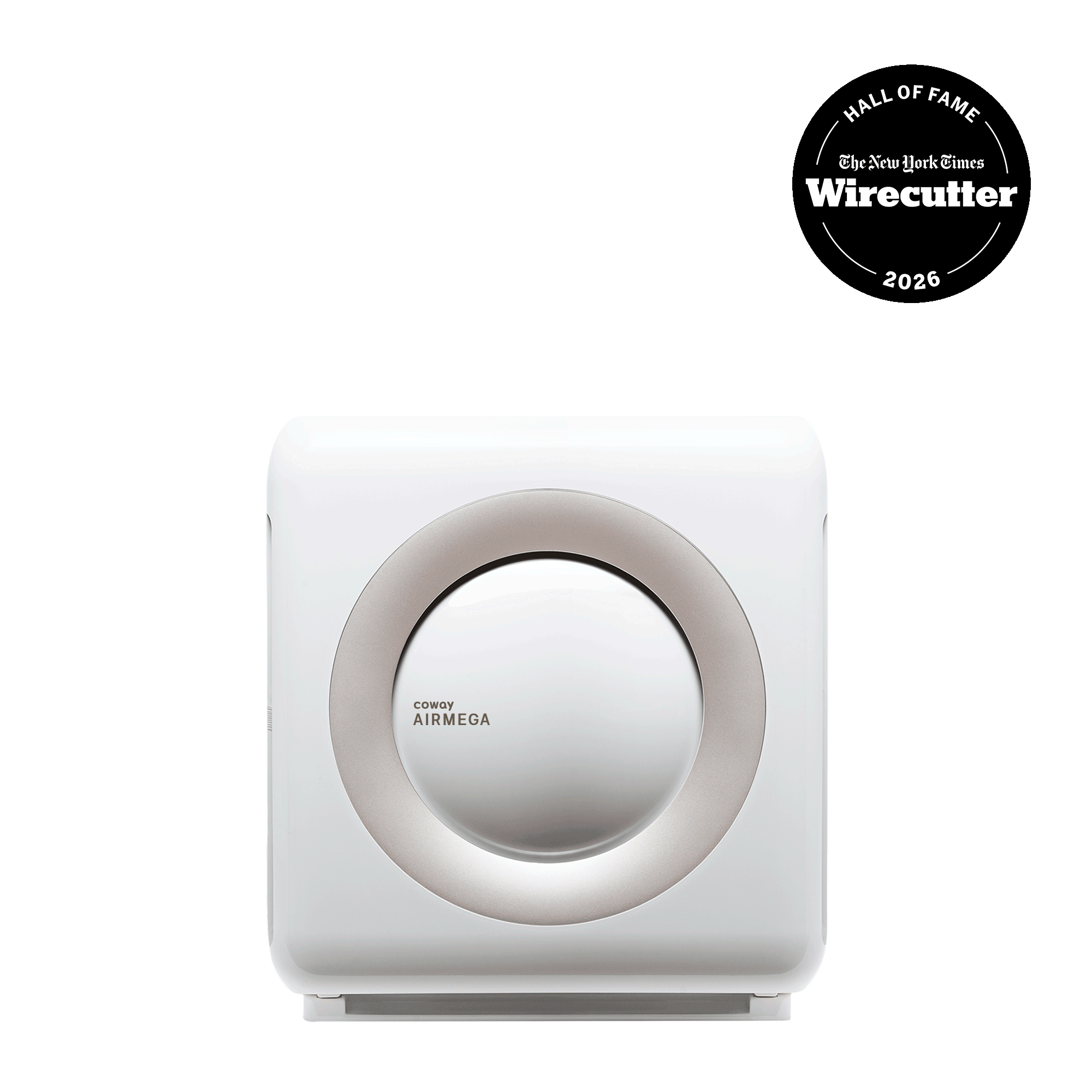

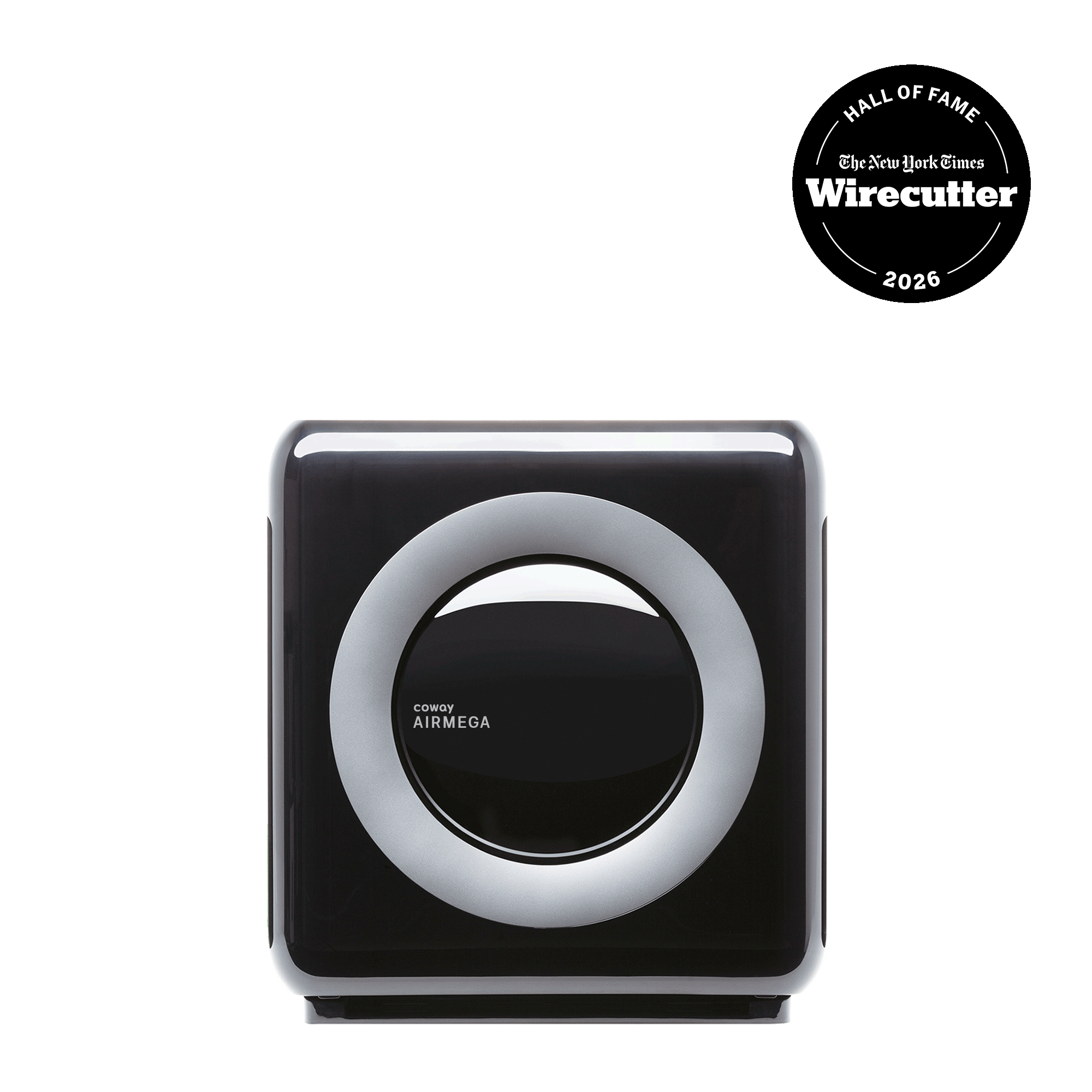

Use the rating at the cleaning pace you expect
The manual explains three different turnover rates on an assumed eight-foot ceiling: 361 square feet at 4.8 air changes per hour (one change each 12.5 minutes), 874 at two per hour and 1,748 at one. If you want frequent turnover, use the 361-square-foot figure, not the broad one-change headline. A 350-square-foot enclosed room fits on paper; above 361 square feet does not meet that published tier. Open doors, high ceilings, room layout and the speed you leave running affect practical fit. These are manufacturer ratings, not measurements made for this review.
The product page lists smoke, dust and pollen CADR separately as 233, 246 and 240 CFM. Those pollutant-specific values do not make one universal CADR number, so compare the smoke figure with a smoke figure rather than treating the largest number as a general score.
Automatic adjustment without phone setup
It starts in Auto, where a dust sensor chooses fan levels 1–3. The panel also gives direct speed selection and Eco. In Eco, the fan stops after 30 minutes without detected pollution and resumes when pollution returns; this is not steady low-speed airflow. Sensor sensitivity can be set to sensitive, standard or insensitive. Its blue, dark-purple and red indicator is not a numeric PM2.5 reading.
Timer choices are one, four or eight hours. The indicator light can be switched off, but the exact model’s manual documents local buttons, not Wi-Fi, app scheduling or a remote-control routine. Someone who wants a sensor to manage fan speed without another account or phone setup may appreciate this arrangement. If app control or a numeric reading on the unit is essential, compare a connected model such as Levoit’s Core 400S-P instead.
The ionizer is a separate feature, not another filter cartridge
Coway counts the pre-filter, deodorization filter, True HEPA filter and bipolar device as four stages. The manual lists three replaceable filter parts and a separate ionizer on/off button. If you need to switch an ionizer off, this provides that control; if ionizer hardware itself is unacceptable, off is not absent. A longer press also switches off the air-quality light. The manual prints an ozone-compliance statement, but I have not independently measured ozone output.
The ordinary included filter stack is a washable pre-filter, deodorization filter and True HEPA filter. Coway separately lists Fresh Starter, Allergen, Intense Smoke and Pet replacement-filter choices compatible with AP-1512HH. Those are future filter profiles, not four filters included with this purifier. In particular, the standard offer should not be mistaken for Coway’s optional Pet filter; the two products are not the same as a dedicated Pet Allergy Filter included in the box.
Make room for the maintenance routine
The manual recommends removing dust from the pre-filter every two to four weeks; it can be vacuumed or rinsed, but must dry completely before it goes back in. It lists the deodorization filter for replacement every six months and the HEPA filter yearly, based on eight hours a day at maximum airflow. Actual intervals can vary by room and use. The filter indicator tracks replacement cycles, but it does not remove the need to inspect and clean the washable screen. Coway also says to clean the air-quality sensor and inlet/outlet about every two months, more often in a dusty environment. At setup, remove all filter packaging and fit the components in the manual’s stated order.
The body is 16.8 × 18.3 × 9.6 inches and 12.3 pounds. Keep at least 20 cm from nearby objects, 30–60 cm overhead, and 2 m from electronics such as a TV; do not block airflow. The listing specifies indoor use from a grounded 120-V/60-Hz outlet. Noise values conflict: the product page says 24–53 dB(A), while its sheet says 24.4–55.1. Neither is a settled cutoff for a quiet-room requirement.
Who should shortlist it
Shortlist it if its 361-square-foot 4.8-ACH rating fits, you want local Auto and manual speeds, and you can keep up with the washable screen and separate deodorization/HEPA schedule. Optional carbon profiles change a later replacement choice, not the purifier’s rating or initial box. White and Black are exact current finishes with no separate coverage claim.
If your room is smaller and you value a narrower body or a simpler combined-filter replacement, compare the Airmega 150 and Airmega 100; both publish lower 4.8-ACH areas. If you need app control or a numeric PM2.5 display, the Core 400S-P is a more relevant comparison, though its controls and filter system differ. Skip the Mighty if your room exceeds its faster-turnover rating, if the front and top clearance will not work, or if the ionizer’s presence—not merely whether it is switched on—is a hard no. This assessment is based on Coway’s exact product record and linked manual, not hands-on testing.
Primary sources: Coway’s exact Airmega Mighty AP-1512HH page, its linked current US manual, Coway’s one-sheet and the compatible replacement-filter listing.
Key details at a glance
| Room area at 4.8 ACH (stated or calculated) | 361 sq ft |
|---|---|
| Published room area at 1 air change per hour | 1748 sq ft |
| Room area at 2 ACH (stated or calculated) | 874 sq ft |
| Published rated input power | 77 W |
| App control | No |
| Body width | 16.8 in |
| Body depth | 9.6 in |
| Body height | 18.3 in |
| Published product weight | 12.3 lb |
| On-unit numeric PM2.5 display | No |
| Included Pet Allergy Filter with ARC Formula | No |
| On-unit lock for accidental control changes | No |
| Turbo fan setting | No |
| Automatic pre-filter scraper and dust tray | No |
| Separate TVOC sensor | No |
| Manufacturer filter-check/replacement guidance | Manual: clean the pre-filter every 2–4 weeks by vacuuming or rinsing, and dry it fully before reinstalling; replace the deodorization filter every 6 months and HEPA filter every 1 year on the stated 8-hour/day maximum-speed use basis. Environment and operating time may change actual life. |
| Important specification note | The page lists pollutant-specific CADR values rather than a generic value; the manual explicitly states a different area at 4.8, 2 and 1 ACH. Do not use the 1-ACH 1,748-ft² figure as the 4.8-ACH rate. |
| Placement and care | The washable pre-filter is a recurring two-to-four-week task; the carbon/deodorization and HEPA filters have separate replacement cycles. Plan sensor and airflow-path cleaning as well, and keep the required wall/overhead clearance. |
| Built-in bipolar ionizer | Yes |
| Local ionizer on/off control | Yes |
Use the exact model’s instructions for operating limits, supplied equipment and version differences.
Sources for this assessment
- Exact current Coway US Airmega Mighty AP-1512HH product page
- Coway Shopify AP-1512HH White/Black variant record
- Current exact-product-page-linked US AP-1512HH manual
- Coway AP-1512HH two-page product sheet
- Coway AP-1512HH / Airmega 200M replacement filter product page
- Coway Shopify AP-1512HH / Airmega 200M custom replacement-filter offers
- Targeted SaferProducts recall query for exact AP-1512HH model
- Targeted SaferProducts recall query for Coway Airmega Mighty
Check the room rating against your actual space.
Compare room-area figures at 4.8 air changes per hour, then check their stated or calculated basis, placement and filter care.